

Belden
Single Pair Ethernet at field level
Single Pair Ethernet as a key technology for a continuous network from the sensor to the cloud is accelerating the use of Ethernet in process and factory automation, building technology and transportation.
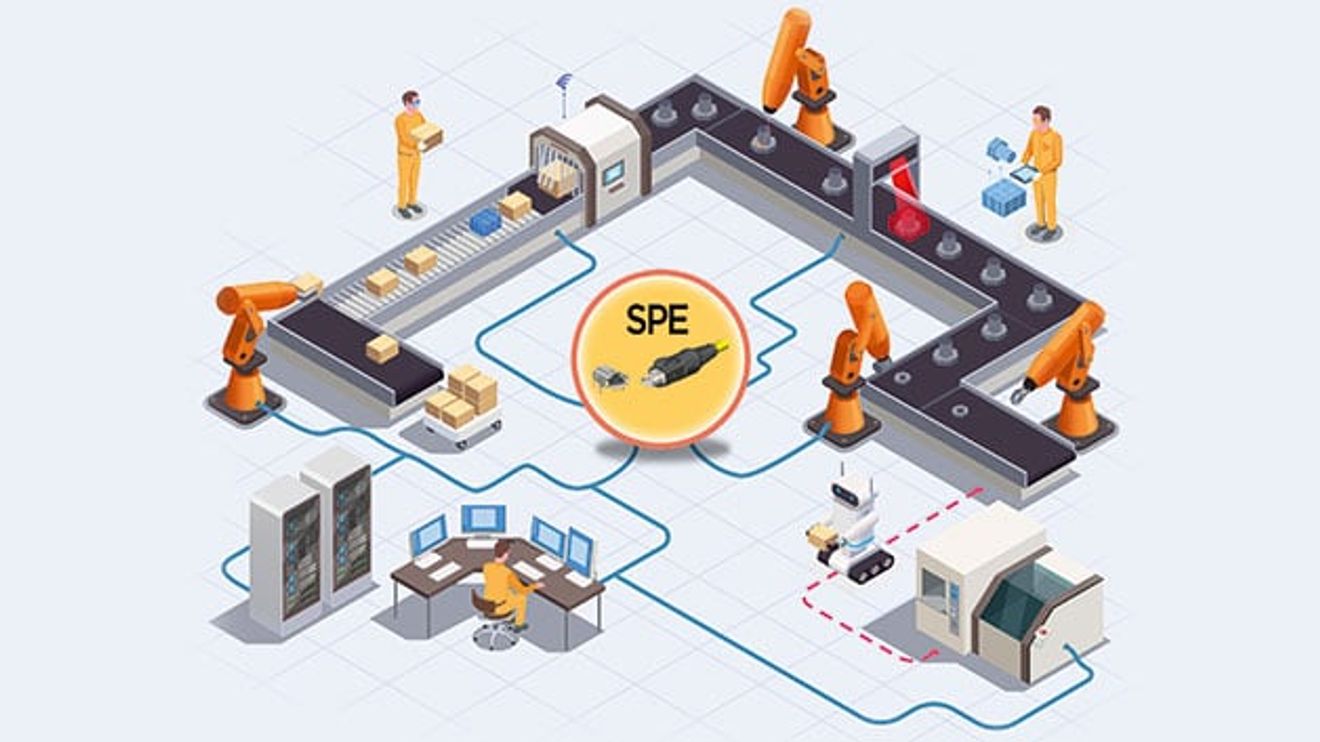
In the foreseeable future, the unbroken trend towards digitalization and networking will affect all areas of industry, transportation and building technology. The cyber-physical system (CPS) enables the connection of information in the form of software with electromechanical components. To implement a CPS, a powerful and robust data infrastructure is required, which can be realized via Ethernet technology in accordance with IEEE 802.3.
What's behind the technology

Since the publication of the first Ethernet standard 10BASE-T in the 1990s by IEEE 802.3, Ethernet technology has developed rapidly. The first Ethernet CAT 5 cables in accordance with TIA-568 A/B with a transmission rate of 100 Mbit/s came onto the market as early as 1995, followed by the 1000BASE-T standard in 1999. Today, 1,000 MHz cables in accordance with IEC 61156-5/-6 for 10GBASE-T are state of the art in the cable industry.
The IEC (International Electrotechnical Commission) and its affiliated national standardization committees are developing uniform standards for components, devices and system requirements in line with the technological development of Ethernet technology, which is mainly driven by the IEEE (Institute of Electrical and Electronics Engineers) and TIA (Telecommunications Industry Association) organizations. Time Sensitive Networking (TSN) in accordance with IEEE 802.1 and IEEE 802.3 makes it possible to transmit time-critical and business-critical information with defined response times and accelerates the use of Ethernet technology in industrial environments. The option of using Power over DataLine (PoDL) to transmit data and power via a single-pair data line, which is now specified for different power classes via IEEE 802.3bu and IEEE 802.3cg standards (currently up to 52 W, Power Class 15 according to IEEE 802.3cg), extends the benefits and application possibilities of Ethernet technology. With regard to the IEEE 802.3 specifications, there are a large number of system and product standards for SPE that have been developed and published by the IEC standardization committees:
- IEC 61156-11; -12, -13, -14 (NP) for 1-pair cables
- IEC 63171-1; -2; -4; -5; -6; -7; Connectors for 1-pair data transmission
- ISO/IEC 11801-1 & -3; generic cabling; requirements
- ISO/IEC TR 11801-9906; generic cabling; balanced 1-pair channels up to 600 MHz
- ISO/IEC TS 29125 AMD 1; requirements for remote powering of terminal equipment
- IEC 61918 ED4.0; Installation of communication networks in industrial buildings
Single pair Ethernet connectors are required to connect the SPE cables to the end devices. In order to meet the different requirements in office and industrial environments, connector variants must be selected in accordance with the environmental classifications specified in ISO/IEC TR 29106. IEC 61918 Edition 4.0 contains additional requirements for the 1-pair infrastructure.
Specifications in the fieldbus organizations

The future infrastructure for IIOT: The control level in particular is divided into decentralized control units directly in the field and virtual controllers in the cloud.
© BeldenThe definition of the specifications for Single Pair Ethernet in the user organizations such as PI, ODVA and OPCF is well advanced. As soon as this work has been completed, the specifications of the user organizations will be included in the corresponding parts of the IEC 61784-5 Fieldbus Profiles series of standards.
The specifications for Ethernet-APL, which were jointly created by the user organizations PI, ODVA, OPC Foundation and FieldComm Group, are already available. Ethernet-APL also uses 1-pair Ethernet technology, which enables both communication at 10 Mbit/s and the power supply of devices. Ethernet-APL supports Ethernet-based protocols and is primarily intended for connecting field devices, mainly for use in hazardous areas in the process industry, to an automation network. The length of an APL trunk segment can be up to 1,000 m. The advantage of Ethernet APL is that the existing fieldbus cable infrastructure can continue to be used. The cable used is a type A fieldbus cable, which is specified in IEC 61158-2. The Ethernet-APL engineering guideline describes the basic system requirements for Ethernet-APL. Single Pair Ethernet technology is being continuously developed with regard to higher data rates, transmission distances and performance classes with the aim of offering the user further application options for this new technology.
Change in the automation pyramid

SPE overcomes the dividing line to the field level, field buses will disappear in the long term.
© BeldenSPE is a key technology for transferring information from the field level to the cloud in a decentralized manner with the required bandwidth. SPE is an Ethernet-based technology that is robust enough to be used in the immediate vicinity of value-adding processes under high levels of physical or electromagnetic stress. At the same time, SPE offers a significantly higher transmission bandwidth and complete consistency of the communication infrastructure and protocols from the sensor to the (on-premise) cloud compared to the fieldbuses often used here. This enables further value-added processes such as comprehensive data analysis of manufacturing processes or modern measures to protect against cyber attacks.
Status quo and goals

An SPE M8 connection in accordance with IEC 63171-6 for industrial use in a proven circular connector design.
© BeldenAt SPS 2022 in Nuremberg, Belden showed an SPE application in cooperation with Harting, in which video transmission was realized over 40 m using IP cameras and a 1-pair SPE cable with a data rate according to 100BASE-T1. Six months later at Hannover Messe 2023, the two companies presented an exemplary demonstration of 1,000 Mbit/s data rate according to 1000Base-T1 over a cable length of 90 m by transmitting video and audio data. A transmission length of 100 m with a high bandwidth seems within reach. The SPE Industrial Partner Network has set itself the goal of promoting the standardization of a 1000Base-T1L standard up to 100 m cable length. Single Pair Ethernet will become the backbone of the fully digitized factory. Standardized and cost-effective cables, connectors and devices will create a new ecosystem based on Ethernet technology according to IEEE 802.3. Single Pair Ethernet devices and components will have a significant impact on the automated, intelligent networked factory. Because:
- A network from the sensor to the cloud guarantees control over all production data and thus creates the prerequisite for predictive maintenance and minimizes downtimes in production.
- Increasing bandwidths down to field level enables the use of digital models for simulation, algorithms and services - the digital twin. In combination with artificial intelligence or machine learning algorithms, production processes can be optimized.
- Ethernet technology also offers standardized functions for data security with authentication and encryption algorithms, as well as for ensuring data integrity.

- Other Ethernet technology mechanisms can be used to ensure data availability, particularly in areas with functional safety, such as redundancy protocols in accordance with IEEE 802.1CB or IEC 62439-3 PRP/HSR.
- Thin, lightweight Ethernet cables and miniaturized components enable applications in robotics and other fields of application. The ability to transmit data and power simultaneously via one wire pair enables compact device designs.


You might also be interested in
The top articles in July 2023
The top articles in July? Take the topic of (cyber) security, mix in artificial intelligence, look at the advances in exoskeletons, think about Single Pair Ethernet in manufacturing and ask about news from Siemens.
 read more...
In focus: Connection technology
The e-paper of issue 07/23
Communication and networking is the central theme of the current issue: first insights into the program of the TSN/A-Conference 2023, the cover story is all about SPE at field level and the "Digital Twin" series deals with the digital twin as an...
read more...The Ultra Ethernet Consortium
The Ultra Ethernet Consortium (UEC), which has now been launched, aims to establish a new Ethernet-based communication stack architecture to meet the growing demands on networks for AI & High Performance Computing.
read more...TE Connectivity / Phoenix Contact
SPE development cooperation launched
TE Connectivity and Phoenix Contact will jointly develop hybrid Single Pair Ethernet (SPE) M12 connectivity solutions. The connectors comply with the hybrid format according to IEC 63171-7, which was initiated in the standardization commission at...
read more...IO-Link and Single Pair Ethernet
Competition or cooperation?
Single Pair Ethernet enables the transmission of Ethernet data via just one pair of wires and therefore promises to connect sensors directly to Ethernet communication. In this respect, SPE is entering the traditional territory of the IO-Link...
read more...Smart control cabinets thanks to new Ethernet/IP technology
Rockwell Automation is launching an Ethernet/IP control cabinet solution. The aim of this further development is to meet the growing demand for smarter, faster and better networked production processes.
read more...SPE switch for cost-efficient cabling
Single Pair Ethernet (SPE) is making its way into the ICP Germany portfolio. The 'ITPS-141TX' is a 5-port unmanaged SPE switch.
read more...Unmanaged SPE switch
The new unmanaged switch '10Base-T1L SPE' from Weidmüller offers a range of one kilometer and power transmission with class A Profinet conformity.
read more...Solutions for more interoperability in the industrial Internet
In Industry 4.0, sub-processes are being integrated ever more deeply and access to data is being improved in order to optimize workflows. Communication in the infrastructure plays a decisive role, and seamless integration and interoperability are...
read more...