

Scholz and industry
Foreign skilled workers must be welcome
The East German economy is booming. The Federal Chancellor is convinced of this at a conference. The shortage of skilled workers remains one of the problems. Scholz and the BDI President find clear words.

Bad Saarow (dpa) - Federal Chancellor Olaf Scholz (SPD) and the Federation of German Industries (BDI) are urging greater openness to foreign skilled workers in view of the shortage of skilled workers in Germany. Scholz and BDI President Siegfried Russwurm made this clear on Sunday (June 11) at the East German Economic Forum in Bad Saarow, Brandenburg.
Scholz called for a change in awareness. There needs to be an understanding that foreign skilled workers are not only needed, but are really welcome in Germany. "As an employer, you can contribute locally to this cosmopolitan Germany. And that's what I'm asking you to do today," Scholz appealed to the companies.
Colorful instead of brown - BDI condemns xenophobia and prejudice
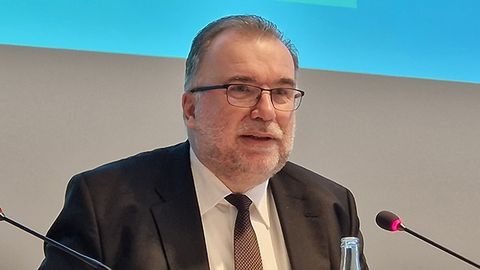
"Let me say it very clearly: xenophobia and prejudice are the very last thing our country needs," warned BDI boss Russwurm. Germany is "colorful and not brown". This is important and right for a country that is more dependent on international networking than almost any other.
Scholz pointed out that the shortage of skilled workers was the biggest concern of East German entrepreneurs. Good wages are a decisive location factor here. "On average, East Germans are still paid around 620 euros less per month than West Germans, in some sectors even up to 1000 euros," criticized Scholz. This must change with the "economic boom in the east". More collective bargaining coverage, strong trade unions and employers' associations also increased the attractiveness of a location.
At the conference in Bad Saarow, around 50 kilometers south-east of Berlin, representatives from politics, business, science and society will be discussing economic change from Sunday to Tuesday. Topics include the conditions for industrial companies, the shortage of skilled workers, global competition and energy supply. Federal Economics Minister Robert Habeck (Greens) is expected to attend the forum on Monday.
New immigration law to come at the beginning of July
"The German government supports companies in the training and further education of skilled workers," emphasized Scholz. "But the truth is that we will not be able to fill the gap that is opening up, particularly in the east, with domestic workers alone." That is why the German government wants to create "probably the most modern immigration law in the world". The Bundestag is currently holding a final debate on the issue - the final vote in the Bundesrat is planned for early July.
This would make it much easier for workers and skilled workers to come to Germany, including to look for a job. However, laws and regulations are only one side of the coin, said the Chancellor. "Employees and skilled workers, especially in future-oriented sectors, can now choose where they want to go. And it is often the supposedly soft factors that make the difference," Scholz made clear. "The beautiful landscape, affordable housing and affordable free schools and nursery places will not be the reason for the failure here in the east."
According to Scholz, eastern Germany can become a growth engine. "East Germany's economy is experiencing a boom. There is actually hardly any future technology, hardly any growth industry that is not already at home here in eastern Germany or is currently looking for a new home here," said the SPD politician.
More courage to reduce bureaucracy
Germany is working on removing bureaucratic obstacles. "But the most important thing, apart from reducing bureaucracy (...), is to have the courage to make decisions," said Scholz. He cited the example of a district authority employee who had to approve an electrolysis plant for the first time. Many experts are consulted out of fear. However, Germany needs many hydrogen-capable gas-fired power plants for its energy supply. Pilot plants are not enough. There are too many regulations and too many expert requirements, Scholz stated. "So Germany must have the courage to reduce a few expert opinion regulations."
Various business representatives at the conference made it clear that companies must also be involved in the numerous laws passed by the federal government. Companies should not be left behind in the transformation, they said in a round of talks with Scholz.


You might also be interested in
Check with Prof. Dr. Peter Fromm
Regularly slowed down
The embedded industry is struggling with a shortage of components and skilled workers. Prof. Dr. Peter Fromm from Darmstadt University of Applied Sciences knows that the latter is now the bigger problem. In this interview, he explains what logistics...
 read more...
Combating the skills shortage with cobots
When it comes to the question of whether to purchase a cobot, the decision is quickly made between buying or leasing. Omron has seven tips for SMEs to finance cobot fleets and keep them up to date more easily.
read more...Skills shortage at its peak
The shortage of skilled workers has reached a peak and is placing an increasing burden on the German economy. Labor market experts do not expect the situation to ease for the time being.
read more...Employer president fears loss of prosperity
You can see it in restaurants, craft businesses and many other sectors: There is a shortage of skilled workers. The employer president describes what this could mean.
read more...Foreign specialists for mechanical and plant engineering
Karl Haeusgen calls on politicians to allow the recruitment of foreign skilled workers by recruitment agencies. In a letter to Nancy Faeser and Hubertus Heil, the VDMA President calls for every possibility to be considered in order to get the...
read more...Bertram Kawlath is the new VDMA President
Bertram Kawlath, a family entrepreneur from Ingolstadt, was elected as the new VDMA President for the next four years by the VDMA General Assembly in Wiesbaden. He succeeds Karl Haeusgen (Hawe Hydraulik SE) in the rotation.
read more...Managing Board expanded
The Friedhelm Loh Group is aligning its group of companies for the future and is expanding its Executive Board to include Prof. Dr. Niko Mohr. He joins owner and CEO Prof. Dr. Friedhelm Loh and CFO Ralph Lindackers on the Executive Board.
read more...Conveyor technology in the picking and packing process
Complex intralogistics processes become a challenge when not only the pure conveying of parcels, packages, unit loads or load carriers has to be ensured, but also picking, sealing and packing have to be integrated into the process.
read more..."Europe needs a single market for secondary raw materials"
For Europe to become climate-neutral, the circular economy must be introduced into all production processes. These circular processes offer enormous potential for medium-sized mechanical and plant engineering companies. The announced Circular...
read more...