

Sensors
The self-learning assistance system
Conventional sensor-based diagnostics provide information about production faults without drawing any conclusions about their causes. This is not the case with an adaptive diagnostic system that uses the machine operator's experience and offers situation-specific solutions.
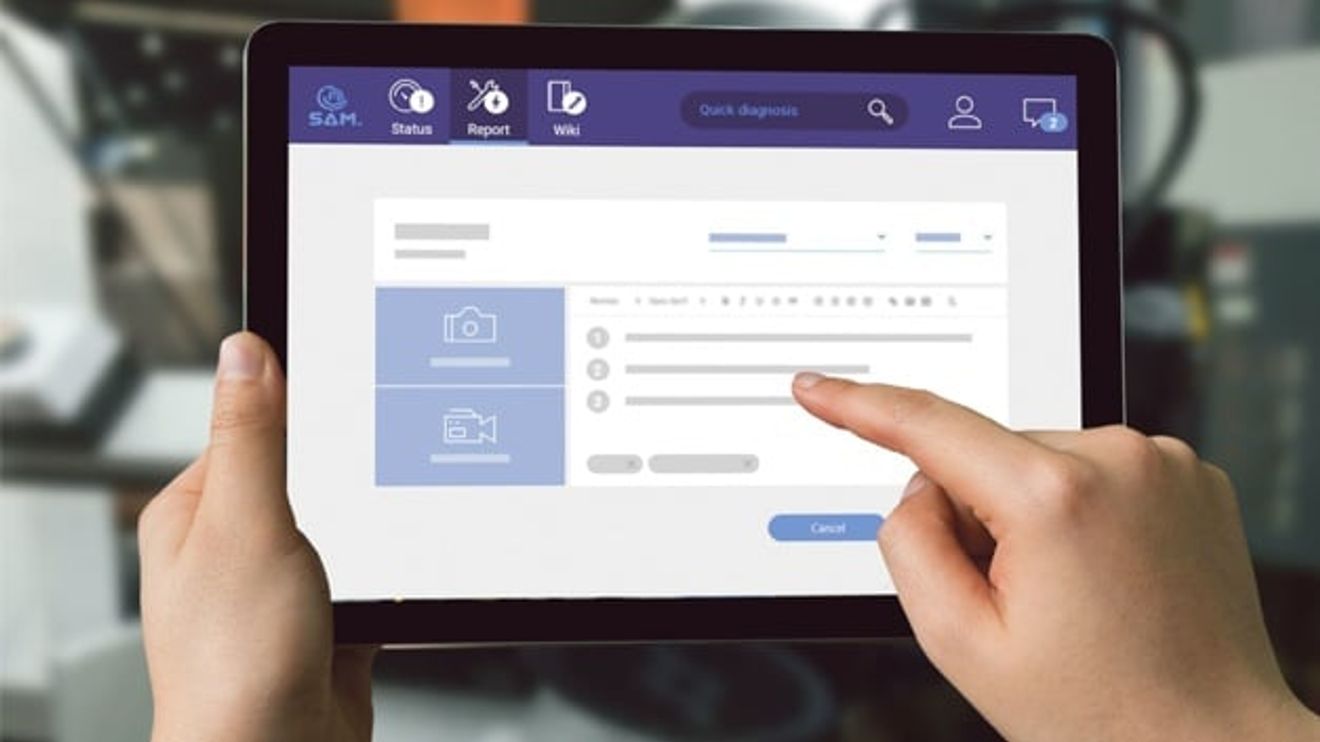
Industrial processes in the processing of biogenic raw materials are heavily characterized by automation, which enables high processing speeds. In order to guarantee the required end product quality, sensor technology monitors both the processes and the products. However, complete monitoring is neither economically viable nor technically possible, meaning that the identification and rectification of faults and their causes remains the task of machine operators. However, this task can increasingly no longer be adequately fulfilled.
The mechanical efficiency of a modern system is up to 99% on delivery, but the actual efficiency achieved is far lower. Since 1995, the Fraunhofer IVV Dresden has regularly carried out efficiency analyses on processing machines, for example during ongoing production operations, as part of contractually agreed commissioning or acceptance tests. The evaluation of over 6000 hours of analysis revealed an overall efficiency of 75% on average, which is often far below the technical possibilities.
High frequency of brief disturbances
The causes of faults are often characterized by complex error chains. One example is the flow behavior of yogurt: even slightly increased product temperatures can lead to splashes on the sealing edge of the cups during the filling process, which can result in sealing defects and leaking packaging. The data from the Fraunhofer IVV shows that very short interruptions occur very frequently: 70% of all unplanned interrupted production phases last less than five minutes, and 70% of all unplanned faults can be rectified in less than two minutes. The high frequency of short disruptions leads to the conclusion that when a disruption occurs, only the symptoms are rectified. Only in rare cases is the cause identified and eliminated. To do this, operators need a high level of experience and process knowledge, even in highly automated systems. However, industrial reality paints a different picture: High staff turnover, a low level of training, language barriers, a lack of exchange between employees and a lack of motivation mean that hardly any experience-based knowledge is built up or passed on. As a result, the technical possibilities of processing machines are not fully utilized; the machines are operated with high reject rates and downtimes.
Combining machine data and empirical knowledge
A classically automated, sensor-based diagnosis can provide information about a fault. However, experience-based fault identification provides far more information and can also draw conclusions about the underlying cause. The use of machine operators with their experience on technical systems is therefore still important and unavoidable. The industry has recognized this and is once again integrating people more closely into process control. In order to provide operators with targeted support under the current conditions, the exchange of experience must be optimized.
Malfunctions can be described manually in digital logbooks and tagged with keywords. However, this approach is time-consuming. In addition, plant operators have different technical vocabularies and describe similar situations differently. This and the fact that the database may have to be compared with other similar descriptions under time pressure make it even more difficult to find a solution quickly. In industrial reality, the use of such a digital logbook is therefore neither suitable for the input nor output of knowledge.
Adaptive diagnostic systems
An adaptive diagnostic system could provide better support. This supports the human diagnostic capability and provides situation-related information. The existing sensors in a system do not need to be expanded for this. To achieve this, such a system observes the machine states and generates its wealth of experience in this way. In the event of a fault, it provides the operator with information on the cause and suggested solutions in a dialog. Process understanding and empirical knowledge are gradually expanded in line with human actions and the success of the solution. At no time does the system actively influence the machine, but only offers the operator support, similar to a navigation system in a car.
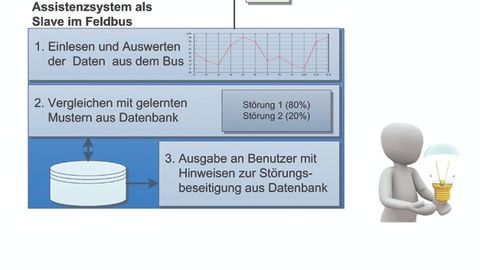
The structure of the operator assistance system 'SAM' (self-learning assistance system for machines).
© Fraunhofer IVVBy analyzing patterns in the system data, machine states can be described if at least one sensor is involved in an error in the process. This theory was developed at the Fraunhofer IVV Dresden and forms the basis of the 'SAM' operator assistance system. The 'self-learning assistance system for machines' obtains the sensor data from the field level and the MES and then analyzes it using machine learning methods. Operators and technicians can then assign detailed descriptions and instructions to the resulting states. In this way, the operators receive correct information from the assistance system in the event of a fault.
It must be possible to obtain the data from the technical system with the highest possible time resolution (PLC cycle). To achieve this for a manufacturer-independent assistance system, a powerful interface to the PLC is required. For this purpose, a universal interface card is installed in the PC of the assistance system, which enables connection to the machine's field bus.
Evaluation of sensor data
With this solution, the sensor data of all machines controlled from there can be read without influencing the control process. For larger systems with several controllers, it is possible to use suitable slave-slave cards in the respective PLC. In this case, the interface card in the assistance system assumes the function of fieldbus master and reads the signals from the slave cards of the controllers. Alternatively, the use of the standardized OPC UA format is conceivable, whereby real-time capability is only possible here via large caches in the controller, as the transmission speed of OPC UA is not sufficient. This could be remedied by OPC
UA TSN could provide a remedy here, but this must first be investigated.
Correlations are now searched for in the data obtained in this way. Instead of classic time series methods, process knowledge is used for this, for example via time differences. This allows features to be generated that can be used in machine learning processes (sub-area of supervised learning) to identify corresponding machine states in real time. Identified states can then be assigned to the fault information stored in the database.
State of development
Preliminary tests with the system have already been carried out successfully. For example, pattern recognition was achieved after just a few runs on a typical industrial form, fill and seal machine. Tests on a Fischertechnik factory simulation showed that the learning effort can be reduced by introducing process knowledge. In current validation projects, which have not yet been completed, the first trials with demonstrators in industrial use are underway. Computers record data on the machine. Their evaluation and the adaptation of new models are carried out by employees of the Fraunhofer IVV Dresden. However, new faults can be learned on site - the models adapt to the new patterns to be found and can then recognize and identify these faults when they occur.
Further technologies for situation recognition are currently being researched as part of other research projects. The aim is to use not only machine data to determine the current situation, but also the operator's ability to describe a situation. In a cooperative dialog, the operator can use a case-based reasoner (CBR) to iteratively approach the possible cause of the error and corresponding solution strategies by asking questions and queries of the system. The operator's knowledge of the situation or parts of the situation is used to narrow down the possible error cases. The selection of cases from the CBR can be further narrowed down by clever combination with recorded sensor data and machine learning. This approach is being investigated in more detail as part of the BMBF project Cooperative human-machine dialogs in the diagnosis and elimination of faults in processing plants - 'KoMMDia' for short.
In order to be able to analyze machines with just a few sensors, research is also being conducted into a system for the optical detection of movement anomalies, for example. Object detection will be used to determine movement trajectories of working elements and packaged goods. These trajectories can then be recorded in the assistance system as nominal operation or as a specific fault. Initial preliminary tests of this approach have already shown promising results. The great advantage of optical systems is that they are easy to integrate into systems; especially in existing systems (brown field), this eliminates the need for time-consuming integration into the control system. These and other modules to be developed can be used to create an increasingly precise picture of the situation in order to support the operator in his daily work in a targeted and precise manner.
Authors:
Alexander Petrenz is a research associate in the Digitalization and Process Efficiency working group at the Fraunhofer Institute for Process Engineering and Packaging IVV in Dresden;
Andre Schult is head of the Digitalization and Process Efficiency working group at the Fraunhofer Institute for Process Engineering and Packaging IVV in Dresden;
Tilman Klaeger is a research associate in the Digitalization and Process Efficiency working group at the Fraunhofer Institute for Process Engineering and Packaging IVV in Dresden.


You might also be interested in
SWIR hyperspectral camera for industrial high-speed inspection
Teledyne Dalsa launches 'Kaleido', a hyperspectral camera for use in the shortwave infrared (SWIR) range, designed to overcome the existing integration and performance limitations of industrial sorting processes.
 read more...
IDS and Prophesee intensify partnership
IDS and Prophesee are intensifying their partnership for the next generation of event-based industrial cameras. Together they want to explore new sensor architectures that combine classic imaging with Prophesee's event-based 'Metavision' technology.
read more...Dual leadership in Shanghai
Stefan Becker has been appointed Managing Director of Eckelmann Automation Technology in Shanghai and will manage the subsidiary together with Zhongwei Huang.
read more...IDS Imaging Development Systems
Camera series for streaming, monitoring and event recording
IDS Imaging Development Systems launches the 'uEye Live' camera series with the 'uEye SCP' and 'uEye SLE' product ranges. They specialize in monitoring tasks, deliver various live streams and also enable event recording.
read more...AI and streaming meet robustness
IDS Imaging Development Systems is expanding its range of AI cameras with the 'IDS NXT oslo'. The model combines artificial intelligence with video streaming and recording functions in a compact, industrial-grade housing.
read more...With real-time data against disasters
A digital twin is more than just a two- or three-dimensional digital copy. It combines precise data with intelligent analysis and solves complex challenges. With locations in Paderborn and other cities, Eviden relies on the combination of artificial...
read more...Sold to Exaktera
AutoVimation will be part of Exaktera LLC, a portfolio company of Union Park Capital, based in Boston.
read more...Young Professional Award 2024 announced
The EMVA Young Professional Award is an annual prize worth 1500 euros that recognizes the outstanding and innovative work of a student or young professional in the field of machine vision or image processing.
read more...IDS Imaging Development Systems
Design freedom for board cameras
IDS has developed the 'uEye ACP' series, whose modular design principle makes a wide range of camera variants possible. The online configurator can be used to put together models that are available directly from stock.
read more...