
Displacement measurement
Customized hydraulics
Linear position sensors are indispensable in hydraulic applications. Magnetostrictive measuring systems are particularly suitable for detecting the piston rod position in fluid cylinders.

Magnetostrictive linear position sensors have already evolved from a trend to a standard in the fluid industry. The devices are used for fast detection of the piston position of hydraulic axes as well as for slow but highly accurate adjustment of a roll within a roll stand. As the path is detected directly in the cylinder, it is insensitive to external influences and excludes possible inaccuracies caused by transmission elements and play from the outset.
When recording linear movements, users rely on both inductive and magnetostrictive measuring systems. The differences between the two systems qualify them for different applications: While the magnetostrictive sensor is typically installed inside a fluid cylinder, inductive sensors measure paths directly on linear axes or moving parts.
Inductive linear position measuring systems are based on a so-called resonant circuit coupling, which detects a position encoder floating above the sensor without contact or wear.
Magnetostrictive linear position measuring systems, on the other hand, are based on a physical torsion effect. The sensor sends an electrical start pulse via a waveguide. This pulse causes a magnetic position encoder to generate a torsional wave on the waveguide, which travels from the position encoder towards the sensor unit. The transit time from the pulse to the detected torsional wave is measured, from which the distance to the position sensor is calculated. The main advantage over inductive systems is that the measuring length of magnetostrictive sensors is virtually unlimited thanks to a waveguide that can be extended almost infinitely.
Contactless measurement
The magnetostrictive measuring system has two main advantages:
● Magnetostrictive measuring methods are absolutely contactless and wear-free. This means that important properties of the sensors, such as accuracy and linearity, are retained over the entire life cycle.
● Thanks to the non-contact waveguide measuring principle, magnetostrictive sensors can be manufactured in rod design and thus enable uncomplicated installation in hydraulic cylinders. For this purpose, the piston rod is hollow drilled to accommodate the measuring rod of the sensor. A magnet is attached to the piston base of the cylinder. This position sensor is pushed onto the measuring rod when the hydraulic cylinder is retracted. As the measuring rod is integrated into the cylinder, it is protected from external influences and mechanical damage. Only the sensor unit protrudes from the outside at the end of the cylinder.
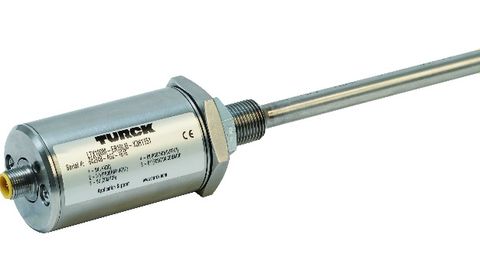
The stainless steel version of the 'LTX' is particularly popular in heavy industry and complies with protection class IP68.
© TurckMagnetostrictive stroke measurement is the standard in hydraulics. Only for very long strokes or telescopic cylinders do hydraulic manufacturers have to resort to alternative measuring methods
One of the more recent alternative systems for detecting the hydraulic piston position consists of an optical reading unit mounted on the outside of the hydraulic cylinder and a piston rod lasered with a barcode. The reading unit reads the barcode as the piston extends and retracts and determines the current position and therefore the stroke of the piston from the course of the code. This system provides the user with absolute position information. The system is relatively inexpensive, as lasering the piston costs less than the long-hole drilling of the piston rod, which requires magnetostrictive sensors. One disadvantage of the barcode system, however, is the susceptibility of the optical unit to contamination. In addition, the piston rod must be secured against twisting so that the read head can detect the code accurately.
Absolute position measurement
Magnetostrictive linear position sensors, which measure an absolute position and do not require reference runs after machine stops, are therefore used far more frequently. The sensors must provide absolute signals and be easy to set up. In addition, they must be easy to connect to the machine control interfaces commonly used in the respective industry. Not all types of linear position sensors are equally suitable for every industry and application. Manufacturers therefore offer linear position sensors for a wide range of industries. In addition to magnetostrictive sensors for use in factory automation, Turck also offers devices for use in mobile machinery, for example.
The 'LTX' linear position sensor, for example, is a pressure-resistant sensor in rod design especially for use in industrial hydraulic cylinders. The sensors in this sensor family are resistant to moisture and dust thanks to the IP68 housing. The measuring rod is made of stainless steel and thus protects the internal measuring system. Alternatively, the linear position sensor is available completely made of stainless steel, which is particularly interesting for heavy industry. Available up to a length of 7600 mm, the sensor can withstand vibrations up to 30 g and shocks up to 100 g. The LTX devices are equipped with an auto-tuning system for commissioning; the sensor automatically adjusts itself to the position encoder being used, making commissioning simple and safe. Blind zones can be adapted to the application on site using an optionally available teach adapter.
Easy handling
When replacing the sensor or diagnosing a fault, the electronics housing and measuring system can be easily removed. All you need to do is separate the actual sensor from the pressure pipe using two screws. The cylinder remains hydraulically pressurized and closed while the actual sensor is safely removed. The sensor status is diagnosed by means of a multi-colored LED attached to the sensor housing. This diagnostic LED provides information on the status of the position signal and other operating states. This allows the current status to be recorded at a glance without complicated diagnostic procedures or additional electronics. The magnetostrictive sensors can also be precisely programmed to the desired measuring range. If a different measuring range is required, this can be adapted without additional tools.
Mobile hydraulic applications

The 'Embedded LTE' is optimized for use in mobile hydraulics. It has an internal resolution of 16 bits and offers three signal ranges for mobile machines in addition to the analog output signals of 0 to 10 V and 4 to 20 mA.
© TurckDue to their bulky sensor unit, the linear position sensors used in industry are not suitable for the mobile hydraulics market. Space-saving sensors are required here. Turck offers the robust 'LTE' linear position sensor for these requirements. In addition to the design, its standards also meet the requirements of the mobile equipment sector. Thanks to its integration into the hydraulic cylinder, the sensor is protected in extreme environmental situations and is therefore insensitive to external influences. It withstands shocks of up to 100 g and vibrations of up to 30 g, which are commonplace in agricultural or forestry machinery; it is also suitable for hydraulic cylinders in construction machinery.
Author:
Christan Voß is Head of Product Management Linear and Rotary Position Sensors at Turck in Mülheim.


You might also be interested in
Paving the way for digital transformation
Automation solutions from Turck support the profitability, efficiency and sustainability of machines and systems. In this way, they not only increase competitiveness, but also contribute to more environmentally friendly production and intralogistics.
 read more...
Magnetic field/temperature sensor with IO-Link
The 'CMMT' 3-axis magnetic field/temperature sensor with IO-Link is the third sensor type that Turck has developed specifically for easy-to-use condition monitoring applications - alongside the 'CMVT' vibration/temperature sensor and the 'CMTH' for...
read more...Inductive IO-Link sensors with analog output
Turck is expanding its sensor range to include measuring inductive sensors with IO-Link and analog output for flush and non-flush mounting.
read more...These are your winners!
We put 96 products in twelve categories to your vote in December, and now the winners have been chosen! The trophies were presented at a 'Winner's Dinner' at the Seehaus in Munich. These are your "Products of the Year 2024"!
read more...Software & IT - The winners
For the first time, an IT company has been voted among the top 3 in the 'Software & IT' category. An indication that OT and IT are truly growing together.
read more...The e-paper special: looking for products of the year 2024
They've earned it: all 96 nominated products from 12 categories in their own e-paper. Browse through the individual areas and make your personal selection. You can also find out more about the companies and their solutions in the accompanying video...
read more...IIoT and service platform for Turck devices
Easy management of devices in Ethernet industrial networks - this is made possible by the Turck Automation Suite, TAS for short. Visitors can find out about its functionality at the trade fair stand.
read more...The top articles in June 2023
Interest in the topic of artificial intelligence continues unabated and is also reflected in our most-read article of the month of June: two youngsters who have set out to overcome fears of AI technologies lead the ranking. The top 10 at a glance.
read more...Multitool for the IIoT
With the IIoT platform 'TAS', Turck promises an easy-to-use and standardized overall solution for the commissioning and management of Turck devices in industrial Ethernet networks, from the sensor to the controller. The tool celebrated its premiere...
read more...