

SEW-Eurodrive and TH Cologne
Functionally safe automation simply implemented
Edge computing combined with safety and security is changing the requirements for automation. One trend is to build automation systems from partially autonomous subsystems. This allows complex applications with cooperating robots to be implemented quickly.

Timo Wilkening with the new automation solution, which is currently at the stage of a confirmed concept study.
© SEW-EurodriveWhen networking automation subsystems, edge controllers connected via publish-subscribe (PubSub) methods such as MQTT or Data Distribution Service (DDS) can replace traditional fieldbuses. Such easily networkable systems include machine modules, robots or cobots, automated guided vehicles (AGVs) and mobile logistics assistants. These requirements can be implemented quickly and easily with a new automation solution designed in cooperation between the TH Köln, SEW-Eurodrive, Intel and Codesys. A tripod from autonox Robotics with three servo axes and two virtual axes was set up as a technology demonstrator (Fig. 1).
Operating the tripod safely

Figure 1: In Codesys, the module controller contains a non-safe soft PLC and a very fast, safe soft PLC Safety SIL2 for complex safe motion applications. Safety Data: 1 - FSoE rd/wr --> STO/SBC, 2 - Black-channel --> current/torque, 3 - Black-channel --> encoder position
© SEW-EurodriveTripods enable very fast movements that can be dangerous to people. In cooperative operation, it is necessary to monitor the speeds of the tool center point and the three elbows in a functionally safe manner. With a tripod, the necessary coordinate transformation is comparatively complex, as a functionally safe processing of complex floating point algorithms is required.
As with all human-robot collaborations, simple programming of fast and functionally safe multi-axis movements in combination with flexible networking is required. An industrial PC with an Intel quad-core processor certified by TÜV Süd becomes a PLC with motion control and fully integrated safety control, which uses two processor cores for safety functions in accordance with IEC 13849 Cat. 3.

The programming and configuration of the non-safe machine controller with EtherCAT as the system bus is - as usual at SEW-Eurodrive - IEC 61131-3-compatible with Codesys. The development system on the engineering PC can be used to create and commission automation systems (Fig. 2). The cyclical execution of the algorithms as a soft PLC is made possible by the Codesys runtime.
Linux with real-time extension as the operating system for the runtime enables the use of the open PC architecture with its diverse expansion options. The additional safety controller integrated in the new automation solution is based on Codesys Safety SIL 2, an IEC 61131-3 software certified by TÜV Süd. A special feature of the implementation is the extremely high safety-related computing power for complex floating-point algorithms.
Multi-axis safe motion with Codesys Safety SIL2, FSoE and EnDat 3

Figure 3: The motor-integrated, safe encoders are used as safety sensors. The central safety controller can switch to the safe state using the STO and SBC safety functions (integrated in the drives).
© SEW-EurodriveThe Codesys Safety SIL2 Runtime is executed within a separate virtual machine synchronously with the non-safe Runtime on the same quad-core processor. Communication with the safety controller takes place via shared memory areas. The CMP50M servomotors with PxG gear units from SEW-Eurodrive were equipped with EnDat 3 encoders and a 2-wire interface. The encoder communicates fully digitally with the drive without a separate cable via the two wires in the motor connection cable that are usually intended for the temperature sensor. The safety functions in the drive - Safe Torque Off (STO) and Safe Brake Control (SBC) - are controlled via EtherCAT / FSoE. In the multi-axis Safe Motion system, the motor-integrated encoders are safety-related sensors (Figure 2). STO and SBC in the drive form the safety-related actuators.
The extremely high computing power for a safety controller makes it possible to equip the connected drives with significantly reduced safety logic in a space-optimized manner by replacing the safety functionality in the drives with safety modules in the module controller (Figure 3). The safety functions specified in IEC 61800-5-2 can be implemented centrally for multi-axis systems.

Figure 4: Because the module controllers are based on x86-compatible IPC technology, networking with each other and with the control level or IT is very flexible.
© SEW-EurodriveThe central safety diagnostics also make it particularly easy to implement degraded operating modes. A so-called "qualified diagnosis" assesses centrally according to error type and error location whether a safety sub-function - possibly under conditions that must be observed - may continue to be operated in compliance with the standard.
Connection via Profinet or PubSub methods
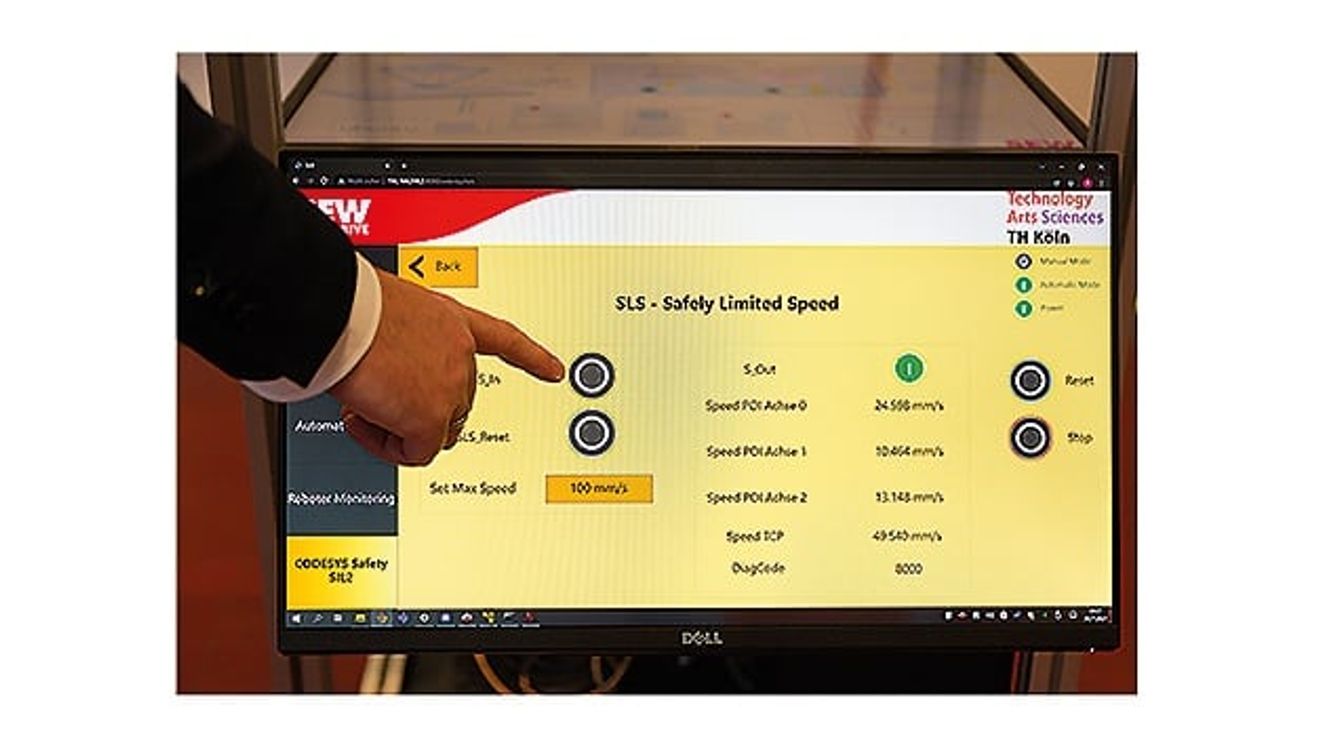
Figure 5: Standard operation and safe operation and analysis are integrated in one visualization. The safely (kinematically) reduced speed SLS (Safely Limited Speed) is used to monitor the Tool Center Point (TCP) and the Point of Interests (POI) to be defined.
© SEW-EurodriveWhen integrating an automation module into larger automation systems, the requirements are usually weighted differently. Safe motion functions above the module controller are often digital. It is not necessary here to transmit safe encoder positions cyclically; instead, safety functions such as Safely Limited Speed (SLS) are only switched on or off in a safety-relevant manner via Profinet/Profisafe or MQTT/OPC UA Safety. Networking in accordance with IEC 61499 with its focus on interoperability and event-oriented programming in conjunction with Ethernet-based PubSub methods makes it possible to network a large number of module controllers with each other (Figure 4). Thanks to the possibility of connecting to the current Robot Operating System ROS 2 via DDS, robots and cobots can now very easily use proven methods from automation, in particular safe motion functions for multi-axis systems.
High dynamics and flexibility

The authors (from left): Holger Goergen, Technology Field Manager for Machine Automation at SEW-Eurodrive in Langenfeld; Dr. Jens Krah, Professor at Cologne University of Applied Sciences; Tobias Schmidt, Research Assistant at the Institute of Automation Technology at Cologne University of Applied Sciences; Timo Wilkening, Research Assistant at the Institute of Automation Technology at Cologne University of Applied Sciences.
© SEW-EurodriveThe new automation concept enables flexibly networkable, highly dynamic systems with integrated safety control and higher functionality while significantly reducing hardware and software complexity. The use of Codesys for both the standard area and for functional safety speeds up commissioning, reduces the possibility of incorrect parameterization and simplifies support. The very fast, safe kinematics make complex applications with cooperating robots more economical and faster to implement. The advantages of the solution are particularly interesting for mobile applications such as AGVs or pallet shuttles, where space, functional safety and energy savings are key aspects.


You might also be interested in
Forum Safety & Security - Live and in color!
The interdisciplinary "Forum Safety & Security" is finally taking place in person again: From September 21 to 22, 2022, everything will revolve around the topic of security in IT and OT at Landshut University of Applied Sciences. The program is...
 read more...
Get out of the switch cabinet!
A look at mechanical engineering shows how modularization can also be achieved with decentralized technology. In special machine construction in particular, it offers more flexibility in planning, commissioning and day-to-day work.
read more...Communication with visible light
Cooperative AGVs cannot reliably exchange data via WiFi channels alone. If visible light is also used for this purpose, the susceptibility of communication to interference is significantly reduced.
read more...Four robots, one unit
Handling pipes is a major challenge. Especially when they are up to four meters long and space is limited. An application-specific handling and transfer unit with four Scara robots solves the problems.
read more...Secure remote controls with smart devices
Making conventional smart devices functionally safe - this is the goal being pursued by the Faculty of Plant, Energy and Machine Systems at TH Köln and the company Brehmermechatronics in the joint research project 'SDeFS'.
read more...Identity-related security incidents at company level are on the rise
According to a recent study by Palo Alto Networks, 80 percent of German companies have been affected by at least three successful identity-related security incidents in the past twelve months. The 'Identity Security Landscape Report 2026' sheds...
read more...Virtualized Control Technology in Practice
Software determines functionality in televisions, vehicles, smartphones, and increasingly in industrial automation and industrial control systems. This development has led to the emergence of virtual PLCs (vPLCs). The following article describes how...
read more...Safety solutions for the smart factory
Schmersal is launching IO-Link safety products on the market with the solenoid interlock 'AZM42' and the safety sensor 'RSS362'.
read more...Security portfolio expanded
Adlon is further developing its Security Operations Center and adding another module to the existing Managed SOC for Microsoft 365 environments (based on Managed XDR): 'Managed SOC Advanced'.
read more...