

TUM and Neura Robotics
World's largest robotics training center planned
The Munich Institute of Robotics and Machine Intelligence (TUM MIRMI) at the Technical University of Munich (TUM) and Neura Robotics are joining forces to create the world's largest research and training center for robotics in the scientific field. The new robotics hub is being built in the TUM Convergence Center at Munich Airport.
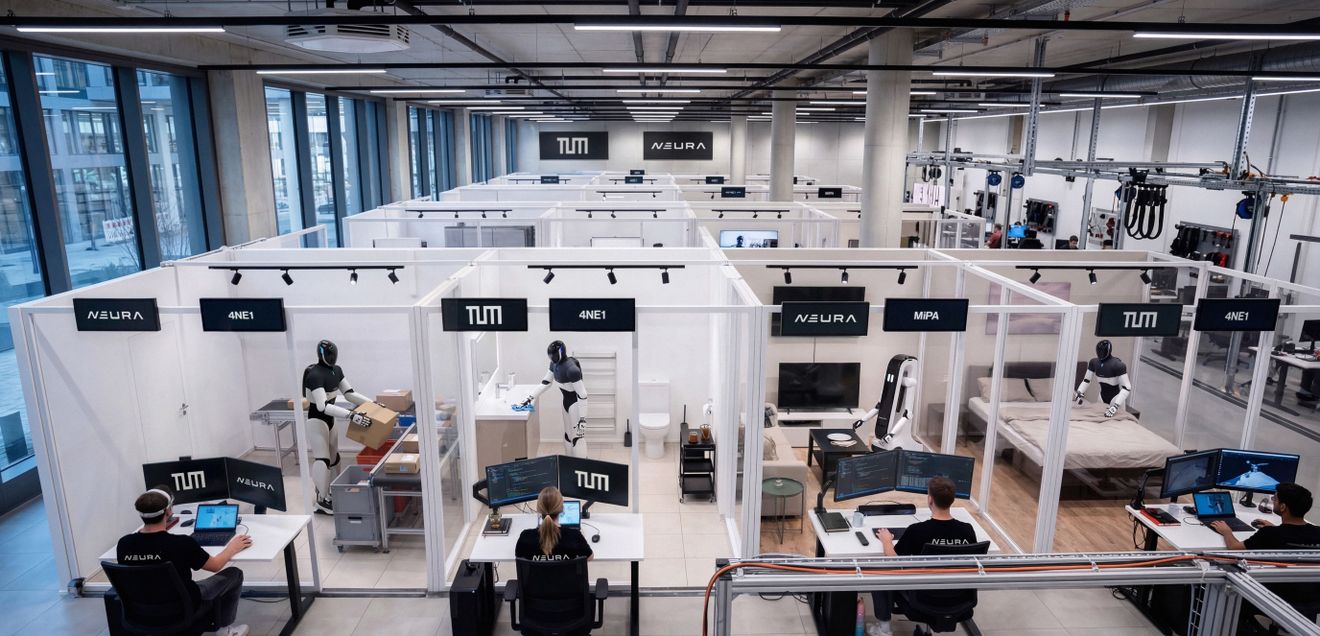
Under the leadership of TUM MIRMI professors Lorenzo Masia and Achim Lilienthal, hundreds of robotic systems, including several humanoids, will be further developed and trained with AI support at the research and training center for their use in everyday life. The partners are jointly investing 17 million euros in the TUM RoboGym. Neura Robotics is contributing the lion's share of eleven million euros, primarily to procure robots and ensure the maintenance of the hardware. "In return, Neura Robotics participates in our research," says Prof. Achim Lilienthal. "The combination of high-end robotics technology and top-class academic research in artificial intelligence will give development a huge boost," says the scientific coordinator of the new robotics hub called 'TUM RoboGym (powered by Neura)' and initiator of the new TUM MIRMI cooperation together with Lorenzo Masia. To this end, the partners TUM MIRMI and Neura Robotics have signed a corresponding cooperation agreement.
Humanoid robots are becoming part of everyday life
TUM President Prof. Thomas F. Hofmann emphasizes: "Humanoid robots have long since left the status of science fiction. In the near future, they will be an integral part of our everyday lives and support people in many tasks. Together with Neura Robotics, we at TUM are working on accelerating this development and, above all, ensuring the safety of coexistence between humans and robots in addition to functionality."
The founder and CEO of Neura Robotics, David Reger, says: "The decisive competitive factor in intelligent robotics is no longer mechanics, it lies in the data. Those who have high-quality, realistic training data set the pace. This is precisely where we at Neura Robotics bring our strengths to bear: By setting up robot gyms worldwide and networking training data via our Neuraverse platform, we are creating scalable training infrastructures for physical AI. Together with TUM, we combine excellent research with entrepreneurial implementation power. In this way, we are setting new standards in intelligent robotics and sustainably strengthening Germany's and Europe's technological leadership in one of the key future technologies of our time."
For the Director of TUM RoboGym and TUM MIRMI Executive Director Prof. Lorenzo Masia, the cooperation offers the opportunity to help shape future developments in robotics worldwide: "European sovereignty is extremely important in times of geopolitical competition between East and West. With this research and training center, which is one of the largest in the world, we are creating a unique infrastructure in Europe for our researchers and students, where they can experience, develop and learn new approaches in robotics and AI and thus become a strong core of European experts when they enter the job market."
Gaining valuable data from human movements
In the TUM Convergence Center at Munich Airport, the cooperation partners are jointly researching the next generation of humanoid robots on an area of 2,300 square meters. Among other things, AI-supported training of robotic systems is planned. TUM MIRMI and Neura Robotics will make most of the data generated from this available to the robotics community in an open ecosystem.
Unlike language models such as ChatGPT, it is not possible in embodied AI to access almost any amount of data from the internet and learn with its help. Web videos in which robotic arms are used to perform certain tasks, for example, are hard to find. It is also still unclear how well movements can be read from videos. Simulations are also usually far too imprecise and cannot reliably reproduce frictional forces that exist in the real world.
"These are the reasons why we need a training center where people can teach the robots individual skills, such as folding a box or putting components together," says Prof. Lilienthal. "The robots will learn general skills in the RoboGym, which they can then transfer independently to specific tasks." The prerequisite for this is a large number of data sets, which are now being created in RoboGym by human robot trainers.


You might also be interested in
International Federation of Robotics
U.S. Robotics Industry Sees Double-Digit Growth
In the U.S., sales of industrial robots rose by 11% compared to the previous year: 38,000 units were newly installed in 2025. This significant recovery is driven by robust growth in the food industry and other non-manufacturing sectors. However, the...
 read more...
Development Collaboration for Humanoid Robotic Hands Launched
Schunk is entering into a new development partnership with Robert Bosch Robotics. Their shared goal is to develop an industrial-grade robotic hand that can be integrated into various humanoid robot systems.
read more...International Federation of Robotics
The 2026 IERA Award was presented
The 2026 “Award for Innovation and Entrepreneurship in Robotics & Automation” (IERA) goes to the Swiss deep-tech company Verity for its fully autonomous indoor drone system. The flying robots support the logistics and retail sectors by...
read more...Quantum-resistant hardware security for Nvidia robotics platform
Infineon Technologies integrates the hardware security module 'Optiga TPM SLB 9672' into Nvidia's 'Jetson Thor' computing platforms for robotics and autonomous systems. The module secures cryptographic keys directly at chip level and thus protects...
read more...AI-supported lighting robot wins German Innovation Award 2026
Ledvance, provider of innovative lighting solutions, was named "Winner" in the Excellence in Business to Consumer Lighting category at the German Innovation Awards 2026. With the AI Companion Lighting Robot 'Elix', the company presents an...
read more...Regulation and safety slow down robotics projects in Germany
QNX has published the study "Inside the Robot: Architecture Benchmark Report". The results of the global survey of 1000 robotics developers show that software and safety requirements are increasingly becoming the central bottleneck for innovations...
read more...Michael Ardelt becomes first COO at Robco
Robco, a company for autonomous industrial robotics, is further expanding its management team. As the company's first Chief Operating Officer, Michael Ardelt will assume responsibility for structuring and scaling Robco's growth in operational terms.
read more...Takeover of Invent Smart Intralogistics Solutions
Comau has signed a binding agreement to acquire Invent, a Brazil-based company specializing in intralogistics and warehouse automation solutions, with a strong focus on e-commerce and high-throughput distribution environments.
read more...Embedded system for OR robotics via voice command
A robotic assistance system is designed to relieve surgeons during minimally invasive procedures by taking over camera control. It is based on an industrial embedded platform designed for low latency, system stability and long-term availability.
read more...