

Syncore and Sereact
Rollout of more than 100 AI-controlled Robot Systems planned
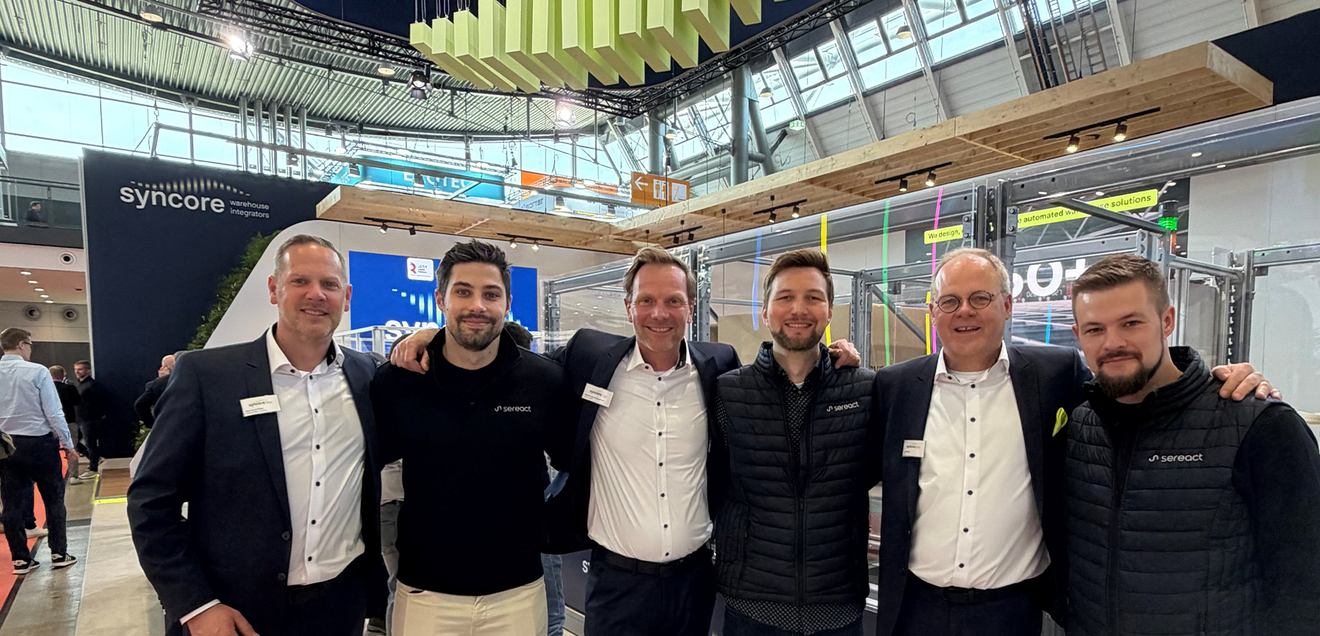
Syncore (formerly known as Reesink Logistic Solutions) and Stuttgart-based AI robotics company Sereact are deepening their partnership. At Logimat, the companies signed a letter of intent to expand their partnership with the aim of introducing more than 100 robot systems in the coming years.
Sereact robots are already being used by some of Syncore's fulfillment service providers and retail customers, including Deltilog, Monta and World of Sweets. The experience from these projects shows: The need for flexible, AI-supported automation is increasing across all industries.
"The results we are seeing with our customers have completely convinced us," says Machiel van den Hazelkamp, CCO of Syncore. "We believe in strong scaling effects and assume that AI-based robotics will become the standard in warehouse logistics in the coming years."
In addition to pick-and-place applications, in which Sereact robots autonomously pick and place a wide variety of items without prior training, and the AI-based inventory monitoring system Sereact Lens, the partnership is now also increasingly focusing on returns handling. Returns are considered one of the biggest pain points in logistics and have long been too complex for conventional automation solutions. This is precisely where the new dual-arm robotics from Sereact opens up a completely new field of application. The two-armed robot stations handle returns flexibly, check them and put them back into storage. According to the companies, there is enormous development potential here, which is to be tapped into jointly.
"Returns handling is one of the biggest cost drivers for many of our customers. The fact that Sereact can now automate this process opens up a field of application that our customers have been asking about for a long time," explains van den Hazelkamp.
A key strategic advantage of the growing robot fleet is that each system generates data in real operation, which Sereact's Cortex AI model learns from. The more robots are in use, the more efficient all systems become. A continuous self-improvement that becomes more effective with each new installation.


You might also be interested in
Aachen-based start-up transfers AI robotics to industrial applications
Many developments in the field of artificial intelligence have so far failed to be transferred from the research laboratory to industrial practice. The spin-off Athenyx Robotics from RWTH Aachen University aims to change this: The start-up is...
 read more...
Strike at the start of the Hannover Messe
On the occasion of the strike announced by ver.di on the first two days of Hannover Messe 2026 (20 and 21 April), which will paralyze public transport in Hanover, the organizer, Deutsche Messe, is expressing clear criticism and great concern about...
read more...Strategic Cooperation between SEW-Eurodrive and Safelog
SEW-Eurodrive and Safelog announced a strategic partnership at Logimat to jointly develop and establish a powerful software system for controlling mobile and stationary processes in intralogistics.
read more...Modular Robot Hands for Industry
Schunk and DLR intensify Cooperation in Humanoid Robotics
Schunk and the German Aerospace Center (DLR) are expanding their collaboration in humanoid robotics. The aim is to improve the fine motor skills of humanoid robot hands for industrial applications and to translate research into practical solutions...
read more...IFR presents Award Winners
To give women in the robotics industry more visibility and recognition, the International Federation of Robotics (IFR) has honored eleven women in 2026 who are shaping the future of robotics.
read more...Schaeffler expands its Global Partner Network
Motion Technology Company Schaeffler has agreed a partnership with Leju Robotics Technology, a Chinese technology company in the field of humanoid robotics. This is Schaeffler's first cooperation with a Chinese company.
read more...Exoskeleton: Strength to put on
Automation specialist Comau is expanding its portfolio of wearable robots with a new exoskeleton. The wearable system reduces muscle strain by up to 50 percent and is aimed at a wide range of applications in industry and SMEs.
read more...100 Million US Dollars for the Expansion of Autonomous Industrial Robotics
Robotics company Robco announces a financing round of 100 million US dollars. The company intends to use this to accelerate its roadmap for physical AI and expand its presence in the USA.
read more...Automation for Chip Production
Beckhoff optimizes Semiconductor Processes with precise Control Technology
Semiconductor production is one of the most complex manufacturing processes in the industry. Beckhoff shows how precise automation, flexible control systems and open communication standards accelerate production processes and equip manufacturing for...
read more...