

International Federation of Robotics
Service robot sales increase by 48% worldwide
The number of service robots for professional use has risen by 48% worldwide to a total of 158,000 units sold. Staff shortages are prompting many companies to automate with service robots.
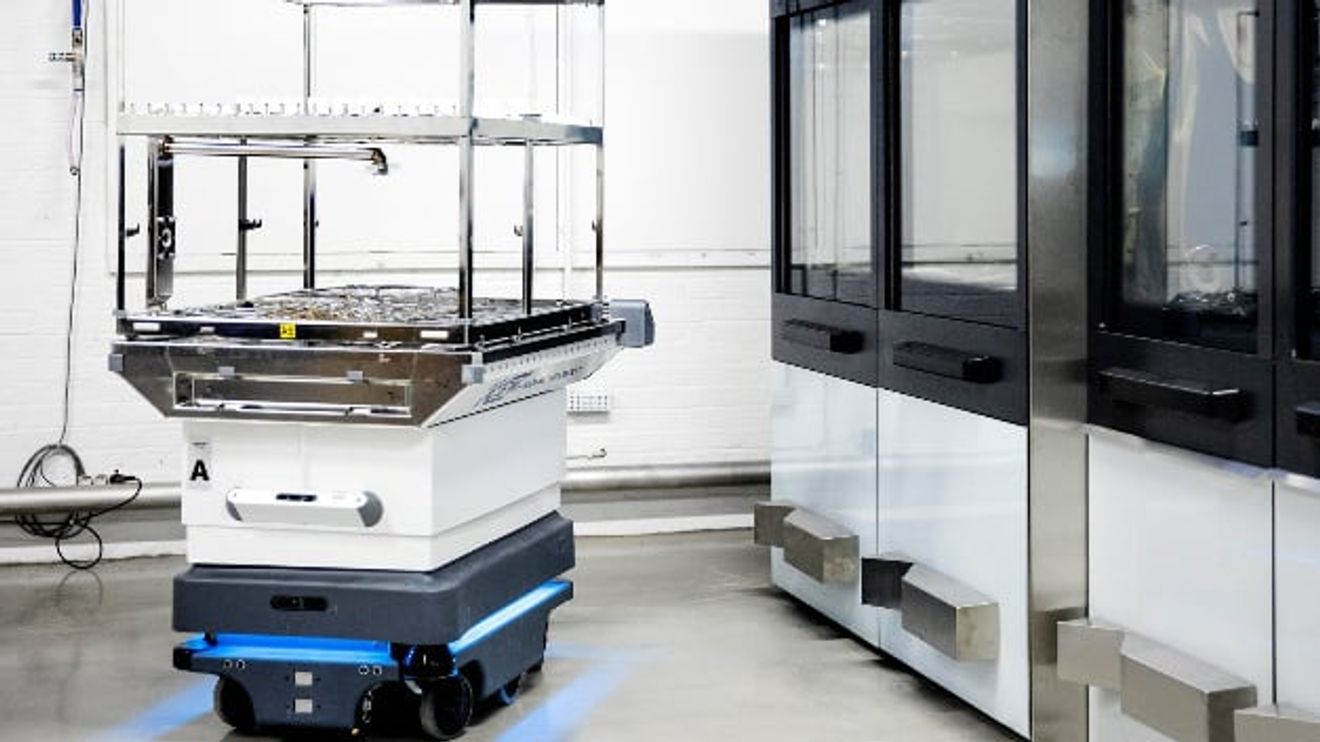
KEN Hygiene has developed a fully automated sterilization center with an autonomous mobile robot that acts as a logistical link.
© Mobile Industrial Robots"The service robot industry is developing rapidly," says Marina Bill, President of the International Federation of Robotics (IFR). "The shortage of skilled workers and the difficulty of filling service positions with personnel are increasing demand. The IFR has identified almost 1,000 service robot providers worldwide that offer automated services."
Top 5 applications for professional service robots according to sales figures
Mobile robot solutions in transport and logistics account for the largest market share: more than every second professional service robot is used to transport goods or merchandise. With a good 86,000 units sold, sales in this segment rose by 44% in 2022. Sales of robots that work in open indoor spaces with public traffic developed particularly dynamically: The number rose by 78% to just under 37,300 units sold. Many of these robots are used to deliver food and drinks in restaurants.
Robots in the hotel and catering industry are enjoying a sharp rise in demand: more than 24,500 units (+125%) were sold in 2022. Robots as mobile stations for information and telepresence make up the majority of this segment.
Sales of medical robots fell by 4% to around 9,300 units. Almost 4,900 surgical robots (+5%) were sold, but sales of robots for rehabilitation and non-invasive therapy fell by 16% to 3,200 units.
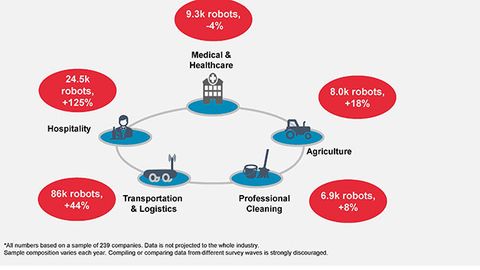
Sales of robots in the agricultural sector rose by 18% with almost 8,000 units delivered. More than 5,800 robots (+9%) were sold for agricultural tasks such as milking and barn cleaning. The shortage of labor in agricultural regions and the trend towards more sustainable agriculture make service robots an important player in this market.
The number of professional cleaning robots increased by 8%, reaching almost 6,900 units sold. With an increase of 10% and 4,900 units sold, floor cleaning is the application with the highest demand. This corresponds to more than 70% of deliveries in this application group.
Service robots for private and domestic use
Service robots for private and domestic use are produced in very large quantities for a large consumer market. This segment is therefore very different from service robots for professional use. For comparison: 5.1 million units sold in the consumer segment compared to a total of 158,000 units sold for professional use in 2022.
The strongest demand from private consumers is currently for household robots: almost 4.9 million robots were sold in 2022. With around 2.8 million units sold, floor cleaning is the most important area of application. Robot vacuum cleaners in particular have been established in private households for many years. Apart from cyclical fluctuations, the IFR statistics department forecasts growth potential in the low double-digit range for the coming years.
Just like robotic vacuum cleaners, garden robots have become an integral part of people's everyday lives: sales of lawn mowing robots reached 1.1 million units in 2022.
Robots for social interaction and education are the second largest group of consumer applications, with 157,000 units sold in 2022: Just under 104,000 educational robots were sold - for robots for social interaction and companionship, the number of shipments rose to around 53,000 units.
The World Robotics Service Robots Report is based on sample data. The data is not extrapolated to the entire industry. The composition of the sample varies each year. All figures from the World Robotics Service Robots 2023 annual report are based on a sample of 239 companies.


You might also be interested in
International Federation of Robotics
Top 5 robot trends 2024
The number of industrial robots worldwide has reached a new record of around 3.9 million units. The International Federation of Robotics (IFR) defines the most important trends that will shape robotics and automation in 2024.
 read more...
Mobile robotics moves into focus
Continental acquires the Kinexon specialty division for on-board operating systems for the intelligent control of autonomous mobile robots (AMR). The aim is to strengthen its position in the strategic growth area of mobile robotics.
read more...International Federation of Robotics
'Go4Robotics' campaign launched
With the online platform 'Go4Robotics', the International Federation of Robotics (IFR) offers decision-makers in small and medium-sized companies an independent source of information for their steps towards automation.
read more...One million robots in the automotive industry
The automotive industry has the largest number of industrial robots working in factories around the world: The operational inventory has reached a new record of around 1 million units.
read more...International Federation of Robotics
The top 5 robot trends for 2023
The global stock of industrial robots has reached a new record of around 3.5 million units - the value of installations is estimated to have risen to 15.7 billion US dollars. Which five trends will shape robotics and automation in 2023?
read more...IFR World Robotics Report 2024
Record number of robots in use worldwide
Over four million robots are in use in factories worldwide, reports the IFR in the current "World Robotics Report 2024" - a record number. However, sales of industrial robots have fallen.
read more...International Federation of Robotics
Beijing wants to use robots to drive growth
During the third plenary session of the Central Committee, China repositioned its economic policy and announced a technology-centered approach. Chinese robot manufacturers are strategically preparing for this.
read more...Realtime Robotics honored
The 'Award for Innovation and Entrepreneurship in Robotics & Automation' (IERA) 2024 goes to Realtime Robotics. The US company from Boston received the prestigious award for its program that plans the movements of industrial robots fully...
read more...Growth forecast for 2024 halved
The VDMA Robotics and Automation Association has reduced the industry's original sales forecast for 2024 from 4% to 2% growth to EUR 16.5 billion. In the previous year, companies achieved record sales growth of 13% to reach 16.2 billion euros.
read more...