

Cooperation
RoboDK and Keba work together
RoboDK and Keba Industrial Automation have announced their collaboration. Together, they want to simplify the life cycle of a process solution with integrated robotics - from quotation preparation to after-sales support.
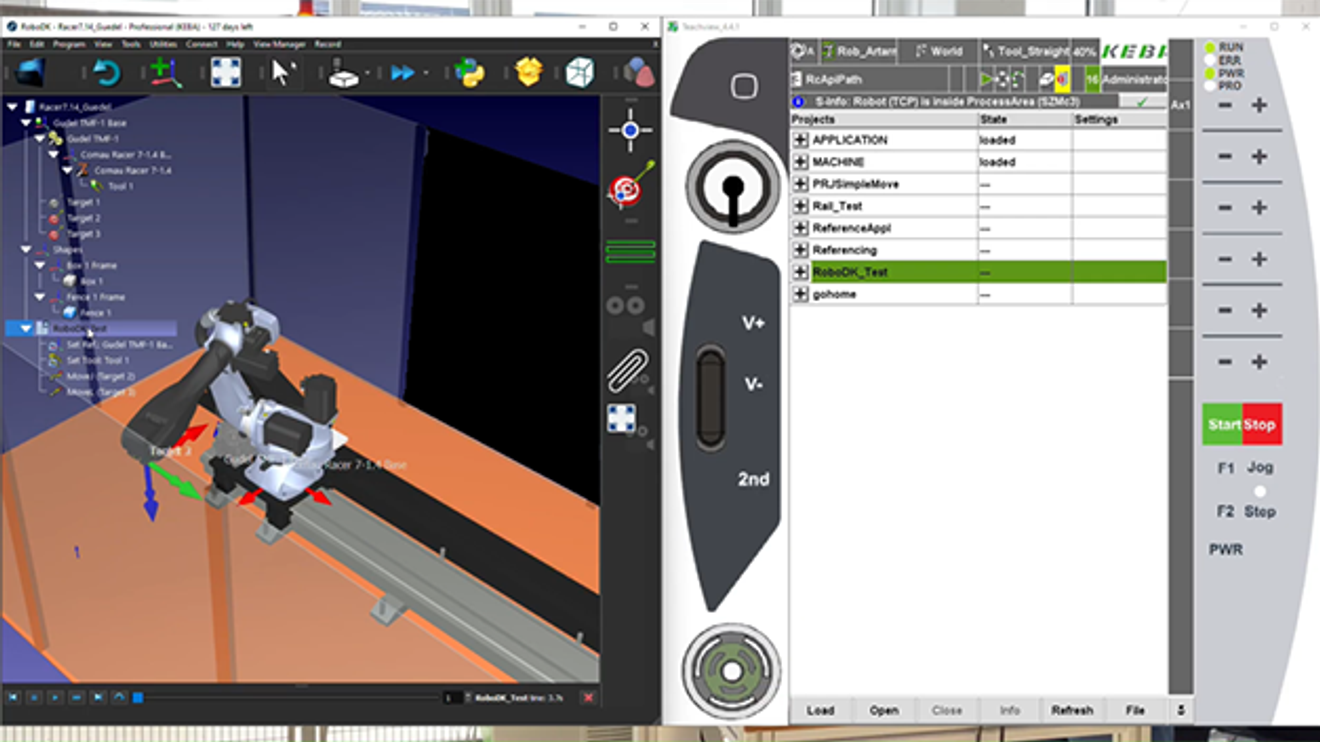
The connection of Keba control technology to RoboDK enables users to virtually create and test robot cell scenarios in a simulated environment.
© RoboDK/KebaRoboDK was founded in Canada in 2015 and specializes in offline programming and simulation. With its Kemro X automation platform, Keba enables optimum interaction between the overall solution, the movement of the robot and the respective process functionalities. As part of the collaboration, the Keba control technology will be connected to RoboDK. The Canadians developed a KeMotion-Keba driver for this purpose, which is based on Keba's new web APIs and thus enables corresponding workflows. This should also benefit existing customers who are already supported by the RoboDK robotics library.
OEM developers can now combine Kemro X and RoboDK. The two open platforms make it possible to create and test several robot cell scenarios from the desktop and only then set up the real production cell. This allows the optimum positioning of the robot to be determined before it is actually used. Cycle times are minimized, singularities are avoided and accessibility is ensured. This leads to shorter commissioning times, conserves employee resources and ultimately enables a fast and reliable quotation to be prepared for the customer, according to the companies
From programming and simulation to maintenance
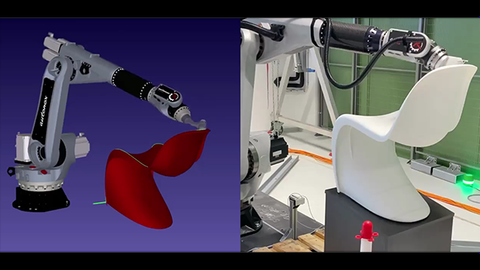
The execution of the robot movement can be monitored both in a digital environment and with the actual robot controller within RoboDK.
© RoboDK/KebaThe currently available functionality enables the creation of robot programs in the Keba language Cairo within the RoboDK environment based on 3D models of parts and systems, which can then be transferred to Keba controllers. The execution of the robot movement can be monitored both in a digital environment and with the actual robot controller within RoboDK.
Samuel Bertrand, Software Development Lead at RoboDK: "Connecting Kemro X to RoboDK provides Keba users with advanced simulation and programming capabilities, including CAD-to-path functions, offline programming (OLP), digital twin functions, collision checking, CAM for robots and more. By connecting KEBA systems to RoboDK, we aim to improve efficiency, control and flexibility in robot automation."
Even after the production cell is set up and in operation, it can be easily maintained or modified with the help of the digital twin. The recorded data makes it easier to identify problems quickly and enables efficient customer support and service.


You might also be interested in
Manage and secure assets
In today's fast-paced industrial environment, it is essential that production processes run smoothly and efficiently. However, one critical aspect that is often overlooked is the importance of PLC backup and restore procedures.
 read more...
Update brings support for TIA V19
Delta Logic has updated the 'Accon OPC UA Server' software to version 1.4.0.0. The new features include support for TIA Portal projects of version V19 and for the latest firmware for CPUs of the Siemens S7-1200 and S7-1500 controllers.
read more...Branch office opened in Norway
The Austrian company Bachmann electronic, which specializes in automation technology for maritime applications, renewable energies and industry, is opening a branch in Norway.
read more...Raquel Torres is the new President
Raquel Torres succeeds John Conway as President of UniversalAutomation.Org.
read more...Subsidiary founded in Vietnam
The Schmersal Group has founded a new subsidiary in Ho Chi Minh City, Schmersal Vietnam Co. Ltd.
read more...Safe programming of PLCs
In collaboration with Codesys, Fraunhofer IEM has integrated static code analysis development methods into the Codesys development environment commonly used for PLCs.
read more...Frank Stührenberg hands over to Dirk Görlitzer
At the end of the year, Frank Stührenberg will hand over the position of CEO of Phoenix Contact to Dirk Görlitzer. Until then, there will be dual leadership.
read more...SPS - Smart Production Solutions
SPS from 2025 again at the end of November
From next year, the SPS will return to the familiar dates and will take place in Nuremberg from November 25 to 27, 2025. The subsequent dates until 2027 will also be at the end of November.
read more...Autonomous flying in a swarm
The 'BionicBee' is an ultra-light flying object from Festo that can fly in large numbers and completely autonomously in a swarm. The BionicBee performed its first air show at the Hannover Messe 2024.
read more...