

RobCo
No-code programming interface
RobCo has released the latest version of the easy-to-use programming interface 'RobFlow 5'. Based on the 'RobCo Studio' software platform, companies can configure, implement and manage robots in use via a digital twin.
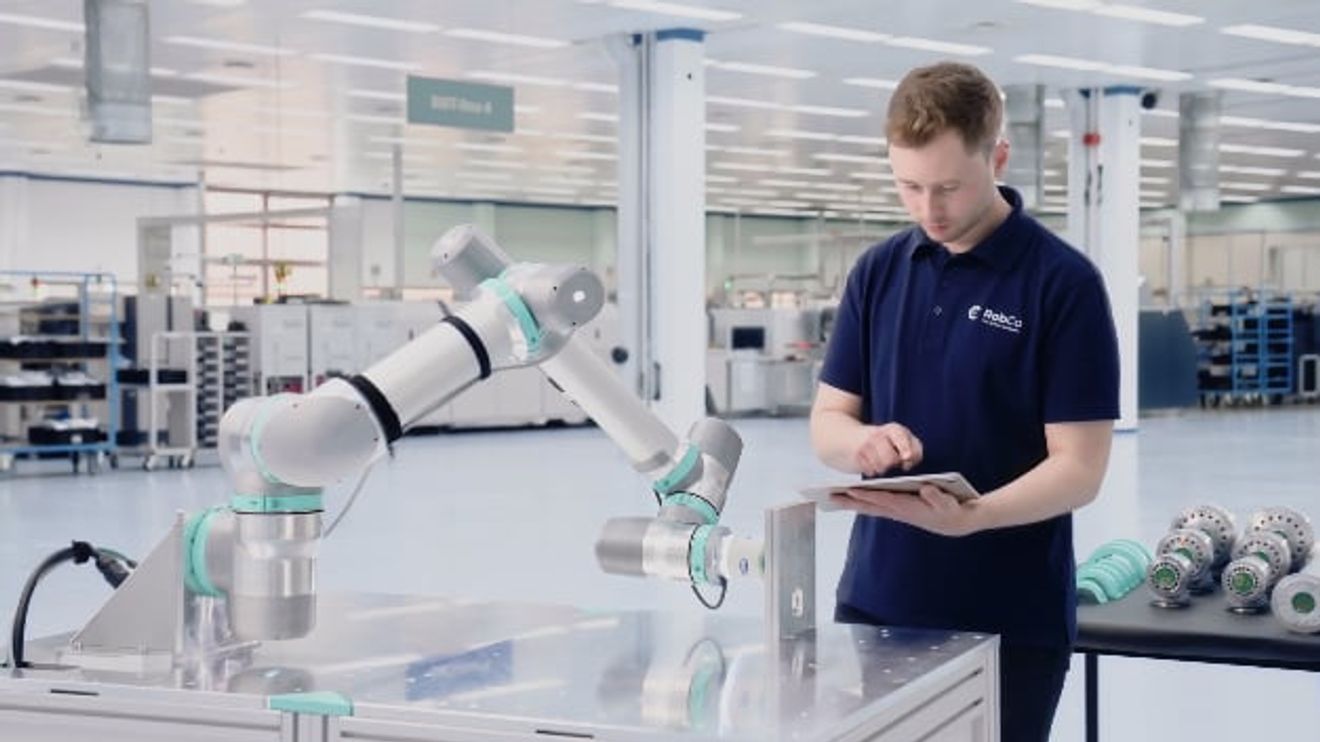
Thanks to the no-code concept, a quick and easy plug-and-play deployment is possible in just a few days, according to supplier RobCo. This makes the technologies particularly suitable for small and medium-sized manufacturing companies with limited financial and human resources - whether for machine loading, palletizing, dispensing or welding. The company's portfolio includes hardware as well as on-premise and cloud software. 'RobFlow 5' offers functions such as the 'Robot Visualizer', which can be used to visualize the configurations of connected robots and modules as well as their environment - such as conveyor belts or CNC machines - in the form of moving images. In addition, it is now also possible to create, edit and monitor variables that can be used for user-defined parameters. The following variable types are currently supported: Boolean, Integer, Float, Input, Output, the Modbus Holding Register, the Modbus Input Register and Modbus Coil. Variables can be created both globally (for use in all programs) and locally (for a specific program). Alternatively, peripheral signals - for example to control a digital output or a PLC - can be read and written. Dashboard widgets can be individually adapted in terms of color and size. Version 5 has a password-protected authentication mechanism to ensure a high standard of security for users in RobFlow. When opening RobFlow for the first time after the update, the user is asked to set a password. Only with this password can they use certain applications and execute processes in future. This authentication process applies to opening the flow, subflow and dashboard editors, the robot configuration and protected dashboards in the dashboard viewer.


You might also be interested in
'Robot kitchen' opens
The CeTI Cluster of Excellence at TU Dresden has opened a 'robot kitchen' as a research laboratory for human-machine interaction. Among other things, it is intended to demonstrate the capabilities of modern cobots.
 read more...
Robotics & Handling - The winners
They ensure fast and safe handling of components and get them reliably from A to B: the winning products in the 'Robotics & Handling' category.
read more...25 years of Computer&Automation - The e-paper
For 25 years, Computer&Automation has accompanied the growing influence of IT in automation technology. Ultimately, IT and automation can no longer be clearly separated. In this anniversary issue, you can read about the importance that...
read more...International Federation of Robotics
U.S. Robotics Industry Sees Double-Digit Growth
In the U.S., sales of industrial robots rose by 11% compared to the previous year: 38,000 units were newly installed in 2025. This significant recovery is driven by robust growth in the food industry and other non-manufacturing sectors. However, the...
read more...Development Collaboration for Humanoid Robotic Hands Launched
Schunk is entering into a new development partnership with Robert Bosch Robotics. Their shared goal is to develop an industrial-grade robotic hand that can be integrated into various humanoid robot systems.
read more...International Federation of Robotics
The 2026 IERA Award was presented
The 2026 “Award for Innovation and Entrepreneurship in Robotics & Automation” (IERA) goes to the Swiss deep-tech company Verity for its fully autonomous indoor drone system. The flying robots support the logistics and retail sectors by...
read more...Quantum-resistant hardware security for Nvidia robotics platform
Infineon Technologies integrates the hardware security module 'Optiga TPM SLB 9672' into Nvidia's 'Jetson Thor' computing platforms for robotics and autonomous systems. The module secures cryptographic keys directly at chip level and thus protects...
read more...AI-supported lighting robot wins German Innovation Award 2026
Ledvance, provider of innovative lighting solutions, was named "Winner" in the Excellence in Business to Consumer Lighting category at the German Innovation Awards 2026. With the AI Companion Lighting Robot 'Elix', the company presents an...
read more...Regulation and safety slow down robotics projects in Germany
QNX has published the study "Inside the Robot: Architecture Benchmark Report". The results of the global survey of 1000 robotics developers show that software and safety requirements are increasingly becoming the central bottleneck for innovations...
read more...