

Igus
Low-cost robotics in use
How can a 100% inspection at the end of a production line be automated cost-effectively? A manufacturer of chargers for electric vehicles relies on a 5-axis articulated arm robot that takes over the test cycle and uses various test equipment.

The Bocholt-based company Benning is a supplier of chargers for electric vehicles such as forklift trucks. In the current generation of traction chargers in the Belatron series, the high-efficiency charging process is monitored electronically. The devices and in particular the charging cycles can be configured individually if the customer so wishes. The traction chargers are available for voltages from 24 to 120 V. Comprehensive connectivity enables integration into energy management systems, among other things. The test system at the end of the production line was designed and implemented using 'on-board resources'. The aim in developing the test system was that the operator only has to connect the charger and all other processes run automatically.
One robot for many testing tasks
To achieve this goal, a low-cost robot from Igus was mounted on the ceiling of the test cell, which plays a central role in the test. As it has many tasks to perform, the tool on the 'Robolink' robot arm is versatile: in addition to a camera for image recognition and a laser distance sensor for measuring the device, an electrically conductive test needle is integrated for housing contacting and for actuating the operating elements.
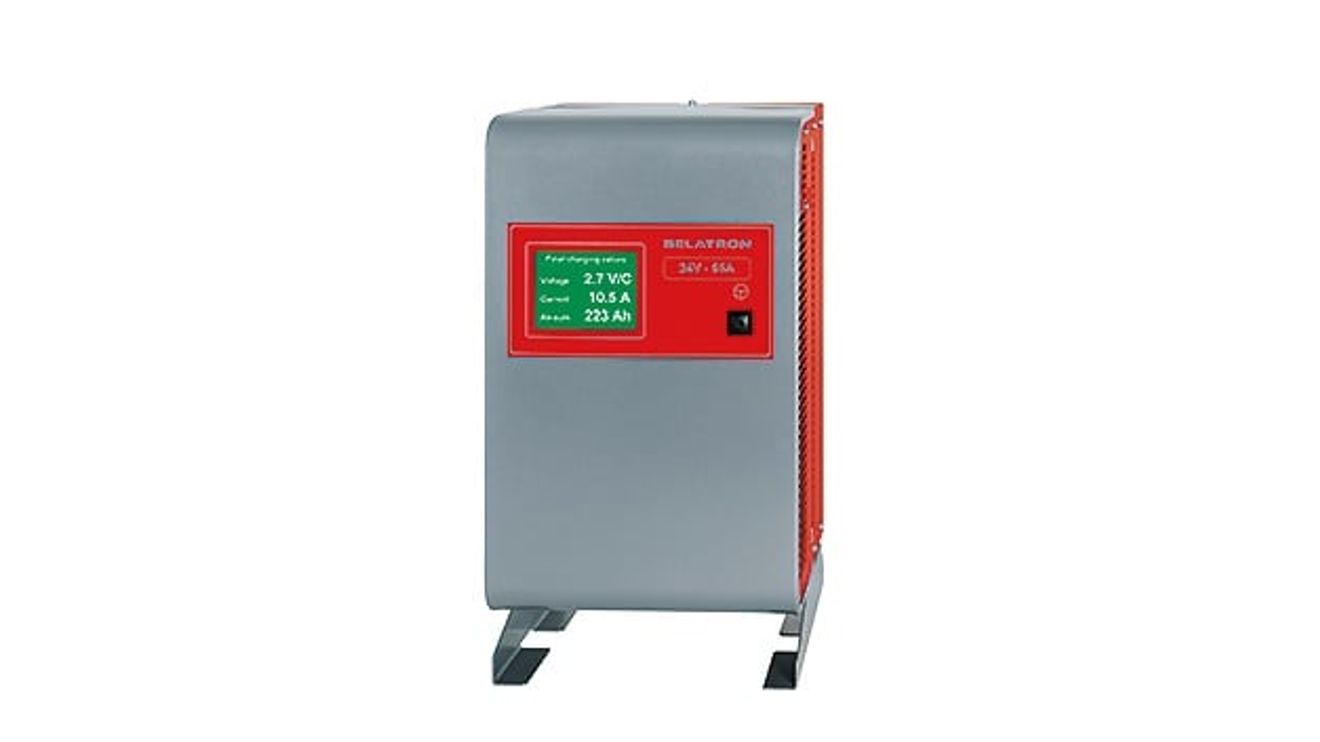
The current generation of 'Belatron' chargers from Benning Traction Batteries can be integrated into energy management systems, for example.
© BenningIn the first step, the robot identifies the individual charger by scanning the barcode with the camera. It then 'knows' the test program. It then measures the device with the laser sensor and uses the camera to evaluate the device color and label. This is followed by an important and mandatory step for safety reasons: to perform the GND safety test, the test needle contacts the housing and must move to a different test position depending on the size of the housing. The robot arm then presses each individual button on the membrane keypad with the test needle. This enables the test system to ensure that the operating elements function perfectly.
The low-cost robot is also flexible when it comes to adapting to changing conditions. As it is controlled by the test system, it is easy to switch to new device designs or test criteria, for example. In principle, testing can also be carried out without a robot; in this case, an employee takes over its activities. The various electrical tests and software installation take place in parallel to the robot-assisted tests.
The right robot

When searching for the right robot for the test cell, Benning's design engineers were able to use their existing expertise, as collaborative robots were already being used in production. Ultimately, the choice fell on an Igus 5-axis articulated arm robot of the type 'Robolink RL-DP-5'. The robot, which is largely made of tribologically optimized (for friction and wear) and lubricant-free plastics, can move payloads of up to 3 kg and achieves cycle times of less than 7 seconds. Its arm has a reach of 790 mm and the positioning accuracy is 1 mm.
The engineers involved broke new ground when planning and commissioning the test cell. The tool is fully integrated into the robotics software. Image processing is performed by a standard camera, for which a separate program was written on an open source basis and integrated into the inspection system. The LED light in the cell changes with each camera position. Documentation is also generated automatically. Overall, Benning was able to carry out the majority of the design and project planning itself; Igus was involved in the design of the tool in that different variants were developed, one of which Benning decided on after testing.

The author: Alexander Mühlens is Head of the Low-Cost Automation division at Igus in Cologne.
© IgusAfter a good year of experience with the self-developed test cell and the robot, those responsible at Benning have come to an all-round positive conclusion: after contacting the test specimen, the operator can take over other tasks for the entire test cycle, which lasts several minutes. This optimizes costs - keyword ROI. The quality of the test is also improved, as the results are evaluated objectively. Another positive side effect: comprehensive statistics and evaluations are generated, which can be used as a basis for further process improvements. Thanks to the individual documentation of the complex testing process, a 'digital twin' of each individual traction charger is created almost automatically.


You might also be interested in
Interview with Alexander Mühlens, Igus
Affordable robot automation for small and medium-sized companies is the goal of the 'Low Cost Automation' division of Igus. Computer&Automation asked Alexander Mühlens how the offer is being received.
 read more...
Vector Award 2022 presented
The Hungarian company Gepber Szinpad wins the Golden Vector Award 2022 for the most spectacular energy chain application of the last two years with a multifunctional hall that transforms at the touch of a button.
read more...Check with Michael Blass, Igus
The plastic recycler
Igus launched the 'green chainge recycling program' at the end of 2019. Michael Blass reveals how this recycling program for plastic energy chains and drag chains has proven its worth.
read more...Room gantry robot in low-cost version
Igus expands its low-cost automation range with a drylin XXL room gantry robot.
read more...Nominations for Electrifying Ideas Award have been announced
An independent jury of top-class experts from business, research and society has nominated three companies for the Electrifying Ideas Award 2026: Ideas from Philips, Rittal and ZeMA - Center for Mechatronics and Automation Technology convinced the...
read more...Circular economy for flexible materials
With a budget of 7.5 million euros and twelve partners from six countries, the European research project 'FlexCycle' is pursuing the goal of making recycling processes for the reuse of flexible materials suitable for industrial use. To this end, it...
read more...Schunk founds tech spin-off for humanoid robot hands
Schunk is bundling its activities in humanoid robotics by founding its own spin-off at the beginning of January. The aim of the new company is to develop modular humanoid robot hands for industrial applications.
read more...Second generation of vacuum grippers
Coval has redeveloped the carbon face gripper 'CVGC'. The new generation also takes into account current and future trends in the market for collaborative robots.
read more...Schunk receives the Hermes Award 2024
Schunk was honored with the Hermes Award for its AI-based project during the opening ceremony of the Hannover Messe.
read more...