

Logimat 2026
AI shapes intralogistics
More than 1600 exhibitors will be presenting technological developments for intralogistics at Logimat in Stuttgart. The focus will be on AI-supported control systems, autonomous mobile robotics and alternative drive concepts designed to increase efficiency, scalability and operational reliability.
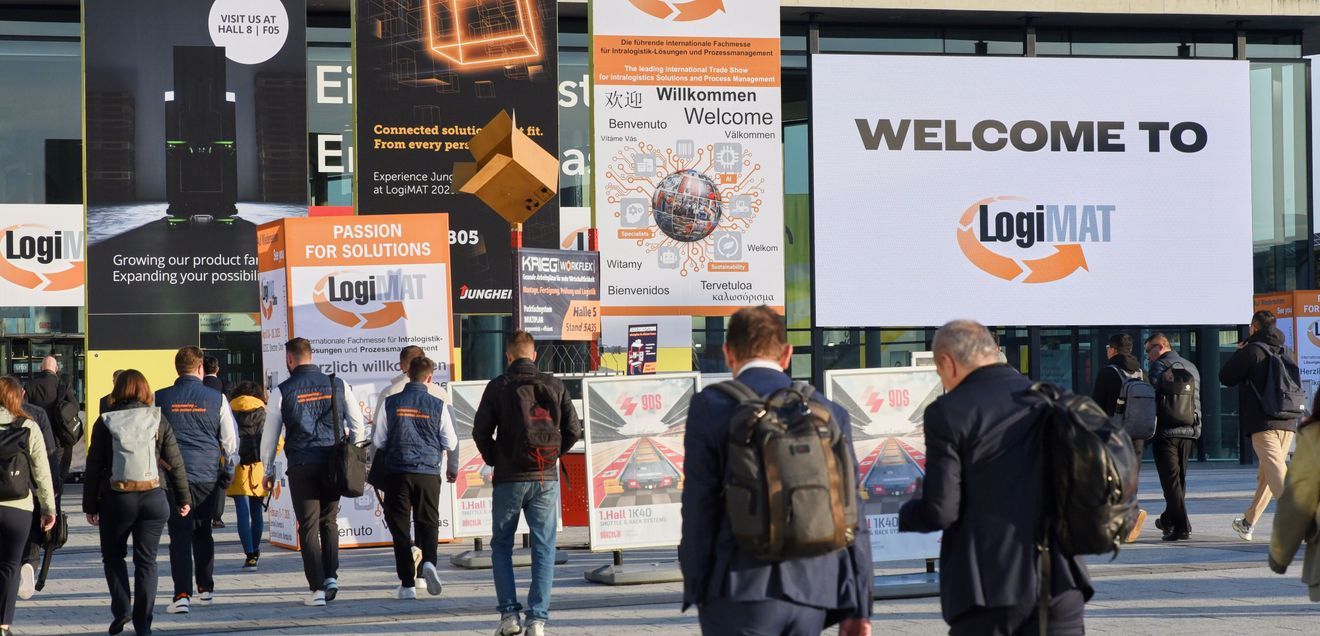
When Logimat opens its doors from March 24 to 26, 2026, more than 1,600 exhibitors from over 40 countries will showcase the latest trends and developments in intralogistics on around 120,000 m² of exhibition space. The focus will be on solutions that not only automate processes, but also orchestrate them based on data.
Artificial intelligence as the analytical backbone
A central focus is on the integration of AI in warehouse management systems (WMS), transport management systems (TMS) and material flow computers. In Hall 4, software providers will present applications that provide data-based support for operational decisions.
AI models are used for demand forecasts, sales forecasts and dynamic scheduling, among other things. Cloud-based forecasting services analyze historical sales data, seasonal fluctuations and external influencing factors to generate continuously updated forecasts. These can be integrated into existing ERP and planning systems. For users, this means more precise inventory planning, reduced safety stock levels and less capital tied up.
In order picking, AI algorithms take over the dynamic batch formation. Algorithms optimize the composition of orders to minimize walking distances and increase picking performance. In two-stage picking processes, article groups are bundled in such a way that transport and provision times are reduced. This reduces process costs and increases throughput.
AI agents are increasingly being used, which can be configured via graphical interfaces and aggregate the data streams from warehouse management, sensor technology and transport control. They detect anomalies in real time and provide recommendations for action. For operators of complex warehouse structures, this increases transparency regarding capacity utilization, bottlenecks and sources of disruption.
AI in robotics and material flow
In addition to the software level, AI is increasingly finding its way into physical process automation: image processing systems, coupled with learning algorithms, enable robots to reliably recognize objects and dynamically adapt gripping strategies, even under variable lighting and environmental conditions. AI-based quality controls identify deviations as early as goods receipt or during picking, thereby reducing error rates.
In the fleet management of autonomous systems, AI models analyze movement profiles, traffic volumes and order priorities. Routes are adjusted in real time, bottlenecks are predicted and resources are allocated dynamically. This is supplemented by predictive maintenance approaches: Sensor data on temperature, vibration or charging cycles are incorporated into models that anticipate potential failures and optimize maintenance windows.
Autonomous mobile robots (AMR) and automated guided vehicles (AGVs) are another focus of the trade fair, particularly in Hall 8. Flexibility and scalability are key for users, which is why mobile units are increasingly replacing rigid conveyor technology and AMR fleets are comparatively easy to expand or adapt to changing layouts.
Several manufacturers will be showing modular platform concepts. Their payloads range from 250 to 1600 kg, in some cases with pulling capacities of up to 900 kg. With speeds of up to 2 m/s, they enable shorter internal transport times. Modular systems allow individual superstructures such as lifting modules, roller conveyors or collaborative robot arms.
Special attention is paid to flat AMR systems for pallet transportation, which pick up loads directly from the floor. Two synchronized robot runners enable pallets to be moved completely underneath. This results in new process architectures, for example in block storage or truck loading, as there is no need for additional transfer stations.
Safety aspects play a central role here: 360° laser scanners, overlapping sensor systems and AI-supported obstacle classification increase navigation safety, even in dynamic environments. In confined production areas, optimized sensor arrangements enable precise manoeuvring.
Alternative drives and energy management
In the industrial trucks segment in Halls 9 and 10, the focus is on electrified drives. Lithium-ion batteries are increasingly becoming the standard energy source. They offer short charging times, high energy density and constant power output over the entire discharge cycle. For multi-shift operations, this means less downtime and better planning.
New electric counterbalance trucks cover payload ranges of up to five tons. Integrated lithium-ion systems reduce maintenance costs compared to traditional lead-acid batteries. At the same time, assistance systems and camera solutions improve operational safety.
Some manufacturers rely on alternative energy storage systems such as LiFePO4 batteries or capacitor systems. Contactless charging systems enable intermediate charging during operation, for example at defined transfer points.
In the heavy-duty sector, new terminal tractor units with tractive forces of 70 to 85 tons will be presented, designed for handling terminals and European regulatory requirements. Electric drives help to reduce local emissions and comply with strict environmental regulations.


You might also be interested in
International Federation of Robotics
U.S. Robotics Industry Sees Double-Digit Growth
In the U.S., sales of industrial robots rose by 11% compared to the previous year: 38,000 units were newly installed in 2025. This significant recovery is driven by robust growth in the food industry and other non-manufacturing sectors. However, the...
 read more...
Development Collaboration for Humanoid Robotic Hands Launched
Schunk is entering into a new development partnership with Robert Bosch Robotics. Their shared goal is to develop an industrial-grade robotic hand that can be integrated into various humanoid robot systems.
read more...International Federation of Robotics
The 2026 IERA Award was presented
The 2026 “Award for Innovation and Entrepreneurship in Robotics & Automation” (IERA) goes to the Swiss deep-tech company Verity for its fully autonomous indoor drone system. The flying robots support the logistics and retail sectors by...
read more...Quantum-resistant hardware security for Nvidia robotics platform
Infineon Technologies integrates the hardware security module 'Optiga TPM SLB 9672' into Nvidia's 'Jetson Thor' computing platforms for robotics and autonomous systems. The module secures cryptographic keys directly at chip level and thus protects...
read more...AI-supported lighting robot wins German Innovation Award 2026
Ledvance, provider of innovative lighting solutions, was named "Winner" in the Excellence in Business to Consumer Lighting category at the German Innovation Awards 2026. With the AI Companion Lighting Robot 'Elix', the company presents an...
read more...Regulation and safety slow down robotics projects in Germany
QNX has published the study "Inside the Robot: Architecture Benchmark Report". The results of the global survey of 1000 robotics developers show that software and safety requirements are increasingly becoming the central bottleneck for innovations...
read more...Michael Ardelt becomes first COO at Robco
Robco, a company for autonomous industrial robotics, is further expanding its management team. As the company's first Chief Operating Officer, Michael Ardelt will assume responsibility for structuring and scaling Robco's growth in operational terms.
read more...Takeover of Invent Smart Intralogistics Solutions
Comau has signed a binding agreement to acquire Invent, a Brazil-based company specializing in intralogistics and warehouse automation solutions, with a strong focus on e-commerce and high-throughput distribution environments.
read more...Embedded system for OR robotics via voice command
A robotic assistance system is designed to relieve surgeons during minimally invasive procedures by taking over camera control. It is based on an industrial embedded platform designed for low latency, system stability and long-term availability.
read more...