

Bionics meets automation
Learning from elephants and octopuses
According to the motto 'Learning from nature', Festo engineers are always looking for new impulses for factory and process automation. As inspiration for future robotics concepts, the focus is on the human arm, the tentacles of the octopus and the elephant's trunk.
In everyday factory life, automation technology performs typical tasks such as gripping, moving and positioning goods as well as controlling and regulating processes. Nature solves all these tasks quite naturally, simply and energy-efficiently. So what could be more obvious than to look at its phenomena and learn from them? Festo therefore set up the Bionic Learning Network back in 2006, a research alliance with universities and institutes, development companies and private inventors. The aim is to use bionics to identify new technological approaches and adapt them to industrial automation.
Using three current projects, Festo recently presented what the Esslingen-based company believes a safe and direct collaboration between man and machine could look like in the future:
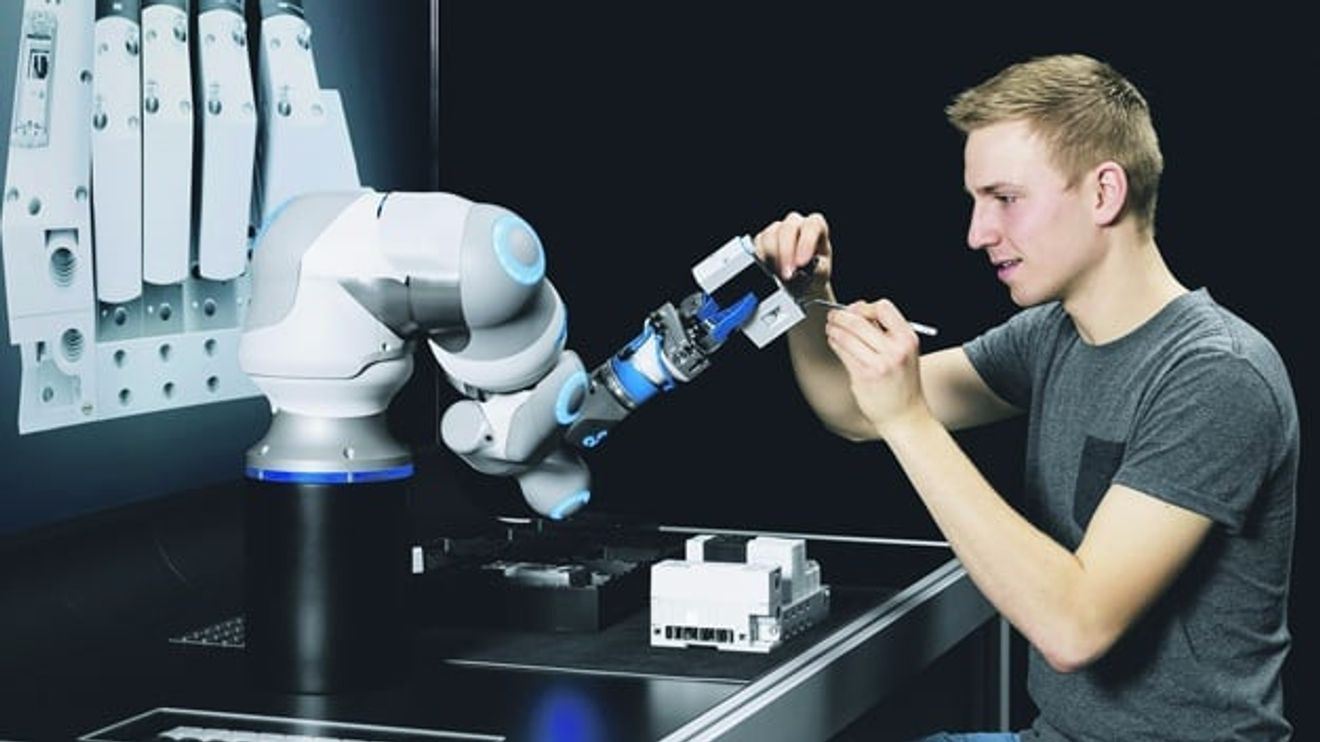
One of the projects is the Bionic-Cobot. This is a pneumatic lightweight robot with human movement dynamics. Due to its natural movement patterns and the compliant pneumatics used, this concept is virtually predestined for safe human-robot collaboration and is also a cost-effective alternative to classic robot concepts based on electric drives.
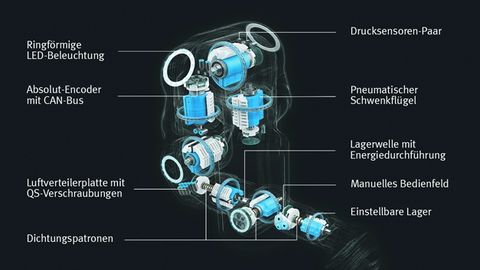
The movement of the BionicCobot is modeled on the human arm - from the shoulder to the upper arm, elbow, ulna and radius to the hand. It makes use of the natural mechanism of action of the biceps and triceps muscles, i.e. the efficient interaction of flexors and extensors. Whether gripping powerfully or picking up carefully, squeezing firmly or tapping gently - the interaction of opposing muscles is always necessary for us humans to be able to perform a movement. The developers have technically implemented this principle of agonist (player) and antagonist (opponent) in all seven joints of the BionicCobot. This enables it to perform very sensitive movements like its biological model.
Specifically, there are three axes in the shoulder area of the robotic arm, one each in the elbow and forearm and two axes in the wrist. Each axis contains a pivoting wing with two air chambers. These form a drive pair that can be continuously adjusted like a mechanical spring by filling it with compressed air. This drive concept allows the force potential and therefore the degree of rigidity of the robot arm to be precisely determined. In the event of a collision, the pneumatic arm yields automatically. According to Festo, this inherent flexibility and the low weight of the system allow it to be used without a protective cage, thus enabling direct and safe collaboration between man and machine.
The BionicCobot can be operated intuitively via a specially developed graphical user interface. Using a tablet, the user can easily teach the actions to be performed and sequence them as required. The open source platform ROS (Robot Operating System) is used to transfer the programmed motion sequences to the integrated motion terminal, which controls and regulates the kinematics. Depending on the task, different grippers can be connected to the BionicCobot.
Lightweight arm with twelve degrees of freedom
Another lightweight robot developed in the Bionic Learning Network is the BionicMotionRobot, which is also pneumatic. This imitates the flowing movements of an elephant's trunk or octopus tentacles with its flexible pneumatic bellows structure and corresponding valve and control technology. The concept of compliant kinematics is based on the Bionic Handling Assistant from 2010, for which the researchers were awarded the German Future Prize at the time.
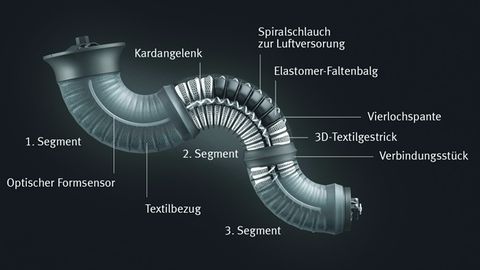
The arm of the BionicMotionRobot consists of a total of three flexible base segments, each of which is moved by four pneumatic bellows. The complex control and regulation of the twelve flexible bellows structures is also handled by a motion terminal. An optical shape sensor along the longitudinal axis of the system records the position, shape and interactions of the entire kinematics. This modular design allows the robot arm to perform three different directions of movement simultaneously.
The bellows are made of robust elastomer. Each one of them is covered with a special 3D textile knitted fabric, the function of which has an astonishing parallel to nature: similar to the muscle fibers in an octopus tentacle, its threads are oriented in such a way that they allow the bellows structures to expand in the desired direction of movement while simultaneously limiting them in the other directions. According to Festo, this innovative fiber technology allows the force potential of the entire kinematics to be exploited. Specifically, the bionic robot arm has a load-bearing capacity of just under three kilograms - with roughly the same dead weight. It is also operated intuitively or by teaching via its own graphical user interface. The defined work steps can then be lined up as required in a timeline using drag & drop. The entire motion sequence is virtually mapped and simulated at the same time.
Combination of frictional connection and vacuum
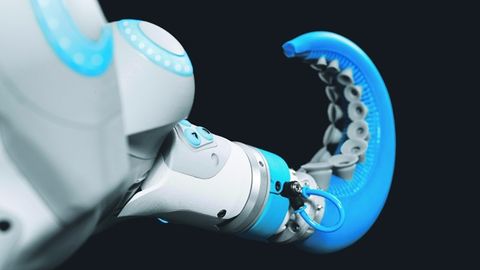
Thanks to its soft material, the artificial tentacle can not only grip gently and securely. It also meets the strict criteria of a soft robotic component.
© FestoFesto's third new project is the so-called OctopusGripper - a bionic gripper derived from the octopus tentacle. It consists of a soft silicone structure that can be controlled pneumatically. When it is filled with compressed air, the tentacle bends inwards and can wrap itself gently and positively around the object being gripped. As with its natural model, two rows of actively and passively controlled suction cups are attached to the inside of the silicone tentacle. This allows the innovative gripper to pick up and hold a variety of different shapes. Thanks in particular to its soft and flexible structure, the OctopusGripper has great potential for use in collaborative workspaces of the future.
Festo's new ideas for lightweight robotics are still concepts for the future. However, according to Dr. Elias Knubben, Head of the Corporate Bionic Projects department, the Esslingen-based company is planning to enter pilot projects at a very early stage and ultimately develop them into series products at some point.


You might also be interested in
Act economically
Festo presented new concepts at SPS IPC Drives 2017 - from handling systems and drives to a new automation system.
 read more...
First robot factory in Europe
On November 2, Yaskawa broke ground for its new robot factory in Europe in the Slovenian town of Kočevje. The first Motoman robots are to be manufactured there from 2018.
read more...Kuka plans to double production in China
Kuka, the Augsburg-based high-tech company acquired by the Chinese, plans to double its robot production in Shanghai. This was announced by CEO Till Reuter on October 27, 2017 during a conference call with journalists.
read more...VDMA raises growth forecast
The VDMA has raised its 2017 growth forecast for the German robotics and automation industry from 7% to 11%. This means that the sector's turnover is expected to break the record of 14 billion euros for the first time this year.
read more...Pneumatics makes technological leap
With Festo's 'Controlled Pneumatics' compressed air technology, the 'VTEP' proportional valve terminal achieves sensitive pressure control down to less than 1 mbar. According to the supplier, the technology also uses piezo valves to reduce...
read more...Autonomous flying in a swarm
The 'BionicBee' is an ultra-light flying object from Festo that can fly in large numbers and completely autonomously in a swarm. The BionicBee performed its first air show at the Hannover Messe 2024.
read more...Expansion in North and South America and India
After years of strong growth, 2023 was a year of consolidation for Festo. At around 3.65 billion euros (- 4.3%), turnover was just below the previous year's level
read more...Phoenix Contact at the Hannover Messe
Strategic technology partnership with Festo
Festo will use PLCnext Technology, the open ecosystem from Phoenix Contact, in future intelligent devices. In this way, both companies want to combine their innovative strength with the aim of taking industrial automation to a new level.
read more...E-Paper: HANNOVER MESSE DAILY Day 2
In today's issue, you can read about the tour of the trade fair by German Chancellor Olaf Scholz and the Prime Minister of the host country Norway, Jonas Gahr Støre, the partnership between Festo and Phoenix Contact and the demands of the...
read more...