

International Federation of Robotics
Western Europe leads in Robot Density
Robot density in industry continues to rise worldwide. Western Europe is ahead in an international comparison, followed by North America and Asia. New data from the International Federation of Robotics shows clear differences between regions and countries.
Industrial automation continues to increase worldwide. According to the latest data from the International Federation of Robotics (IFR), Western Europe reached a new high of 267 industrial robots per 10,000 employees in the manufacturing sector in 2024. This puts the region ahead of North America (204 units) and Asia (131 units).
"The robot density indicator relates the total number of robots used in a country to the number of employees as a measure of the respective economic performance and thus provides a good benchmark for comparison between economies of different sizes," says Takayuki Ito, President of the International Federation of Robotics.
Robot density in Europe on the rise
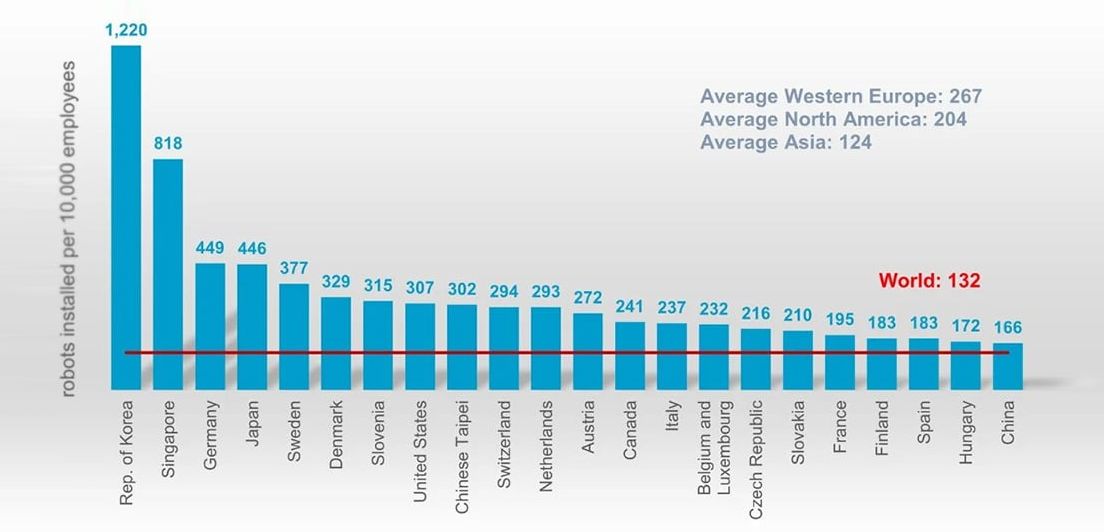
Within Europe, robot density increased by 3%. Eight Western European countries are among the top 20 nations worldwide, including Germany, Switzerland and the Netherlands. The EU-27 averages 231 robots per 10,000 employees, well above the global average of 132.
North America recorded an increase of 4%. The USA ranked eighth in the world with 307 units, while Canada had 241 and Mexico 62. Growth in Asia was significantly stronger at 11%. South Korea, Singapore, Japan and Taiwan are particularly highly automated.
Largest operating portfolio in China
China plays a special role within Asia. With 166 robots per 10,000 employees, the country ranks 22nd in the world, but was able to increase its robot density by 17% year-on-year. At the same time, China has the largest operational stock of industrial robots in the world: around 2 million units are in use. In 2024, China accounted for 54% of global installations, which corresponds to around 295,000 newly installed robots.
In a country comparison, South Korea leads the rankings with 1220 robots per 10,000 employees. It is followed by Singapore (818), Germany (449) and Japan (446). Other countries in the top 10 include Sweden, Denmark, the USA and Switzerland.


You might also be interested in
Aachen-based start-up transfers AI robotics to industrial applications
Many developments in the field of artificial intelligence have so far failed to be transferred from the research laboratory to industrial practice. The spin-off Athenyx Robotics from RWTH Aachen University aims to change this: The start-up is...
 read more...
Hanover Messe starts
Topics such as digitalization and sustainable production will shape Hannover Messe 2026, and a number of prizes will also be awarded during the trade fair.
read more...Strategic Cooperation between SEW-Eurodrive and Safelog
SEW-Eurodrive and Safelog announced a strategic partnership at Logimat to jointly develop and establish a powerful software system for controlling mobile and stationary processes in intralogistics.
read more...Rollout of more than 100 AI-controlled Robot Systems planned
Syncore (formerly known as Reesink Logistic Solutions) and Stuttgart-based AI robotics company Sereact are deepening their partnership. At Logimat, the companies signed a letter of intent to expand their partnership with the aim of introducing more...
read more...Modular Robot Hands for Industry
Schunk and DLR intensify Cooperation in Humanoid Robotics
Schunk and the German Aerospace Center (DLR) are expanding their collaboration in humanoid robotics. The aim is to improve the fine motor skills of humanoid robot hands for industrial applications and to translate research into practical solutions...
read more...New Solutions for Physical AI
NXP Semiconductors has introduced innovative robotics solutions for reliable, secure real-time data processing and transmission as well as advanced networking. These enable sensor fusion, machine vision and precise motor control.
read more...IFR presents Award Winners
To give women in the robotics industry more visibility and recognition, the International Federation of Robotics (IFR) has honored eleven women in 2026 who are shaping the future of robotics.
read more...Schaeffler expands its Global Partner Network
Motion Technology Company Schaeffler has agreed a partnership with Leju Robotics Technology, a Chinese technology company in the field of humanoid robotics. This is Schaeffler's first cooperation with a Chinese company.
read more...Exoskeleton: Strength to put on
Automation specialist Comau is expanding its portfolio of wearable robots with a new exoskeleton. The wearable system reduces muscle strain by up to 50 percent and is aimed at a wide range of applications in industry and SMEs.
read more...