

Beckhoff
Beckhoff relies on AI-supported engineering
Chatbots have been on everyone's lips since ChatGPT at the latest. Beckhoff also uses the technology in its TwinCAT XAE engineering environment.
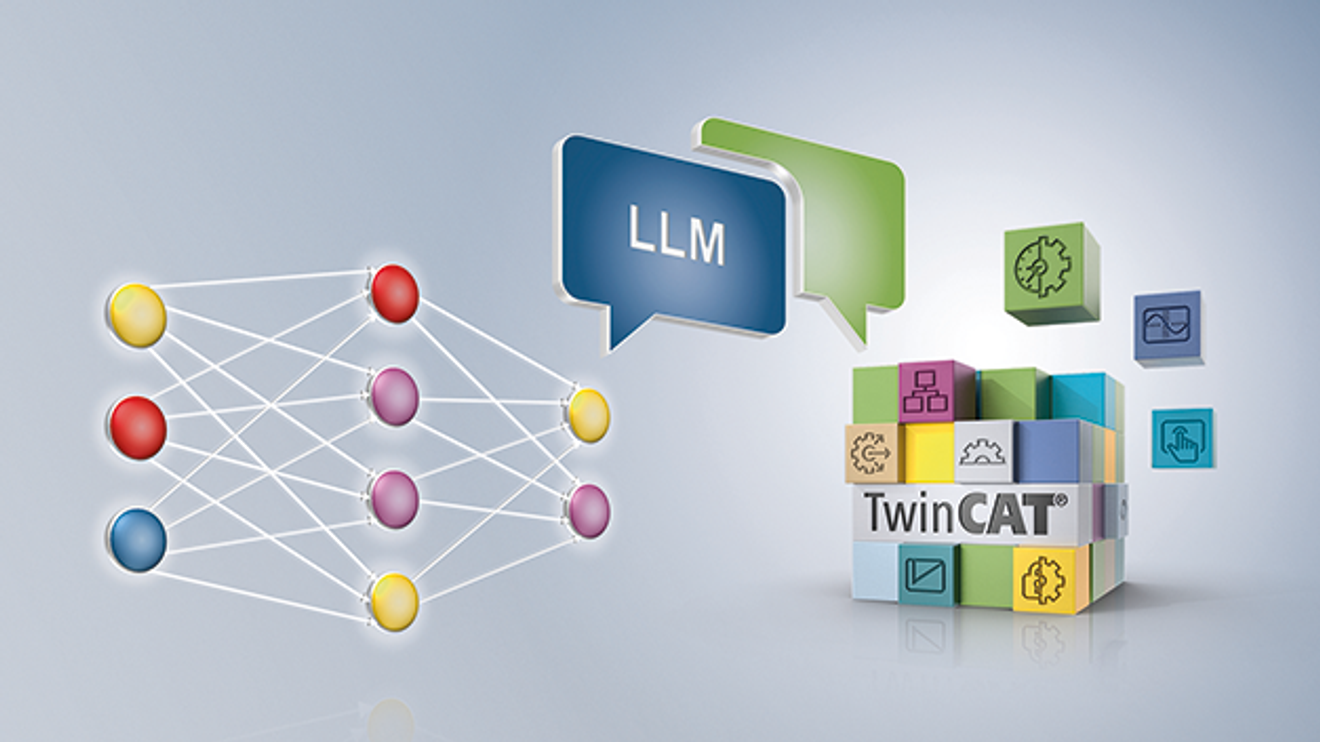
With the help of the TwinCAT Chat Client, chatbot technology can now also be used in the TwinCAT XAE engineering environment.
© BeckhoffBeckhoff wants to optimize control programming and is relying on chatbot technology to do so. The automation specialist has therefore developed the TwinCAT Chat Client for its TwinCAT XAE development environment. It allows so-called Large Language Models, LLM for short, to be used for the development of a project. LLMs are language models that have been created on the basis of a neural network and trained with a large number of texts. Among other things, they can write texts or generate source code. One of the best-known representatives is currently ChatGPT from OpenAI.
The TwinCAT Chat Client enables AI-supported engineering and automates, for example, the creation or addition of function block code or code optimization, documentation and refactoring. This client implemented in TwinCAT XAE establishes a connection to the host cloud of the respective LLM, for example Microsoft AzureTM in the case of ChatGPT. It also offers a user interface and an automation interface via which communication with the PLC development environment is provided. This is available via a corresponding chat window in Visual Studio, whereby the LLM functionality has been specially supplemented with TwinCAT-specific content.
Planar motor system can be controlled via several IPCs
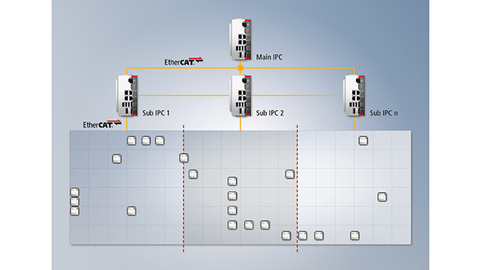
Modular design: The planar motor system can be expanded with the help of XPlanar Multi-Computing.
© BeckhoffThe XPlanar planar motor system has been on the market since 2018, and the modular system can now also be controlled via several industrial PCs. Multi-computing, which is available via a software update, enables the modularization of the entire system. This means that a larger number of tiles and movers can be realized per system.
If the overall system is divided into individual subsystems, each controlled by a sub-IPC, via multi-computing, computing-intensive tasks are distributed to the corresponding system segments. If the application requires movers to move across several segments, the communication required for the transfer takes place between two subsystems.
The so-called main IPC controls the flow of the entire system. It is also centrally responsible for application programming and diagnostics, i.e. for using the familiar functionalities of TwinCAT 3 XPlanar. Access from the application to the subordinate sub-IPCs is not required for this.
If required, new subsystems can be mechanically linked to the existing system. The subsystem is integrated via a program adaptation in the main PC.
EtherCAT at the Hannover Messe for the first time 20 years ago
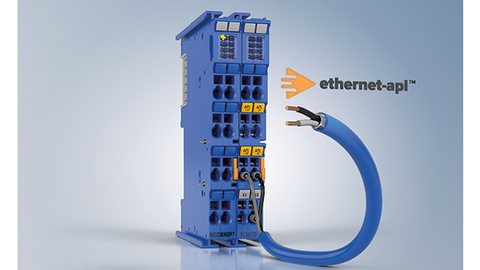
With the 2-channel communication interface 'ELX6233', Ethernet APL field devices can be integrated into the control architecture.
© Beckhoff20 years ago - also at the Hannover Messe - Beckhoff presented a communication system: EtherCAT. According to the company, the real-time Ethernet technology was developed so that the performance of the Ethernet PC interfaces available as standard in the early 2000s could have an optimal effect on machine automation.
To enable other communication protocols to be connected to the Beckhoff system, the automation specialist also offers various terminals. A new member is the ELX6233 EtherCAT Terminal for integrating Ethernet-APL into process control. It can be used to connect Ethernet APL field devices directly to the modular I/O system, even in hazardous areas of zones 0/20 and 1/21. This means that Ethernet APL, HART or simple digital signals can now be integrated into a terminal block. Other features of the terminal include expandability, an application-specific adaptable number of channels, a compact size and combinability with all EtherCAT Terminals and couplers.
The ELX6233 supplies the sensors in accordance with the SPAA (TS10186) port profile and integrates them into the system via Profinet. Two APL ports are available in the 24 mm terminal housing for this purpose. Data from connected sensors can thus be transferred to the controller and the higher-level process control system (DCS) via EtherCAT communication.


You might also be interested in
The chatbot as a teacher
The potential of text-based dialog systems is demonstrated by a free interactive online course from Münster University of Applied Sciences. A chatbot acts as a teacher to teach the basics of programming.
 read more...
OpenAI introduces next version of the technology behind ChatGPT
The text robot ChatGPT, which can imitate human speech, has been causing a stir for months. The technology that runs ChatGPT has just been given a major upgrade. However, the software's weaknesses and risks remain.
read more...The e-paper of issue 07/2024
Read in the current issue of Computer&Automation how ChatGPT can provide support in the conception phase, how LLMs are used in code analysis and whether TSN can be considered as a backbone for virtualized control systems.
read more...Consistent multicore and multitask support
Beckhoff relies on consistent multicore and multitask support in its current 'TwinCAT MC3' Motion Control generation. Thanks to its modular architecture, axes implemented with 'TwinCAT NC2' can also be seamlessly integrated.
read more...Consistent Multi-Core and Multitask Support
Beckhoff relies on consistent multicore and multitask support in its current 'TwinCAT MC3' Motion Control generation. Thanks to its modular architecture, axes implemented with 'TwinCAT NC2' can also be seamlessly integrated.
read more...Beckhoff simplifies AI training
An evolutionary development every year, a revolutionary leap every five to seven years - this is how Beckhoff aims to secure its technological leadership. At the press conference, the company from Verl also presented some technological highlights.
read more...AI training made easier
An evolutionary development every year, a revolutionary leap every five to seven years - this is how Beckhoff aims to secure its technological leadership. At Hannover Messe, the company from Verl also presented some technological highlights.
read more...HANNOVER MESSE DAILY Day 4
The top news from the fourth issue: Robert Habeck at the trade fair tour +++ Technological AI highlights from Beckhoff +++ Radar sensor technology in focus at Pepperl+Fuchs +++ ASi-5 counter module as an active distributor from Bihl+Wiedemann +++...
read more...These are your winners!
We put 96 products in twelve categories to your vote in December, and now the winners have been chosen! The trophies were presented at a 'Winner's Dinner' at the Seehaus in Munich. These are your "Products of the Year 2024"!
read more...