

SoftSelect
AI on the way to the ERP verse
The Hamburg-based IT market research and consulting firm SoftSelect summarizes the ERP trends that are driving the market and what companies should look out for when selecting suitable ERP software in the "ERP Software 2023" study.

Configuring an AI model for use in business applications requires the expertise of AI and data scientists, which, in the case of industry-specific use, requires training with industry-specific knowledge.
© NicoElNino/stock.adobe.comThe "ERP Software 2023" study sheds light on the arrival of artificial intelligence and, in particular, the arrival of ChatGPT in ERP software. While providers are massively advancing developments around the integration of AI tools, companies can soon look forward to new feature upgrades and AI integrations that will provide them with useful tools for optimizing data analytics, cloud migration, the entire customer journey and improving cost structures, among other things.
ChatGPT, the Multimodal Large Language Model from GPT-4, is already increasingly being used to support programming and code development, marketing or customer service to solve customer queries and problems. In addition, the integration of the chatbot into business applications and ERP systems - for which ChatGPT has provided an official API since March 2023 - offers a number of advantages. For example, one of ChatGPT's most important additions is its ability to understand and process natural language. This enables ERP systems to interact with users in a more intuitive way and understand complex requests in natural language rather than being limited to commands or abbreviations.
AI conquers ERP business applications
There are plenty of potential use cases for the application of ChatGPT in ERP solutions. In production planning and control, for example, it can help to optimize the planning of production orders by analyzing historical data, identifying production bottlenecks and suggesting optimal schedules to minimize delivery delays. In the area of quality management, the chatbot can help to analyze quality data from various sources and recognize patterns in order to identify quality problems at an early stage and initiate measures for improvement. In sales and customer service, ChatGPT can be used as a virtual assistant to answer frequent customer queries in real time, take orders and process customer concerns, resulting in better response times and greater efficiency in service processes. By integrating AI models such as ChatGPT into cloud data worlds, companies can also benefit from the vast data resources in the cloud while leveraging the capabilities of AI to query data in natural language, perform analytics and gain valuable real-time insights into complex business scenarios. This would enable companies to make data-driven decisions in a much more efficient and intuitive way than before.
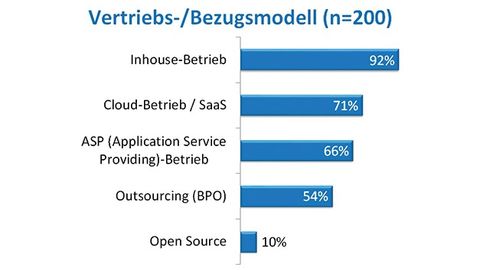
In the ERP sector, 71% of the 200 ERP solution providers surveyed offer SaaS operation from the cloud.
© SoftSelectAI models such as ChatGPT can be integrated in different ways. One option is to integrate ChatGPT as a virtual assistant or chatbot into the user interface of the ERP system. This allows users to interact with the system in a natural way, make requests, query data or perform actions. Alternatively, ChatGPT can also be integrated into the backend system to automate or optimize processes such as data analysis, forecasting or decision-making. However, the integration of ChatGPT into ERP systems requires comprehensive planning and implementation. It is important not only to consider the requirements and specific architecture of the ERP system, but also to design the integration in such a way that it can be seamlessly embedded into the existing software landscape.
Challenges of GPT integration
However, despite all the added value and benefits offered by the use and integration of ChatGPT in business applications, the limitations and risks associated with integration, especially in core business applications such as ERP systems, should also be highlighted. For example, ChatGPT is subject to language restrictions, as it can only work in the languages for which it has been explicitly trained. Data protection and data security raise important issues, as ChatGPT can sometimes access and process sensitive company data. Careful monitoring of access to data and ensuring data protection guidelines are therefore essential to minimize potential risks and avoid data breaches. As human validation is sometimes lacking, errors can also creep in, which can have unforeseeable consequences when integrated into the business process chain. The configuration of the AI model for use in business applications, many of which are not designed for AI and machine learning, can also be complex and requires appropriate expertise from AI and data scientists, which also requires training with industry-specific knowledge in the case of industry-specific use.
Guided workflows in ERP systems
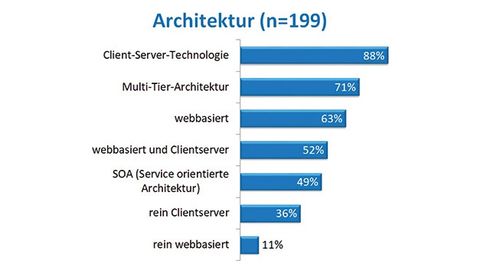
The underlying architecture of the ERP systems examined: 63% rely on a web-based software architecture.
© SoftSelectAccording to the industry association Bitkom, around two thirds of all users now also access ERP systems via a laptop, around half via a smartphone and a good quarter via a tablet. Mobile access to required information such as quotations, prices, orders, orders, stocks or delivery dates is of great importance for process quality. Compared to desktop PCs, however, the use of mobile devices requires very simple and intuitive operating routines. For this reason, more work is being done on the further development of fully mobile business applications and innovative operating concepts that better meet today's requirements for virtual workplaces. In particular, reducing the level of complexity and replacing overloaded information menus with intuitive, guided and responsive processes is a challenge that many ERP providers have to face.
Nevertheless, guided and context-sensitive processes in ERP applications will probably only be realistic in the coming years in encapsulated application areas and for self-contained processes. The splitting of the highly integrated ERP application into several native, role- and area-related apps has so far only been completed in some areas or is even still on the roadmap for most providers.
Integration of on-prem and cloud worlds
The use of hybrid platforms is also becoming increasingly important for more and more German companies. The combination of cloud and on-premise worlds enables companies to bridge existing data silos and create cross-system data lakes. However, the integration of cloud and on-premise solutions requires a lengthy transformation process that includes administration, data security and IT governance in addition to technical integration.
Most ERP solutions examined by SoftSelect can already be provided in the cloud/SaaS model (71%). The offering in the cloud segment is growing, particularly on the provider side. ERP providers have the key task of providing standardized interfaces for data and service platforms from the cloud, as industrial production is increasingly merging with digital processes and services. By linking various data sources with commercial and master data from the ERP system, companies not only improve data quality in the information network, but also create a foundation for controlling and automating workflows beyond the ERP core. Flexible workflow engines in ERP systems also enable companies to adapt their process organization more flexibly to new framework conditions, for example by using microservice architectures.


You might also be interested in
New services need a flexible cloud ERP
New megatrends are constantly challenging companies to change. This applies in particular to industrial topics such as automation and digitalization. These have an impact on a wide variety of areas and are bringing about fundamental innovations.
 read more...
Sustainability test bench for software applications
In the ECO:DIGIT project, the German Informatics Society, the Öko-Institut, the Open Source Business Alliance, Adesso and Siemens want to create a platform for evaluating the sustainability of software applications.
read more...Digital twin as an integration entity
The digital twin is an important component of the Industry 4.0 administration shell standard. However, the "Manufacturing-X" proof of concept for the Asset Administration Shell (AAS) is still pending. Proof of concept for IoT communication...
read more...ERP system for optimizing intralogistics
e.bootis-ERPII from e.bootis is an ERP solution with a focus on warehousing, which, according to the provider, can supplement or in many cases completely replace classic warehouse management systems (WMS).
read more...Embedded community votes for favorites
In addition to the coveted 'embedded award', the 'community choice award' will also be presented for the first time at embedded world. The special feature: The award winner is determined by the embedded community.
read more...Preview on embedded world 2024
Inference can be as Compute Intensive as the Training
With CPUs, GPUs and FPGAs, AMD has all architectures that are used for AI. embedded world Keynote Speaker Dr. Salil Raje shares his view on AI.
read more...International meeting places for the embedded community
From April 9 to 11, the embedded industry will meet in Nuremberg - but not only there, because embedded world will also take place in China and the USA in 2024. How did it go in China? What can we expect in Nuremberg? And a look ahead to the 1st...
read more...In focus: Artificial intelligence
The e-paper of the January 2024 issue
ChatGPT has given artificial intelligence a huge boost over the past year - especially in terms of public perception. In this issue, we want to take a closer look at AI and categorize it in more detail for potential industrial users.
read more...AI boosts the performance of software engineers
New "superpower" for software developers: An AI-supported programming assistant is set to revolutionize the development landscape.
read more...