

Edge Computing
Computer manufacturers show a clear edge
Is the cloud hype over? This year, providers are increasingly offering powerful systems at the "edge" of the network - so-called edge devices.
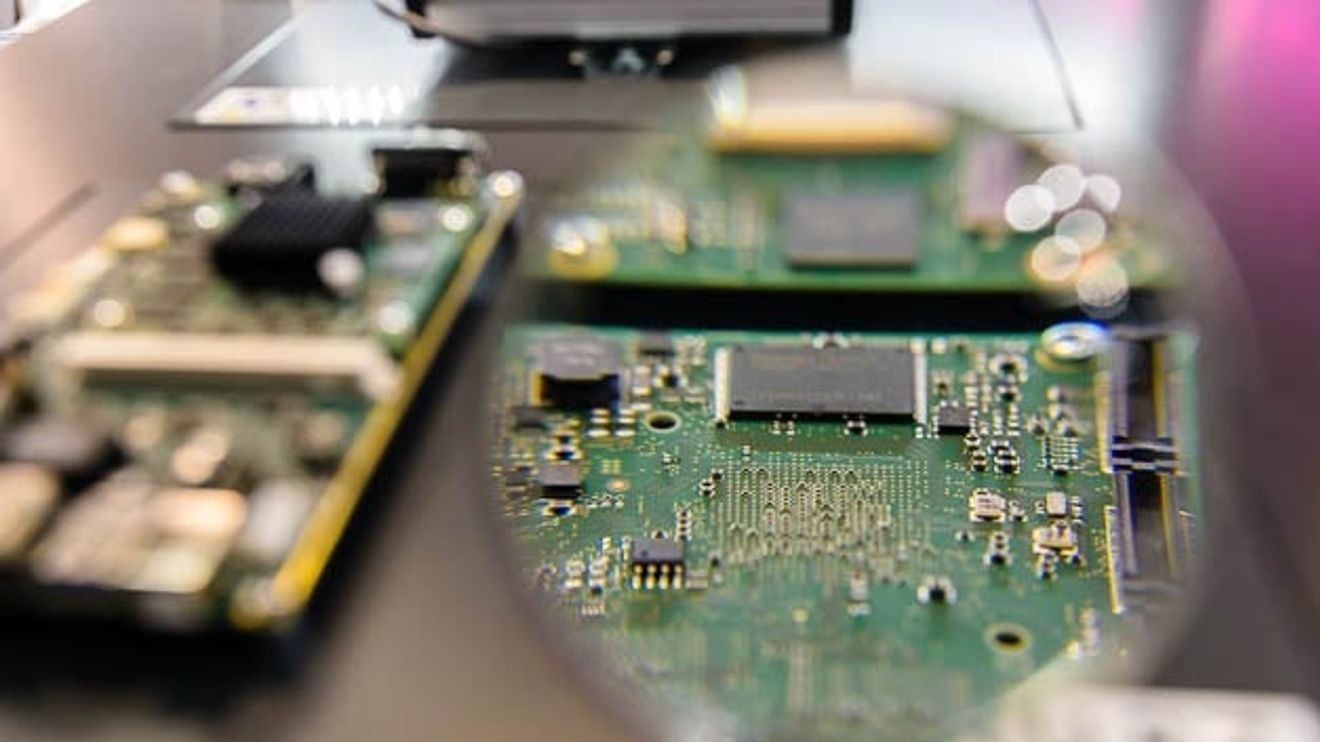
For years, the industry's mantra was: data in the cloud, where storage space is unlimited. This is not a problem for a location in a well-developed industrial area with fiber optic infrastructure, but with the triumph of the Internet of Things, there are more and more applications that rely on narrowband and unreliable wireless connections. Or the latency times for a data connection to the cloud are simply so long that the entire application is not technically or economically viable. In these cases, the data must be processed or at least pre-processed on site. The range of high-performance equipment available at the edge is growing all the time.
Fujitsu, the largest manufacturer of industrial x86 mainboards in Germany in terms of volume, has opted for a new board format: Mini-STX. At 140 × 147 mm2 , this board format offers around twice as much space as the compact NUC boards from Intel. Above all, however, the systems are easier to cool and the board is large enough to fit enough connectors.
Iesy and Congatec are also presenting an innovation with Mini-STX: a modular edge server with a base board in Mini-STX format. Instead of a permanently soldered processor, the board has a module slot for COM Express Type 7, allowing the system to "grow with the tasks" or be scaled in terms of performance. The system integration was done by iesy, the modules with Intel Atom or Xeon-D come from congatec
Adlink takes a more traditional approach and scales not only the computing power but also the housing size: from a compact gateway the size of a notebook to a full-blown but fanless embedded PC with PCI and PCI Express slots.
The industrial PC provider Plug-in Electronic is also presenting an interesting approach: a fanless embedded computing system with Intel C236 chipset and Nvidia Pascal graphics card. Thanks to the Pascal GPU, this system can be used for demanding image processing tasks or for parallel calculations such as AI-oriented applications, robot control and machine learning.


You might also be interested in
Edge computing at the embedded world 2018
At embedded world, board manufacturers will be showcasing powerful devices for edge computing.
 read more...
Focus on edge computing
Kontron is increasingly pushing the topic of edge computing. The company underlined this at embedded world with a cooperation with NXP and a new software platform.
read more...Kontron and NXP Semiconductors cooperate
Kontron and NXP Semiconductors want to work together on the development of Industry 4.0 solutions. To this end, NXP's ARM-based i.MX and Layerscape processors will be combined with Kontron and S&T's expertise in hardware and software.
read more...New products at embedded world 2018
From February 27 to March 1, 2018, the Nuremberg exhibition halls made room for everything to do with embedded systems technology. Computer&AUTOMATION presents a selection of new products that were on show at the stands of the 16th embedded...
read more...The little Mica sister
Harting sees itself as a "pioneer of digital transformation" and wants to set the tone in terms of edge computing and e-mobility at the Hannover Messe 2017.
read more...This is how powerful Linux container technology is
While data in smart factories needs to be collected, analyzed and made available in real time wherever possible, other priorities apply to distributed (M2M) applications - above all the handling of application data and the security of communication.
read more...Nine award categories for the first time
The embedded award recognizes outstanding innovations at the embedded world Exhibition&Conference. It is presented in nine specialist disciplines as part of a networking event on the first day of the trade fair.
read more...The knowledge hub of the embedded community
The embedded systems industry will meet from March 11 to 13. In seven exhibition halls, exhibitors in Nuremberg will provide information on hardware, software, services and tools. Two accompanying conferences, expert panels and exhibitor forums will...
read more...embedded world 2019 - Summary & outlook
Interview with trade fair director Benedikt Weyerer
What makes embedded world special? How did embedded world 2019 go and what is planned for the 2020 trade fair? Benedikt Weyerer from the trade fair organizer - Nürnberg Messe - in conversation with Ingo Kuss on the 'VIP stage'.
read more...