

Part 7 of the TSN series
Time synchronization
Precise time synchronization is essential for TSN networks and is achieved using 802.1AS. What are the basic mechanisms and what are the implementation options?
Time synchronization is a fundamental requirement for TSN-based networks. On the one hand, synchronized time is required for many TSN mechanisms such as the schedule-based sending of data according to 802.1Qbv. On the other hand, time is also required for the distributed applications implemented using TSN. In the simplest case, this can be the generation of a time stamp for measurement data or the high-precision synchronization of a physical application, for example that of several machine axes.
As different as the applications are, as different are their requirements for the accuracy of the synchronization: For a sensor for process monitoring, it may well be sufficient to ensure that it transmits in the first millisecond of a 10 ms cycle.
For highly dynamic axes of a precision machine, synchronization in the lower nanosecond range is required.
In TSN networks, the Precision Time Protocol (PTP) is used for this purpose, which is defined in IEEE 1588 and the IEEE 802.1AS standard based on it. PTP enables synchronization of all nodes in the network
with an accuracy of less than 1 μs.
Typically, however, the synchronization accuracy is significantly better, usually even below 50 ns.
PTP Basics
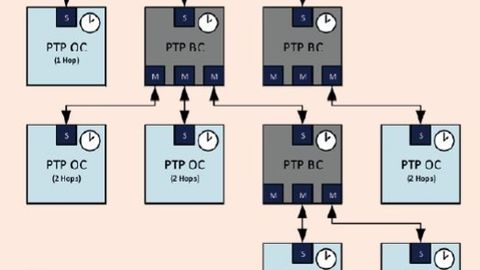
PTP builds a synchronization tree by exchanging 'announce' frames - the information about qualities and priorities of the respective node - and the best-master clock algorithm.
Ultimately, this results in a synchronization hierarchy (Figure 1) in which the time source - called the PTP grandmaster (GM) - is at the top and the time sinks - called PTP slaves (OC) - are at the bottom of the respective branch. The nodes in between are PTP-capable switches (PTP boundary clocks), each of which assumes the role of a time sink (PTP slave) on one port and the role of a time source (PTP master) on the other ports. This means that each PTP connection is a point-to-point connection in accordance with the 802.1AS standard.
Each PTP connection synchronizes the two end points, the slave and the master, according to the same principle. Both the phase between the two participants and the drift due to differing frequencies of the clocks are determined and compensated for.
In order to be able to compensate the phase, both the difference between the local clocks and the latency of the cable connection must be known. To do this, the latency (delay) between two PTP nodes is first determined using a mechanism based on so-called 'Peer Delay Messages' (P2P).
With the knowledge of the latency, the actual phase error (offset) can now be determined using time-stamped messages. Successive measurements are used to determine the frequency error - the drift. How the individual parameters - delay, phase error and drift - are determined is defined in the standard.
How the measured phase and frequency errors are compensated is not defined in the standard and is implementation-specific. This can be done abruptly or using sophisticated control algorithms.
The quality of the synchronization
The achievable accuracy depends heavily on the stability of the time source, the topology and the resulting number of hierarchies in the PTP synchronization tree. In addition, there is also the expected system-related error per node in the hierarchy (timestamp granularity, duration of stay, oscillator stability). And finally, of course, the accuracy depends on the implementation of the end node to be synchronized (timestamp granularity, filter and control parameters, oscillator stability).
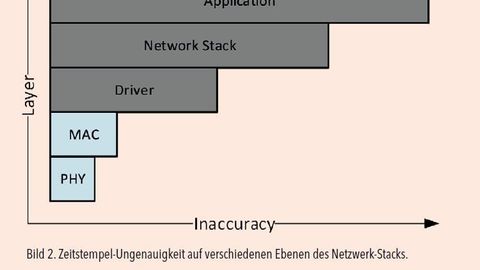
The synchronization hierarchy in Figure 1 shows that the achievable accuracy decreases with an increasing number of levels (hops) between the time source and time sink. This is mainly due to the timestamp accuracy in the individual hops and the calculations based on them, as well as the stability of the oscillators. In principle, PTP does not determine how a timestamp of a packet is taken, but it does determine when a timestamp is taken. This is exactly when the start-of-frame delimiter (SFD) leaves or reaches the cable at the respective node. How the corresponding time stamps are generated depends on the implementation. There are also different levels where timestamps can be taken (see Figure 2 above). In the lower levels, the time stamping takes place in hardware, in the upper levels in software.
Put simply, the higher the layer in the OSI model, the more error-prone the timestamp. Hardware support is necessary to achieve a synchronization accuracy of <1 μs. This also applies because the timestamp is only one of three crucial parts required for highly accurate synchronization and its benefits. The timestamps are ultimately based on a time, which must be adjusted accordingly in phase and frequency, which is the second crucial part: an adjustable clock.
The more accurately the clock can be regulated, the more accurate the time stamps and, accordingly, the more accurate the calculations of the new control parameters. In this context, however, the accuracy of the control also depends very much on the oscillator stability of the clock source for the clock. It is therefore useless if the frequency of the clock is controlled with a resolution of around 1 ppb (1 ns/s), but the clock source has a jitter of 10 ppm (10 μs/s).
Fortunately, many low-cost crystal oscillators with 50 ppm - at constant temperature and vibration - are also very frequency-stable (<10 ppb). The absolute frequency error is irrelevant here, as this can simply be regulated away. It is therefore purely a question of frequency stability. To achieve acceptable accuracy with less stable oscillators, the frame rate can be increased. This means that a node can readjust more often and drift less far away than at lower rates, but at the expense of the network load. The third and final crucial piece of the puzzle is the ability to use the high-precision clock. This involves either triggering time-controlled events (phases and cycles in TSN, synchronous sampling of ADCs, synchronous control of motors or OPC-UA frame triggers) or providing events with the high-precision clock with a time stamp (such as asynchronous events for central correlation). As with timestamps, the more hardware support, the more precise.
The implementation options
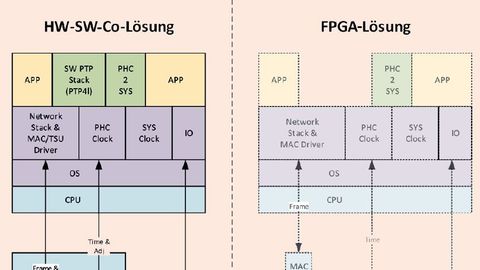
In principle, implementation is possible as a pure software, combined hardware-software or pure hardware solution. For endpoints that only perform non-time-critical tasks in a TSN network, for example a visualization or monitoring application, a software-only solution may be sufficient.
For TSN networks with the requirement of a synchronization accuracy <1 μs and thus the network infrastructure as well as the affected endpoints, there are de facto only two possible approaches (Figure 3): Software with hardware (SW-HW co-solution) or a pure hardware solution (FPGA solution).
The SW-HW co-solution
In a SW-HW co-solution, everything time-critical is usually solved in hardware and everything non-time-critical in software. A widespread example of this is the PTP solution with ptp4l. ptp4l is an open source protocol stack implementation for Linux according to IEEE 1588/IEEE 802.1AS. ptp4l handles everything to do with PTP frame sending/receiving, the protocol algorithms, including the evaluation of the time stamps and calculation of the control parameters for the clock. However, the actual time stamps come from dedicated hardware - for example network cards - which provide the time stamps via the socket API. In most cases, there is also a controllable clock on the same dedicated hardware - the time stamps come from a clock - which is addressed by ptp4l via the PHC API. This solves the problem of timestamps and adjustable clocks.
The point is that the high-precision time is now available on the network card, but apart from PTP it is actually useless there, except for the hardware-specific features, which are manufacturer-specific. This now requires ptp4l-specific tools (phc2sys), for example to track the system clock of the PTP clock (PHC clock) and generate synchronous events or take timestamps. This results in two additional sources of inaccuracy, firstly when synchronizing the system clock and secondly during event generation and time stamping, which can be very CPU load-dependent. In order to achieve high precision, a real-time OS is actually required here. In addition to ptp4l, there are other commercial PTP stacks which also support non-Linux systems, for example, and can then also be used on MCUs.
The hardware solution

A pure hardware solution can be realized, for example, by using FPGAs (Field Programmable Gate Arrays) and corresponding IP cores (NetTimeLogic's TSN or PTP OC IP cores). The idea is to move both the protocol component of PTP (frame sending/receiving, algorithms and calculations), which basically has no hard real-time requirement, and the real-time part (time stamping, clock adjustment) of PTP completely into hardware (FPGA cells). This results in something like a co-processor for time synchronization (or also for TSN), but without the need for a processor. Up to this point, there are still no differences to the SW-HW-Co solution when it comes to the accuracy of synchronization. The hardware solution is particularly interesting when it comes to generating synchronous events or time-stamping events based on the high-precision clock.
The IP cores provide a time that counts up with each clock cycle of the oscillator and is directly available. This means that events can be generated or time-stamped with a granularity of one clock cycle of the clock - for example 10 ns@100 MHz. On the one hand, this time is much more accurate than generating events via software and readjusted system time, and on the other hand it is also much more convenient, as the full parallelism of the FPGA means that several events and timestamps can be processed simultaneously without any loss of accuracy. This not only has advantages and an FPGA-based solution requires an FPGA, which can be an additional cost factor, but the system can also run without a CPU.

FPGA-based solutions are already very often used in connection with TSN. On the one hand, because this close connection to the synchronous clock is required and many other parts of TSN also have hard real-time requirements (e.g. scheduling), but above all because time-controlled data sources and data sinks need to be addressed. As a result, it is often the case that an FPGA is already available, making such a solution ideal. In addition, TSN is still a 'moving target' in terms of new features and standards. This of course speaks in favor of the flexibility of an FPGA solution.
When the two approaches are compared, the following advantages and disadvantages can be summarized:
There are therefore advantages and disadvantages to each approach and both have their raison d'être. In practice, it is important to first analyze the requirements and framework conditions for each system and then select the appropriate approach. In conclusion, however, it can be said that PTP is the perfect choice as the basic technology for TSN thanks to its simplicity and accuracy of less than one microsecond.
Even though there are different approaches for PTP - HW-SW co-solution versus FPGA solution - the overall system must always be considered first and the requirements for synchronization accuracy must be clarified. This usually results in the most suitable and often most economical solution, which fulfills the requirements but does not necessarily exceed them by a factor. Due to the widespread use of PTP in industry today, TSN has a good basis for establishing itself in industry as the convergent network technology of the future.
Overview: IEC 61156 standards for single pair Ethernet cables.
| HW-SW co-solution | FPGA solution | |
|---|---|---|
| CPU required | Yes | optional (configuration or additional data traffic) |
| TSU and Clock HW required | Yes | Yes (is part of the PTP IP in the FPGA) |
| OS & driver required | Yes | optional (MAC driver) |
| Software stack required | Yes | No |
| IP core required | No | Yes |
| Integration effort | Medium (to high if driver not available) | Low |
| Synchronization stability | Depends on the filter and control parameters set by the user | like HW-SW |
| Necessary components (CPU, PHY etc.) | Many | Few |
| Complexity HW | low-medium | medium-high |
| Complexity SW | medium-high | none-low |
| Accuracy PTP | Depends on the timestamp accuracy and precision of the controllability of the clock for the respective implementation | like HW-SW |
| Accuracy Event Generator | - - | + + |
| Accuracy Event Timestamper | - - | + + |
| Costs PTP stack | none (open source) € € (commercial stacks) | € € |
| Costs HW | € (existing HW supports PTP) - € € (dedicated HW) | € (existing HW has an FPGA) - € € (dedicated FPGA) |
| Expandability | limited | very flexible |
| Security (e.g. DOS attack) | - - | + + |
| Robustness | - | + |
| Certifiability | - (entire system must be certified incl. OS) | + (only FPGA must be certified, which which goes under HW |


You might also be interested in
From the sensor to the cloud
OPC UA is set to become the globally recognized standard for the Industrial Internet of Things. During SPS Connect, Stefan Hoppe, President of the OPC Foundation, commented on the status quo of the work.
 read more...
A TSN starter package
A starter package for setting up, configuring and testing TSN networks. TTTech is now launching it.
read more...The key role of configuration
Time Sensitive Networking is gaining ground in convergent networks with critical applications and strict time requirements. But what needs to be considered in network planning? And why does configuration play a key role?
read more...Embedded community votes for favorites
In addition to the coveted 'embedded award', the 'community choice award' will also be presented for the first time at embedded world. The special feature: The award winner is determined by the embedded community.
read more...Preview on embedded world 2024
Inference can be as Compute Intensive as the Training
With CPUs, GPUs and FPGAs, AMD has all architectures that are used for AI. embedded world Keynote Speaker Dr. Salil Raje shares his view on AI.
read more...International meeting places for the embedded community
From April 9 to 11, the embedded industry will meet in Nuremberg - but not only there, because embedded world will also take place in China and the USA in 2024. How did it go in China? What can we expect in Nuremberg? And a look ahead to the 1st...
read more...In focus: Artificial intelligence
The e-paper of the January 2024 issue
ChatGPT has given artificial intelligence a huge boost over the past year - especially in terms of public perception. In this issue, we want to take a closer look at AI and categorize it in more detail for potential industrial users.
read more...AI boosts the performance of software engineers
New "superpower" for software developers: An AI-supported programming assistant is set to revolutionize the development landscape.
read more...ERP trend forecast for 2024
Unit4 forecasts the most important ERP trends for the year 2024. Claus Jepsen, Chief Product and Technology Officer, names nine points that he considers relevant.
read more...