

Belden - SPE - Part 4
SPE - The cost and benefit aspects
Single Pair Ethernet is a technological extension of the Ethernet standard with a lightweight two-wire connection solution. But where can its use actually be expected for economic reasons? What hurdles still need to be overcome?
Part 1 of the four-part series showed that the adoption of Single-Pair Ethernet (SPE) will be different for different market segments and their applications in terms of speed and penetration. Parts 2 and 3 focused on the feature of seamless communication in Ethernet-based networks. These articles highlighted specific benefits for different stakeholders when designing industrial communication with Ethernet. This fourth part examines where SPE can be expected to complement Ethernet networks down to the sensor/actuator level for economic reasons and looks at the obstacles that need to be overcome in order for manufacturers of active infrastructure components (switches, routers) and end devices (sensors, actuators) to significantly expand their SPE portfolios and thus support the establishment of the technology.
The cost/benefit analysis
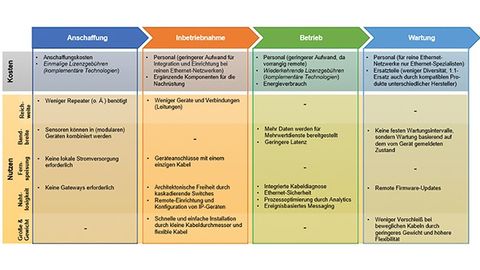
In current discussions, when comparing the costs of implementing a network section with SPE and a conventional implementation based on a fieldbus or serial interfaces, it is often only the acquisition costs that play a role. Costs and benefits for later life cycle phases such as commissioning, operation and maintenance are rarely part of these considerations. Especially when calculating device costs, prices for Ethernet transceivers and additional circuitry (magnetics) are often compared with the prices for simple RS485 or even RS232 interfaces.
>> Read part 1 of the article series
The authors recommend a more detailed consideration of all phases of the installation life cycle, i.e. the total cost of ownership. For this purpose, all costs and benefits for the respective application and complementary technologies for the higher layers are included in accordance with the statements from parts 1 to 3 of this series. Figure 1 shows an attempt at a general representation of this approach. The four phases of acquisition, commissioning, operation and maintenance are considered. During commissioning, a distinction can be made between installation (hardware) and setup (software). The first line contains the costs for the phases, with license costs for complementary technologies shown in italics. The following rows assign the core features of SPE to their phase-related benefits.
The SPE option for the sensor/actuator level
The results of cost-benefit analyses for the entire life cycle allow the classification of sensors shown in Figure 2 with regard to their SPE adoption probability:
- Analog sensors, whose currents (4-20 mA) or voltages (0-10 V) are proportional to the measured variables such as pressures or temperatures and which are converted into digital signals in analog I/O modules and packaged in Ethernet frames, will not or rarely be equipped with SPE due to the low benefit-to-cost ratio.
- Simple digital sensors, where the conversion of the measured variable into a digital signal takes place in the sensor and which are coupled to an Ethernet network via digital I/O modules, will integrate SPE to a small extent in order to take advantage of the consistent implementation of Ethernet. Moving the Ethernet transceiver from the I/O module into the sensors is particularly useful for applications with a small number of sensors or large distances between them.
- Intelligent digital sensors connected via fieldbuses or serial interfaces benefit from the higher bandwidth offered by SPE and especially from security features available for Ethernet. A significant level of SPE adoption can be expected for such sensors.
- Today, intelligent sensors with high bandwidth requirements are already connected via Ethernet systems, such as cameras that require a native bandwidth of 1.6 Mbit/s to 4.3 Mbit/s - depending on the video quality - with a standard codec (H.264) at a resolution of 2 MP and a frame rate of 20 f/s. This bandwidth requirement increases with the addition of SPE. This bandwidth requirement increases with the additional transmission of vital data, which enables value-added services such as predictive maintenance. It is not only because of this need that SPE is most likely to be adopted here, but also specifically because of the long ranges of 10BASE-T1L and 100BASE-T1L (the current IEEE 802.3dg project aims for 100 Mbit/s over 500 m) and remote power supply via PoDL/SPoE.
A frequently held discussion concerns the question of whether it makes sense to make digital sensors that are integrated into a machine or robot by the manufacturer visible outside this environment via Ethernet or - on the contrary - to conceal them from access in the sense of encapsulation. For an answer to this question, please refer to the roles introduced in Part 2: The internal implementation is irrelevant for the operation of the machine or robot, but its visibility can be helpful for diagnostic and maintenance purposes.
Barriers to SPE adoption
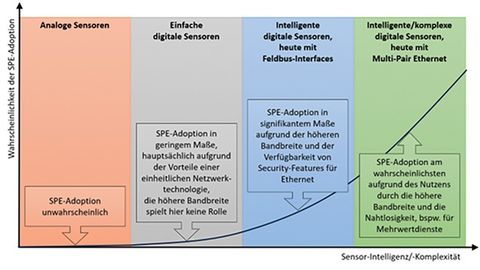
Figure 2: The SPE adoption probability: The cost-benefit analysis for the different sensors over the entire life cycle allows a well-founded classification.
© BeldenBut what is actually standing in the way of rapid SPE adoption? Firstly, there are various standards for the physical transmission layer with different bandwidths, cable lengths and topologies in order to meet the diverse requirements of the relevant target markets. Added to this is the variance in industry protocols for the higher layers and the diversity of connectors. This variance and diversity are due on the one hand to the coexistence and optional application of different standards. In addition, the various application areas and their different requirements in terms of impermeability to dust and moisture, resistance to chemical substances and robustness against mechanical stress and electromagnetic influences contribute to the diversity of SPE solution scenarios.
>> Read part 2 of the article series
It is to be expected that manufacturers of active infrastructure components and end devices will deal with the complexity resulting from the number of possible combinations of requirements by only covering a selection of applications for which the cost/benefit ratio is economically viable. This approach is likely to lead to slower overall adoption of SPE technology. Possible solutions here are early standardization and the definition of an industry on common standards by specifying profiles as described in Part 3 of the series.
In addition to these interoperability requirements relevant to system integration, manufacturers of infrastructure components face the additional challenge that available electronic components have been developed for end devices or automotive applications - also from an economic point of view - and their implementation therefore requires additional effort. A prominent example of this is the tentative provision of suitable switch and multi-port transceiver (PHY) chips for SPE by semiconductor manufacturers: for example, it is currently necessary to connect switch and single-port PHY chips using the medium-independent interfaces RGMII, RMII or MII. These interfaces with their high number of signals, as well as the use of single-port PHY chips, lead to greater complexity in the routing of signals on the PCB and an increased space requirement. While modern interfaces such as SGMII require four signals per port, 16 signals are required for an MII interface and eight signals for an RMII interface. In addition, the MDIO and MDC management interfaces are required for each single-port PHY chip.
SPE multi-port PHY chips with suitable media-independent interfaces such as SGMII or QSGMII are not currently available. Specifically for 10BASE-T1L, these interfaces, which are designed for gigabit operation, are not initially the focus of semiconductor manufacturers. On the other hand, the development of switch ASICSs is being driven by increasing bandwidth requirements and, as a result, corresponding MAC-PHY interfaces with multi-gigabit bandwidths are being optimized. This means that additional chips for protocol conversion must be implemented to overcome the incompatibility of the interfaces. This increases the costs for product development as well as the prices for SPE field switches, which fundamentally calls into question the profitability of these solutions.
>> Read part 3 of the article series
Despite the long history of standardization at IEEE, SPE is still a relatively young technology that will prove itself in more complex and intelligent sensors. As components and hardware become available, SPE will make inroads into the lower cost sensor segments and provide harmonization of network components.


You might also be interested in
Management of Industrial Edge devices and data
Belden, a provider of specialized solutions for network technology, is launching the industrial edge solution 'Belden Horizon'.
 read more...
Belden takes over NetModule
The network technology provider Belden has acquired NetModule, thereby expanding its expertise in the wireless sector.
read more...Rockwell Automation joins the "shapers"
Rockwell Automation is now joining the "Shaper" group of companies to develop a communication solution for real-time and sensor-to-cloud applications in the industrial environment.
read more...Wika takes over Hirschmann MCS
The Wika Group acquired Hirschmann Mobile Machine Control Solutions (MCS) from the US company Belden on January 1, 2018.
read more...News from the security sector
Cyber security will be far more important in industry in the future than it has been in the past. Computer&AUTOMATION has compiled a series of images showing which hardware and software solutions companies can use to protect themselves against...
read more...Michael Riester takes over management of OI4
The Open Industry 4.0 Alliance (OI4 Alliance) is reorganizing its leadership. Michael Riester will take over the position of Managing Director from July 2026. His predecessor Ekrem Yigitdöl is leaving the organization at his own request.
read more...Schaeffler expands its Defense division
Celia Pelaz becomes CEO of STech Defense
Schaeffler is making new appointments to the management of its subsidiary STech Defence GmbH. Celia Pelaz will take over the position of CEO "Defence & New Space" on October 1, 2026 and will manage the business of the Munich-based company.
read more...Flexible analog mix module
The analog mix module 'AM 821' from Sigmatek's S-DIAS series has eight analog differential inputs with 16-bit resolution and two analog outputs.
read more...Ionos and Q.ANT cooperate on AI
Ionos and Q.ANT want to jointly advance photonic processor technologies for AI and high-performance computers. The aim of the partnership is to build energy-efficient and sovereign AI infrastructures in Europe.
read more...