

followed up! - with Christoph Müller
IoT - from a beacon of hope to a disaster?
Everyone is talking about the Industrial Internet of Things. But how is it being implemented? Are there new business models? Was or is the hype justified? An assessment by Christoph Müller, NXTGN Solutions.
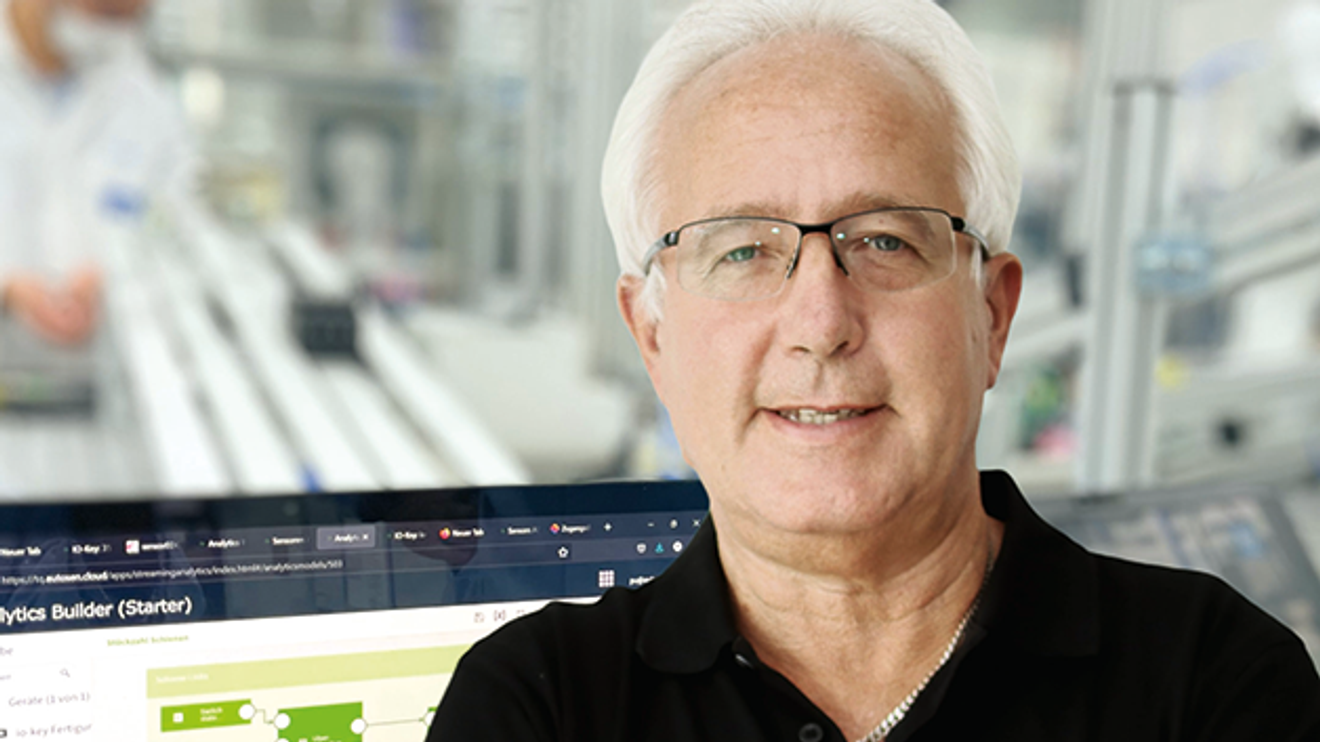
Mr. Müller, you have been involved in IIoT sales since 2006. What was your basic motivation for tackling the topic back then?
At that time, we at Exor were very euphoric about it - even if we were still using the acronyms M2M and Remote Service. We had a business model for a virtual power plant with which we could earn a lot of money in 2006. And so we were optimistic that we would be able to realize further applications that were just as lucrative. We were sure that everyone would want something like this in a few years' time. And the technology was there and it worked. What could possibly go wrong? I went 'all in' with Exor back then and threw myself fully into this topic - unfortunately with moderate success. There were then many other projects, but none of them ever scaled.
How would you rate the topic today in terms of business success for automation providers?
Homeopathically! I don't know of anyone who has achieved any significant success that lives up to the IoT claim. Across the industry, we assumed six-figure achievable quantities. Many companies have invested huge sums in the technology: Siemens in Mindshere, Samsung in Artik Cloud, Conrad Electronic in its IoT offering, Beck-IPC and HMS in the Kolibri portal. However, exponential growth has so far failed to materialize for all of them.
What obstacles to commercial success do you see?
For a long time, I thought it was because the technology was too complex. But it's not the technology: we simply still think in linear terms, i.e. like in the 90s: taking a shower without getting wet is and remains difficult! Let's be honest: much of what we propagate today under IoT is old wine in new bottles - we are usually miles away from 'new disruptive approaches'. What's more, the added value of existing IoT solutions, especially in factory automation, is generally not high enough to attract sufficient attention at decision-maker level. Who needs IoT in their factory when everything is running smoothly and sales and profits are increasing? How often does a motor on a machine really fail unexpectedly?
How could automation companies approach the topic in a more promising way?
I think the key to success lies in convergent technologies. Just as Apple shook up a wide range of industries with the iPhone, it will be virtual approaches in automation that pave the way for the IoT in the future. Take the latest example of the virtual PLC: newcomers such as Logiccloud, but also the top dog Siemens, are now implementing the PLC in the cloud. In other words, the controller merges with other technologies in the cloud and also replaces a lot of hardware in the field. This releases enormous rationalization potential in hardware, but also in terms of maintenance, and therefore has an enormously disruptive effect. IIoT technology is participating as a free rider.
The IIoT is therefore not dead, but is merely going through a disillusionment phase after the initial hype. But one thing must also be clear to us: Customers are not just looking for a gateway and a fancy dashboard, they need a partner who can help them from the sensor to the implementation of the business model, or who can also support them in the development of business model innovations.
| About the person |
|---|
| Christoph Müller was Co-Founder and CEO at Unitronic from 1993-95, then Co-Founder and CEO at Exor Germany from 1995-2014, Business Development IoT at Beck IPC from 2015-2020, Business Development Manager at TQ Systems from 2020-2021, Business Development Manager IIoT at Autosen from 2021-2023 and has been CRO for IoT at NXTGN Solutions since April 2023. |


You might also be interested in
Check with Prof. Dr. Peter Fromm
Regularly slowed down
The embedded industry is struggling with a shortage of components and skilled workers. Prof. Dr. Peter Fromm from Darmstadt University of Applied Sciences knows that the latter is now the bigger problem. In this interview, he explains what logistics...
 read more...
Follow up with Stefan Messerkliger, B&R
"The same mistakes!"
In industrial manufacturing, OPC UA is regarded as the data exchange format of the future. In the world of mobile machinery, such an agreement is still missing. Stefan Messerklinger calls for OPC UA to be introduced in this sector too.
read more...Check with Michael Blass, Igus
The plastic recycler
Igus launched the 'green chainge recycling program' at the end of 2019. Michael Blass reveals how this recycling program for plastic energy chains and drag chains has proven its worth.
read more...These are your winners!
We put 96 products in twelve categories to your vote in December, and now the winners have been chosen! The trophies were presented at a 'Winner's Dinner' at the Seehaus in Munich. These are your "Products of the Year 2024"!
read more...Embedded Computing & IPC - The winners
A 'classic', a 'scene product' and a 'pragmatic approach' convinced the readers of Computer&Automation in the 'Embedded Computing & IPC' category.
read more...The e-paper special: looking for products of the year 2024
They've earned it: all 96 nominated products from 12 categories in their own e-paper. Browse through the individual areas and make your personal selection. You can also find out more about the companies and their solutions in the accompanying video...
read more...A pragmatic IIoT approach
Until now, many users were not prepared to invest in IIoT - business was going very well as it was. The need for demonstrable sustainability is now changing the motivational situation.
read more...In focus: Connection technology
The e-paper of issue 07/23
Communication and networking is the central theme of the current issue: first insights into the program of the TSN/A-Conference 2023, the cover story is all about SPE at field level and the "Digital Twin" series deals with the digital twin as an...
read more...Federation Architecture | Part 3
Toward an Industrial-Grade AI for OT
Operational Technology (OT) controls physical processes and therefore operates under preventive and deterministic constraints. Modern AI, by contrast, is probabilistic and improves through iterative learning. Reconciling these paradigms remains a...
read more...