

Phoenix Contact Electronics
AI - Paving the way for TSN?
What requirements does the use of AI place on automation and networking? Do the mechanisms of Time Sensitive Networks in combination with Profinet perhaps form the optimal architecture for AI applications?

In combination with Profinet, Time Sensitive Networks (TSN) can be a game changer in automation. However, the following questions need to be answered: What new applications and solutions are made possible? How do TSN standards contribute to this? What does the migration look like? And what will happen to the technology in the future?
New technologies always prove successful when they make new applications with major advantages feasible. One of these new applications is the use of artificial intelligence in automation. Usable computing power and tools that can be used for machine learning, image recognition or data mining, for example, are becoming ever cheaper and easier to use. ChatGPT is a good example of this. This development is expected to continue at a rapid pace.
What requirements does the use of AI therefore place on automation and networking? The following points need to be considered:
- Large amounts of data must be transported from the field to the AI.
- The result of the AI operation affects the process to be controlled.
- High-precision time synchronization is essential for processing and evaluating distributed data from the field level.
A concept in which all these requirements can be fulfilled in a single network is ideal. Profinet provides the solution with TSN.
The status quo

The requirements described are now usually implemented in separate networks (Fig. 1). One example is a camera application for optical anomaly detection using AI tools. At least a gigabit infrastructure is required for this purpose. However, currently common fieldbus systems are often only based on a transmission rate of 100 MBit/s and therefore cannot be used to transport this amount of data. High-precision time synchronization is also not currently available in IT networks and systems such as Profinet RT. For this reason, separate networks are often installed for the respective purpose. The advantage of separation is that, in principle, there is no negative influence of IT communication on real-time capability. On the other hand, there are disadvantages such as the effort and costs involved in installing, maintaining and commissioning separate systems for fieldbus, IT and synchronization. In addition, future extensions or changes - such as the subsequent installation of new devices - cannot be implemented or can only be implemented at great expense.
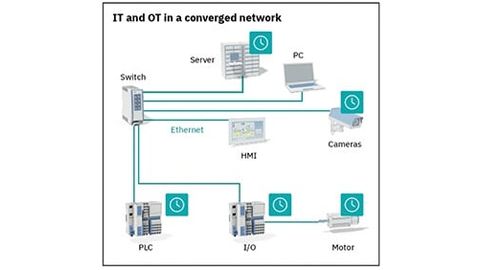
This example shows that there is considerable potential for improvement in combining all the necessary functions in a single network. This is usually referred to as a "convergent network" (Fig. 2). It is particularly important that the disciplines of the IT and OT worlds do not influence each other in a shared network. To ensure this, a number of optimizations must be made in Ethernet itself, collectively referred to as Time-Sensitive Networks (TSN).
TSN: Toolbox for special purposes

Figure 3: TSN is not a single standard, but a toolbox of mechanisms that make a shared network possible.
© Phoenix ContactIt is essential to understand that there is no single mechanism or standard behind TSN. Rather, TSN can be compared to a toolbox containing several tools. Each of these tools serves a specific purpose. The full benefits of a convergent network only unfold when all the tools work together correctly(Fig. 3). A brief explanation of the tools is provided here:
- Quality of Service (QoS): QoS is a well-known concept. Each telegram received at a switch, for example, is sorted into separate memory areas (so-called queues) based on an integrated priority field (VLAN priority), which are reused when sending according to their priority. QoS ensures that real-time critical traffic is not disturbed by other communication and is therefore the most important tool.
- Pre-emption: Another problem that can occur in a convergent network is the delay of real-time critical telegrams due to long TCP/IP telegrams. Pre-emption solves the problem by interrupting a long low-priority packet immediately when a high-priority packet is to be transmitted. The remainder of the low-priority packet still to be sent is saved and continued later. Pre-emption ensures that the variance of data forwarding at 1 GBit/s is reduced to around 1 µs - regardless of the telegram size.
- Precision Time Protocol (PTP, IEEE 802.1AS):Many applications in combination with artificial intelligence (AI) require high-precision time synchronization. However, the common synchronization protocol NTP (Network Time Protocol) is no longer sufficient. Synchronization accuracies in the µs range can be achieved using PTP because the runtimes on the lines and in the switches are measured and compensated.
- Synchronous communication: High-precision time synchronization via PTP also enables the synchronization of communication and applications in the devices involved. Without such synchronization, it is possible for the so-called terminal-to-terminal response time to vary over a wide range, as a cycle can always be missed on the way from the input to the output. Synchronous communication eliminates this.
- Brownfield integration: The use of the tools described requires new hardware in all devices involved. Therefore, TSN will initially only be introduced where there is a significant advantage. A smooth transition from Profinet RT to Profinet with TSN is feasible by using any existing Profinet device at the "boundaries" of a TSN area. In this way, investments in devices and know-how can be safeguarded.
With Profinet with TSN, the tools listed are used in a sensible combination. This results in advantages without changing the look and feel.
Areas of application for Profinet with TSN

The benefits of Profinet with TSN can be illustrated using the example of optical anomaly detection (see box and image). There are also other applications, such as vibration data for predictive maintenance, 3D images via synchronized cameras, frequency synchronization in feed-in and load management of alternative energy generators, highly accurate time stamps in alarm messages to track a sequence or simply the update of large amounts of data during operation.

The author: Gunnar Lessmann is Master Specialist Profinet and TSN in the Automation Systems business unit at Phoenix Contact Electronics.
© Phoenix ContactAll applications in which a shared network with time synchronization promises added value are conceivable. The tools described can be used for Profinet communication between controllers and field devices without changing the application view of Profinet. In many applications, data is not only exchanged between controllers and field devices, but also between different controllers. In this case, OPC UA with pub/sub communication is more suitable. The OPC Foundation is therefore working on a usage concept for TSN as part of its work on OPC UA Field Exchange. The aim is the joint use of Profinet, OPC UA and IT data in a convergent network.
| AI application: Anomaly detection |
|---|
|
The advantages of TSN can be explained in concrete terms using the application example of optical anomaly detection. Optical quality control is to be integrated into a continuous production process for products. Several cameras are used for this purpose, which are located above the passing products and whose image capture is synchronized to a production product. Due to the production speed, one camera alone cannot capture a sharp product image. An AI application located on an edge PC, for example, reads the individual images, compiles them into a complete product image based on the time stamps and compares this image with a learned standard. If this deviates from the standard, the affected component is sorted out in a later step (see image on the right).
All of this can be implemented in a single network. Future expansions are also possible, as any ports can be used for new devices. |


You might also be interested in
First TSN Certification Program
AVNU's TSN certification program is the first of its kind to certify Time Sensitive Networking (TSN) capabilities, specifically the 802.1 TSN standards developed by IEEE SA.
 read more...
First TSN certification program
AVNU's TSN certification program is the first of its kind to certify Time Sensitive Networking (TSN) capabilities, specifically the 802.1 TSN standards developed by IEEE SA.
read more...First TSN certification program
AVNU's TSN certification program is the first of its kind to certify Time Sensitive Networking (TSN) capabilities, specifically the 802.1 TSN standards developed by IEEE SA.
read more...Industrial Ethernet dominates
Every year, HMS Networks conducts a market analysis of industrial networks. The latest study shows that the market for industrial networks is continuing to expand, with expected growth of 7% in 2024.
read more...A resource-based approach
The added value of TSN results primarily from IT/OT convergence in the end points. Exploiting the potential is still complex and requires in-depth knowledge of network technology. An application-centric, resource-based approach is presented as an...
read more...Enabler of SW-defined production?
Digitalization is often reduced to the addition of digital services to traditional systems. However, the real potential lies in a digital ecosystem that needs to be established as part of software-defined manufacturing - TSN plays an important role...
read more...TSN - The current state of affairs
TSN is the extension of the IEEE Ethernet standards to include deterministic quality-of-service mechanisms and is therefore a key enabler for the digitalization of production. This article summarizes current developments and places them in an...
read more...New Automation Management Board strengthened
New Automation, the training association for industrial companies in the field of automation technology, has expanded its board and set up new projects for young talent.
read more...Monitor and protect DC microgrids
Sustainable production using renewable energies begins with the establishment of an industrial DC grid. A multifunctional DC switching device is responsible for switching, protecting, monitoring and precharging DC sectors.
read more...