

Industrial image processing
The eyes of Industry 4.0
Machine vision technology is becoming increasingly important on the road to Industry 4.0: it provides the data required for process optimization, increased efficiency, preventive maintenance and human-robot collaboration.
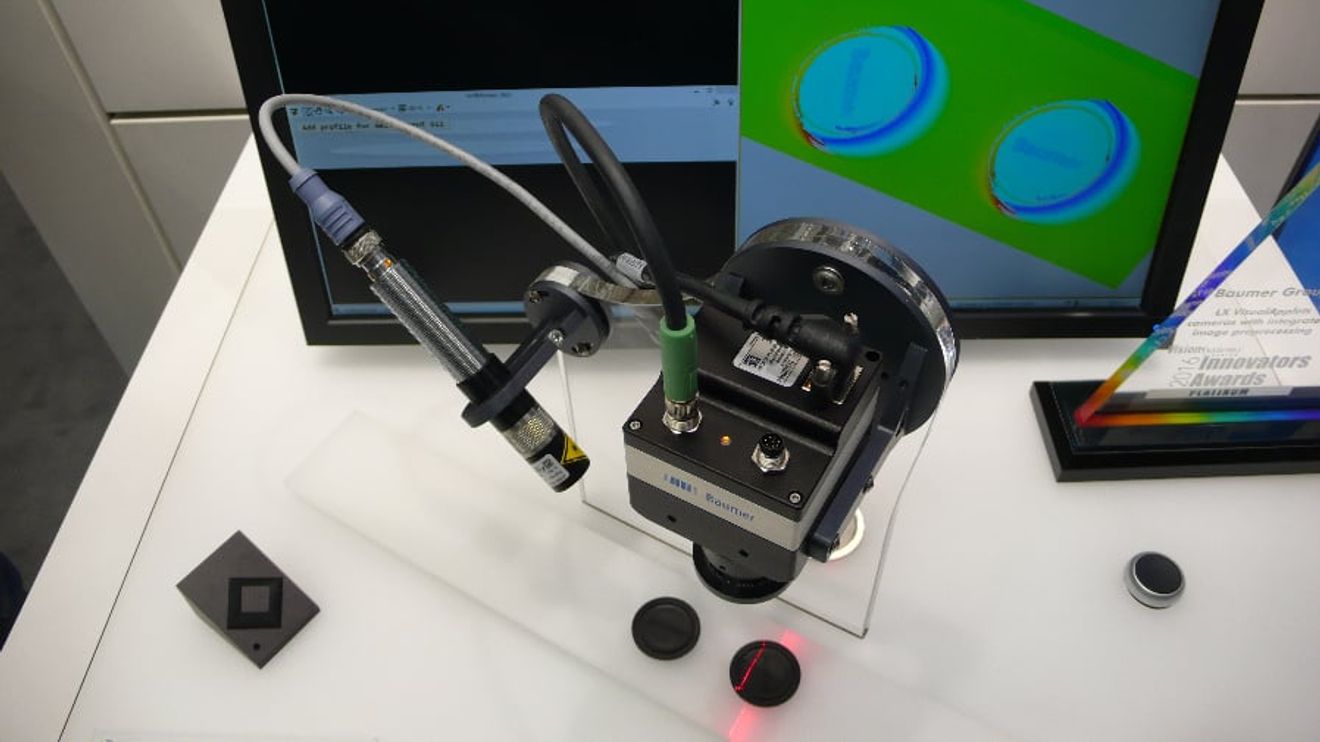
Image processing in Industry 4.0: Baumer has combined the FPGA programming software 'VisualApplets' from Silicon Software with its 'LX-VisualApplets' 3D cameras based on the laser triangulation principle.
© Andreas Knoll / Markt&Technik
Rainer Schönhaar, Balluff: "There will be more apps that use standard interfaces and act as small modular solutions."
© BalluffHow will Industry 4.0-capable image processing systems be structured and what role will vision sensors, smart cameras, apps and mobile devices play in industrial image processing in the future?
Fast format and product changes through to batch size one - machine vision technology makes it possible. Rainer Schönhaar, Product Manager Image Processing at Balluff, explains the prerequisites for this.
Markt&Technik: What new possibilities will image processing open up in Industry 4.0?
Rainer Schönhaar: Image processing will enable process monitoring and complete traceability at almost all process steps. In order to achieve maximum flexibility in production, for example through fast format and product changes, products must be clearly identified and their quality reliably determined. This can be achieved with high-quality image processing systems and complete storage of the inspection results in the system.
What role will networking play for machine vision systems in Industry 4.0?
Rainer Schönhaar: Future machine vision systems will be networked with each other. This means that information about the product to be inspected will be linked and evaluated decentrally using current image data. Only data and results that are relevant for quality assurance will be stored and passed on. In addition, there will be internal process control functions that constantly check whether parameters such as lighting have changed. Status parameters of the image processing products, such as temperature, are also determined intelligently. In this way, production downtimes can be efficiently minimized by indicating changes ahead of time.
What tasks will vision sensors and smart cameras take on in Industry 4.0?
Rainer Schönhaar : There is a noticeable trend towards more complex sensors such as vision sensors and smart cameras increasingly taking on the role of data collector and processor. Data is processed directly where it is generated. A central control system controls the "intelligent" products and provides all the input parameters required for operation, but in return only wants to receive already processed results in an adapted format. A limited integration of standard sensors, signal display and valve control, among other things, will take place directly as an isolated solution from the camera intelligence.
To what extent will mobile devices and apps make the transition from consumer electronics to industrial image processing?
Rainer Schönhaar : The younger generation in particular is growing up with apps that run on all kinds of mobile devices such as smartphones and tablets. In machine vision, we are currently seeing a similar shift from product-side to software-side development of application solutions. Image processing systems are increasingly modular in design and can therefore be expanded. There will be more and more apps that use standard interfaces and act as small modular solutions. In addition to the usual permanently installed human-machine interfaces, there will also be ways to quickly connect to the control system or a smart camera via mobile devices in order to obtain information about the current status.
One organ of sight for three tasks

Mike Gonschior, ifm Electronic: "In Industry 4.0, image processing systems must be true communication geniuses."
© ifm ElectronicIn Industry 4.0, image processing systems act as "eyes" and fulfill three basic tasks. But which ones? Mike Gonschior, Product Manager Object Recognition and Camera Systems at ifm Electronic, explains.
Markt&Technik: Image processing systems are now often referred to as the 'eyes of the robot'. What tasks will they fulfill as eyes in Industry 4.0?
Mike Gonschior: In the fourth industrial revolution, information will be generated from data and knowledge from information, which in turn will lead to autonomous action. Sensors - the sensory organs in this system, so to speak - provide the data. Image processing takes on the role of the eye. The eye then fulfills three basic tasks: Firstly, identification, i.e. reading codes on workpieces or tool carriers as well as recognizing shape, such as the tools themselves. The second task is the visual guidance of machines, robots or transport systems. The third field we have identified is 3D measurement technology for quality control in production and positioning in logistics.
How communicative will image processing systems be in Industry 4.0?
Mike Gonschior: In the context of Industry 4.0, everything revolves around communication. Machine vision systems must therefore be true communication geniuses - bidirectionally, in order to adapt to the application and to deliver the data to the systems quickly and reliably. Communication with the operator himself will also be decisive for the success of the products. Usability will therefore have to measure up to that of consumer products.
What significance will vision sensors and smart cameras have in Industry 4.0?
Mike Gonschior: Smart cameras play an important role. Simple, intelligent sensors tailored to the application will fulfill the tasks mentioned above. User-friendliness, reliability and robustness are crucial here.
Will mobile devices and apps also make inroads into industrial image processing?
Mike Gonschior: Mobile devices and apps running on them will increasingly find their way into the factory and thus contribute to system transparency. Mobile devices will be the viewing window for monitoring autonomous processes and will also serve as an interface for process optimization. The intelligent analysis and interpretation of data, i.e. the preparation of information for visualization and as a basis for autonomous decisions, will be the key to the factory of the future.
Data for process optimization

Christian Ott, SensoPart Industriesensorik: "Machine vision systems in Industry 4.0 must be able to react quickly and easily to changing products."
© SensoPart industrial sensorsProviding the necessary data to control and optimize processes inline - Christian Ott, Head of Product Management Vision at SensoPart Industriesensorik, sees this as the main task of machine vision systems in Industry 4.0.
Markt&Technik: What tasks will image processing be responsible for in Industry 4.0?
Christian Ott: Machine vision will play a central role in Industry 4.0. In order to control and optimize processes inline, image processing must provide the relevant data and measured values. Errors in the process should be detected as early as possible before the parts are further processed. Parts handling will also become an important aspect of Industry 4.0. As the "eye of the robot", image processing will provide data for gripping or positioning parts. Ultimately, customers value the quality of the products produced and flexible and efficient production.
What capabilities must machine vision systems have for Industry 4.0 applications?
Christian Ott: A crucial point for machine vision systems in the context of Industry 4.0 is the issue of interfaces and data communication when networking the various system components. The systems will be integrated directly into the production lines and exchange data via Industrial Ethernet protocols such as Profinet or EtherNet/IP. The vision systems in Industry 4.0 must also be able to react quickly and easily to changing products, for example through various inspection programs that are stored directly on the system, or through the ability to make simple adjustments by the customer or automatically.
Why are vision sensors ideal for Industry 4.0 applications?
Christian Ott: Because of their compact design and the integration of optics and lighting directly into the device, vision sensors and smart cameras are suitable for integration into the system. All the intelligence is in the vision sensor and no separate PC is required for evaluation. Our vision sensors from the Visor series already offer integrated communication interfaces such as TCP/IP, Profinet or EtherNet/IP. Many requirements that will become relevant for image processing in the context of Industry 4.0 can be implemented economically with vision sensors.
Will mobile devices and apps be limited to visualization in the future or will they also take on "real" image processing tasks?
Christian Ott: As things stand today, visualization on mobile devices with a wide variety of operating systems or directly in the user interface of the system control, for example via Web Viewer, is particularly important for customers. Instead of stationary computers at each station, we see a future trend towards mobile devices that can be used flexibly.
Image processing via app

Detlef Deuil, Sick: "Against the background of batch size 1, image processing systems will have to adapt even more flexibly to the target applications."
© SickApps and mobile devices will also penetrate industrial image processing in the future - this is the prediction of Detlef Deuil, Head of Product Management Vertical Integration at Sick, who explains the background.
Markt&Technik: What tasks will image processing fulfill in Industry 4.0?
Detlef Deuil: In my opinion, there will be no way around image processing in order to comprehensively capture objects in factory or logistics automation, for example for quality control, predictive maintenance and process optimization.
What are the consequences of Industry 4.0 for machine vision systems?
Detlef Deuil : Against the backdrop of batch size 1, machine vision systems will have to adapt even more flexibly to the target applications. New concepts are needed to reduce complexity for machine operators, for example. For example, we have developed the "SICKAppSpace" ecosystem, which enables users to develop their own application solutions specifically for their needs and the requirements of their tasks. This is a sensor app tailored to the target application and the machine operator.
How will vision sensors and smart cameras develop on the way to Industry 4.0?
Detlef Deuil : All product categories will continue to be represented on the market. Vision sensors will become more application-specific. The camera-based code readers have set the direction to a certain extent in terms of simple commissioning and market acceptance. Smart cameras will continue to offer integrators and OEMs a universal option for solving image processing tasks in terms of variety or complexity. The topic of simple operability in terms of batch size 1 within Industry 4.0 will be exciting here.
What role do mobile devices and apps play in machine vision - now and in the future?
Detlef Deuil : In smart factories, operators and users will have to master and understand the flood of data resulting from the digital transformation. Transparency will play a major role here. Mobile devices such as tablets, smartphones and wearables will certainly become standard equipment.
Apps in industrial image processing will be one element in reducing the complexity perceived today. They will lead to greater acceptance among users and machine operators.
Already suitable for Industry 4.0

Peter Stiefenhöfer, Stemmer Imaging: "Industry 4.0 is only possible to a limited extent without image processing."
© Stemmer ImagingMachine vision systems for Industry 4.0 applications will hardly differ from today's systems, says Peter Stiefenhöfer, Head of Marketing & Public Relations at Stemmer Imaging - and explains why.
Markt&Technik: What role will image processing play in Industry 4.0?
Peter Stiefenhöfer : Image processing is already an important prerequisite for flexible production in the sense of Industry 4.0. Due to the high demands on sensory systems, the digital factory is a great opportunity for image processing to further establish itself as a key technology in production. There is now hardly a manufacturing industry that can do without image processing if it wants to be profitable. However, the technology is also being used more and more frequently in non-industrial applications, including in medicine, sport and traffic engineering.
What tasks will it fulfill there?
Peter Stiefenhöfer : In principle, machine vision systems in production naturally have the task of detecting faulty parts and, by communicating with the system control, ensuring that these faulty parts are either not used at all or reworked if possible. Increasingly, however, image processing is ensuring that parts are no longer only checked at the very end of a production line to see whether they meet the requirements: If defects are detected at an earlier stage of the process, the affected parts can be ejected before they are further processed or finished. This saves energy and possibly raw materials, thus increasing the efficiency of production. Image processing ensures that errors are detected and classified and that a system reacts correctly to the detected errors. In this sense, Industry 4.0 is only possible to a limited extent without image processing.
How will image processing systems in Industry 4.0 differ from today's systems?
Peter Stiefenhöfer : Essentially, machine vision systems in Industry 4.0 will hardly differ from systems that were used before the advent of Industry 4.0: They detect and classify faults and pass them on to the higher-level plant control system. What could change is the form of communication: there is still no standardization of the interfaces between image processing and the control system, but initial activities are already underway here, which are supported by the VDMA.
Does the development towards Industry 4.0 favor vision sensors and smart cameras over PC-based image processing systems?
Peter Stiefenhöfer : Whether an image processing system is PC-based or designed as a vision sensor or smart camera makes little difference in terms of Industry 4.0. The form of the image processing system is still determined by the image processing requirements. It is only important that the connection to the system allows a flexible response to the results of the image evaluation.
Parameterization via app

Christian Stock, Turck: "The need to parameterize image processing systems via mobile devices such as smartphones or tablets will become ever greater in the future."
© TurckIn future, image processing systems will be able to be parameterized using mobile devices and apps. Christian Stock, Product Manager for Opto/Ultrasonic Sensors at Turck, sees this as a great relief for users and explains the potential behind it.
Markt&Technik: What functions will image processing perform in Industry 4.0?
Christian Stock: The industrial production process is to be networked in a modern way with information and communication technologies - this intelligent networking is the basic idea behind Industry 4.0. For this to succeed, it is essential to network the sensors and actuators involved in the production process. Industrial image processing has firmly established itself in the field of sensor technology and roughly takes over the tasks of the human eye as a control tool.
We differentiate between simpler image processing systems such as vision sensors, which can only execute a limited number of functions and algorithms and are limited in their performance, and higher-quality smart cameras, which are freely programmable and also equipped with more powerful hardware so that high-resolution images and high frame rates can be realized. Tasks such as presence and surface monitoring, positioning, measuring functions, object, position and pattern recognition, to name just the most important ones, are predestined for image processing systems.
How much intelligence do machine vision systems need to have in order to be suitable for Industry 4.0?
Christian Stock: In order to meet the requirements of Industry 4.0 scenarios, machine vision systems must also fulfill the corresponding requirements. The general structure of such a system will not change; it consists of an optical system, an image sensor and an evaluation unit as well as appropriate lighting. However, a communication interface is mandatory in order to communicate with higher-level controllers or web servers via corresponding fieldbus or Ethernet systems.
It is very likely that image processing systems will become increasingly intelligent and therefore more autonomous in the future. During a visual inspection, for example, it would be possible to have the image processing systems decide independently, based on empirical values and process data, which lighting color produces the best contrast for the component to be inspected and thus ensures a reliable visual inspection. In this way, machine vision systems can react autonomously to production decisions or product changes.
What role will mobile devices and apps play in machine vision in the future?
Christian Stock: Because mobile devices have become an essential part of our everyday lives, it is only a matter of time before this trend is also fully established in the professional environment. The need to parameterize image processing systems via mobile devices such as smartphones or tablets will become ever greater in the future. Imagine what added value a complex image processing system would have if you could dispense with time-consuming programming using an industrial PC and software and set all the important parameters via a user-friendly app. Furthermore, by networking the systems, it would also be possible to call up process and log data remotely via a web server for maintenance purposes and, if necessary, even put an image processing system into operation.


You might also be interested in
Safety in sensor technology
What do sensor manufacturers currently offer in terms of safety? At SPS IPC Drives, there were a number of clever concepts on show - including from Sick, Pepperl+Fuchs and Leuze electronic.
 read more...
Video flashback of the three days of the fair
New hall, new topics and a new name in 2019 - the SPS IPC Drives 2018 in seven minutes.
read more...The review in the movie
New hall, new topics and a new name - that was SPS IPC Drives 2018 in seven minutes.
read more...OPC UA and TSN - a major trade fair topic
The OPC UA and TSN communication standards are major topics of discussion in the industry. This could not be overlooked at SPS IPC Drives 2018.
read more...Smart transport - three approaches in the video
How can material and product transport in machines and systems be reorganized in the age of Industry 4.0? Beckhoff, B&R and Bosch Rexroth presented interesting approaches in this regard at SPS IPC Drives 2018.
read more...'Software & IT' in focus
Last year, SPS IPC Drives bundled the topic of 'Software & IT in manufacturing' in Hall 6. In response to high demand, this concept was extended to Hall 5 in 2018.
read more...The 'Automation Hackathon'
At the 'Automation Hackathon' at SPS IPC Drives 2018, seven start-ups had the chance to develop new business models for selected companies in the automation industry in 48 hours. Winner: the start-up Othermo in collaboration with Wago.
read more...Entering the Machine Building Business
Known as a technology supplier to robot manufacturers, Synapticon now plans to offer targeted solutions for machine builders. The kick-off was given at the SPS IPC Drives with the ‚Actilink‘ drive systems and a quick-start package for the production...
read more...The winding does it!
With the market launch of the new brushless DC motor family BXT, Faulhaber is setting new standards in the field of external rotor high-performance drives. The winding plays a central role in this.
read more...