

Specim
Spectral imaging made easy
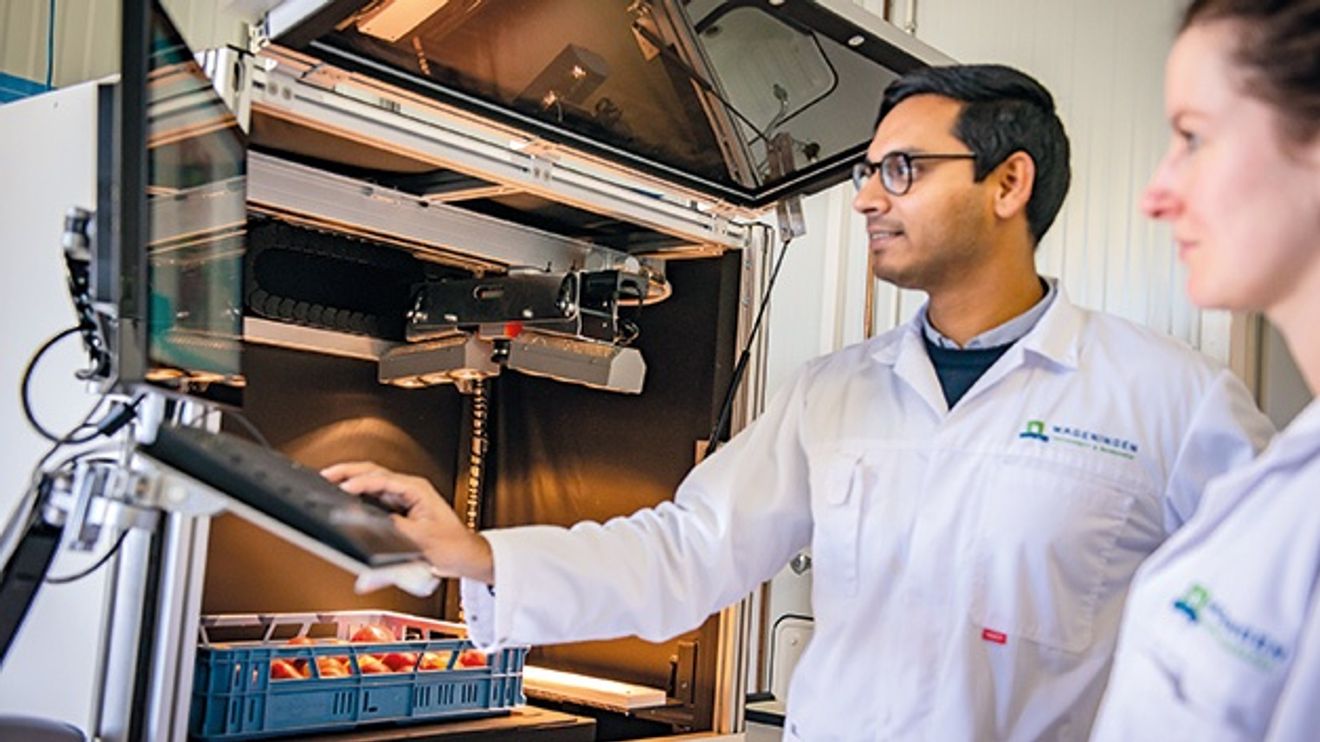
With two hyperspectral cameras, Wageningen University & Research (WUR) has developed an intelligent all-in-one spectral imaging laboratory system for automated data acquisition. This enables the prediction of food properties and the analysis of fresh produce.
Both scientific and industrial applications use hyperspectral image processing for classification and material analysis, among other things. Compared to conventional image processing systems, hyperspectral image processing goes beyond the visible spectrum and is therefore able to recognize information that is invisible to the human eye. This opens up analysis possibilities in areas where precise characterization and identification is essential. However, while hyperspectral imaging has shown significant benefits and potential in various industries and research areas, the complexity of data acquisition and analysis has prevented its widespread use until now.
To change this situation, Dr. Puneet Mishra and his colleagues at the WUR Institute in the Netherlands wanted to develop a system that would enable users without in-depth knowledge of hyperspectral imaging to benefit from this technology. Hyperspectral line scan cameras from the Finnish manufacturer Specim were at the heart of the project. While there are systems on the traditional image processing market, such as intelligent cameras, that enable users to solve tasks without prior knowledge of machine vision, such user-friendly image processing systems for hyperspectral image processing do not yet exist. To change this, an easy-to-use one-touch system was developed at the WUR. The aim of the project was to realize an intelligent all-in-one spectral imaging (ASI) laboratory system for standardized automated data acquisition and the provision of spectral models in real time in order to simplify hyperspectral image acquisition.
Standardized hyperspectral image processing

The joint use of Specim's FX10 and FX17 hyperspectral cameras enabled a more accurate prediction of fruit characteristics than using just one camera.
© SpecimOne of the biggest challenges in hyperspectral imaging is that the cameras available on the market generally require system integration and modeling for calibration. In addition, most of the hyperspectral sensors on the market are currently supplied as data acquisition devices. To perform the measurements and develop the model, the user must therefore design experimental setups into which the sensor must be integrated. In research laboratories, data acquisition and data modeling are usually performed in separate steps - not a very practical solution for routine use by non-experts.
Therefore, WUR developed a standardized spectral image processing system with an embedded PC to minimize unwanted influences on the measurement. The aim was to avoid re-integration of the system and to reuse calibrated models to enable repeatable measurements.
The selection of suitable hyperspectral cameras was essential for the successful realization of the system. At this point, the WUR developers opted for hyperspectral line scan cameras from Specim. WUR had previously used cameras from this manufacturer for other applications in laboratories.
In addition to the cameras, WUR integrated a controlled, standardized lighting environment, a PC system and embedded software for automatic image acquisition and model development. This setup formed the basis for predicting the spatial distribution of sample properties in the ASI system in real time.
Combination of VNIR and NIR cameras
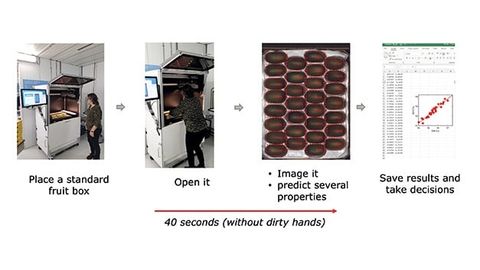
Overview of the All-In-One Spectral Imaging (ASI) setup and workflow for analyzing kiwi fruit.
© Wageningen University & ResearchThe human eye and conventional machine vision cameras have a sensitivity to wavelengths between 380 and 760 nm. As they are limited to this range, it can be difficult to detect the chemical parameters associated with fruit ripeness, such as moisture and soluble solids content. In contrast, the extended wavelength range of hyperspectral cameras allows the prediction of these parameters. To demonstrate the performance of the ASI system, the WUR carried out exemplary predictions of fruit properties for a variety of fruit types such as grapes, cherries, pears and kiwis.
The first system realized used a 'Specim FX10' hyperspectral camera operating in the visible and near infrared (VNIR) range from 400 to 1000 nm. With this setup, the sugar content and some other characteristics of the fruit could be checked. Ultimately, however, the WUR wanted to meet higher requirements in order to capture more detailed information with higher quality that would be able to reliably analyze meat and other foods, for example. The developers achieved this by adding an InGaAs-based 'Specim FX17' near-infrared (NIR) hyperspectral camera to the system, which covers the wavelength range from 900 to 1700 nm. The two cameras complement each other, especially when measuring samples with a high moisture content, such as fresh fruit: for example, it has been shown that the penetration depth of VNIR light is higher in the spectral range from 400 to 1000 nm due to the low water absorption coefficient of water molecules in fresh fruit, which means that more information about the properties below the object surface can be captured. In the 900 to 1700 nm range, the water absorption coefficient of water molecules is high, which enables better prediction of surface moisture in the samples.
In terms of acquisition speed, the Specim FX17 camera is very flexible as it offers the possibility to select and evaluate only a part of the available 224 wavelength bands, using only the wavelengths that provide relevant information for the current application. By reducing the number of observed wavelengths, the standard recording speed of the camera can be increased from 670 lines per second when using all 224 wavelength bands to several thousand lines per second when concentrating on a few wavelength bands. This feature is known as Multi Region of Interest (MROI). It is available on both cameras and offers users flexibility in terms of speed without compromising accuracy. In addition, MROI reduces the amount of data, making it easier to process and store the data. Using the cameras together in one system enables quality inspections across the entire wavelength range from 400 to 1700 nm.
Reliable analysis of fresh produce
According to the WUR, the all-in-one spectral imaging system has met the requirements of the developers for predicting the moisture and solubility content in fresh fruit. When comparing the performance of this system to commercial point spectrometer systems commonly used for NIR analysis, the ASI system achieved similar performance to this long-established technology.
A key difference of the ASI development compared to point spectrometers is that it enables the investigation of spatially distributed properties as the hyperspectral cameras capture extensive spatial information. In addition, the ASI setup enables the reuse of existing spectral data and models previously obtained in laboratory experiments. This opens up new possibilities for a broader use of spectral sensing, as models and data can be shared between different spectroscopy users.

In addition, ASI is a completely mobile system that can be brought to the samples instead of transporting the samples to the laboratory. In many applications, this is a major advantage over conventional technologies. Last but not least, it takes less than 40 seconds for the results to be available. In the past, it was sometimes necessary to wait several days for the results of a moisture analysis.
WUR is already using the ASI system for experiments with all types of food. Due to the good portability of the device, it can even be used for projects such as the analysis of fish on boats directly after the catch.


You might also be interested in
SWIR hyperspectral camera for industrial high-speed inspection
Teledyne Dalsa launches 'Kaleido', a hyperspectral camera for use in the shortwave infrared (SWIR) range, designed to overcome the existing integration and performance limitations of industrial sorting processes.
 read more...
IDS and Prophesee intensify partnership
IDS and Prophesee are intensifying their partnership for the next generation of event-based industrial cameras. Together they want to explore new sensor architectures that combine classic imaging with Prophesee's event-based 'Metavision' technology.
read more...Dual leadership in Shanghai
Stefan Becker has been appointed Managing Director of Eckelmann Automation Technology in Shanghai and will manage the subsidiary together with Zhongwei Huang.
read more...IDS Imaging Development Systems
Camera series for streaming, monitoring and event recording
IDS Imaging Development Systems launches the 'uEye Live' camera series with the 'uEye SCP' and 'uEye SLE' product ranges. They specialize in monitoring tasks, deliver various live streams and also enable event recording.
read more...AI and streaming meet robustness
IDS Imaging Development Systems is expanding its range of AI cameras with the 'IDS NXT oslo'. The model combines artificial intelligence with video streaming and recording functions in a compact, industrial-grade housing.
read more...With real-time data against disasters
A digital twin is more than just a two- or three-dimensional digital copy. It combines precise data with intelligent analysis and solves complex challenges. With locations in Paderborn and other cities, Eviden relies on the combination of artificial...
read more...Sold to Exaktera
AutoVimation will be part of Exaktera LLC, a portfolio company of Union Park Capital, based in Boston.
read more...Young Professional Award 2024 announced
The EMVA Young Professional Award is an annual prize worth 1500 euros that recognizes the outstanding and innovative work of a student or young professional in the field of machine vision or image processing.
read more...IDS Imaging Development Systems
Design freedom for board cameras
IDS has developed the 'uEye ACP' series, whose modular design principle makes a wide range of camera variants possible. The online configurator can be used to put together models that are available directly from stock.
read more...