
Image processing
Securely grip bulk material components
How can robots in production be made to grip bulk material components more easily? Vibration and image processing are the keys.
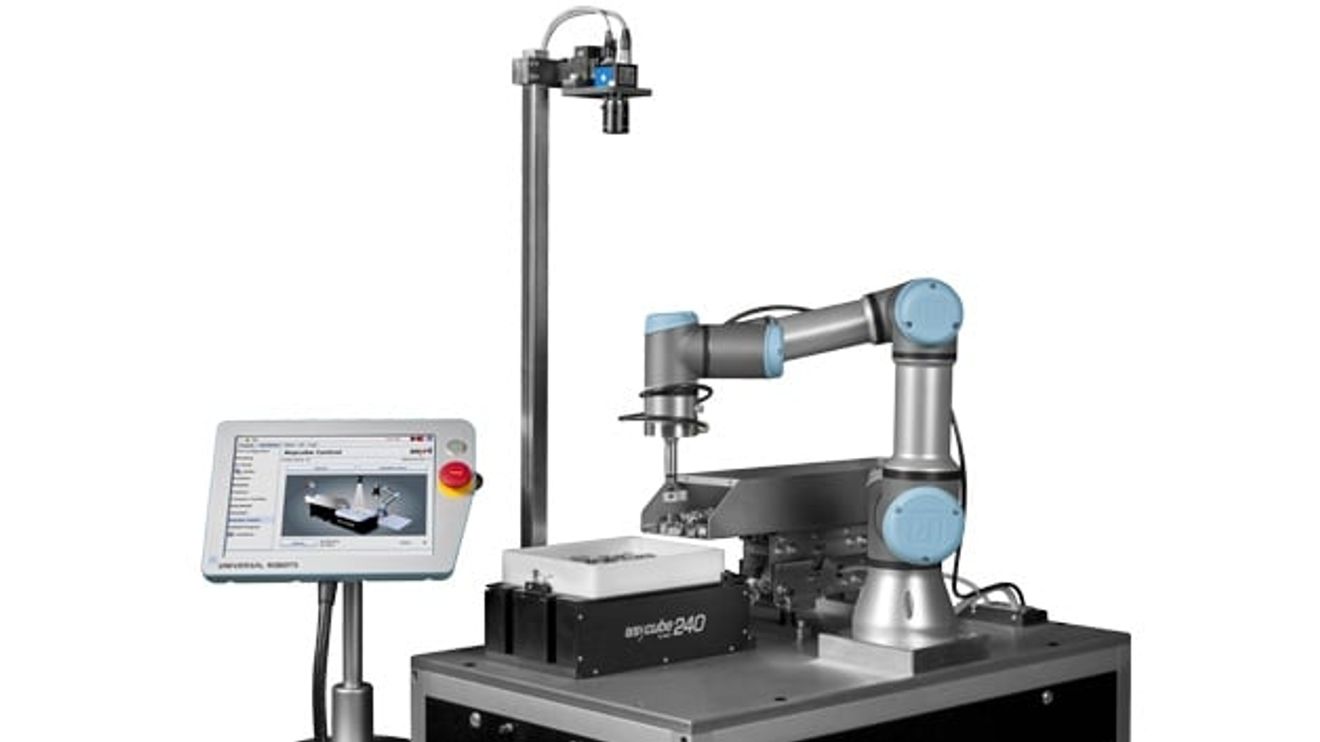
Gripping the box' - i.e. the gripping of disordered components by a robot - is anything but trivial and, despite enormous progress in both robotics and image processing, still poses a major challenge. The reasons for this are obvious: before a robot can grip a component, an image processing system must first reliably recognize it and calculate its orientation in order to then communicate the position and orientation of the gripping points to the robot. If the components to be gripped are chaotically mixed up and partially obscure each other, the safe and fast gripping of individual parts often becomes a slow process. In conventional technology, this multi-stage process leads from recognition to gripping to correct placement and then to gripping with the correct orientation.
Asyril takes a new approach to this task, which is frequently encountered in industry. The Swiss company builds feeding systems for pick & place robots and works with a trick that appears simple at first glance, but is innovative in detail: the bulk material objects lying next to and on top of each other in a box are guided via a feed hopper onto a vibrating platform, separated on this platform and placed in a position that allows easy access by the robot.
Vibration in three axes
The basic idea of the Swiss company goes beyond conventional mechanical systems such as vibrating pots, explains Asyril Product Manager Aymeric Simonin: "The special feature of our high-performance feeding systems is that the results of an integrated image processing system are used to control the vibrations of the platform in a targeted manner so that the objects are separated. The specialized vision system provides the necessary data almost in real time, ensuring that the parts are isolated and placed in an optimal gripping position for the robot."
After separation using 'intelligent vibrations', the vision system communicates the data on the position and orientation of components to be optimally gripped to the pick & place robot, which can then easily access them. To optimize the speed of object detection, the system sends information about the first well-positioned components detected to the robot even before the entire image has been evaluated.


At the heart of the image processing system used in the current 'Asycube' feeders is a camera from SVS-Vistek's Exo series, which is based on Sony's 'Pregius 2' CMOS sensors.
© SVS-VistekThe technical basis for this approach are flexible feeders called 'Asycube'. The actuators of the patented 3-axis vibration technology cause a vibration platform to vibrate, which can be controlled in terms of strength, frequency and duration, thereby enabling fast and precise movement of the components on the vibration platform.
The second core element of the feeder solution is the integrated vision system 'Smartsight', which assesses the quality of the separation and uses the knowledge of the robot gripper's capabilities to determine the positions of the next optimally positioned parts. Following initial systems based on 'Eco' cameras from SVS-Vistek, Asyril opted for camera models from the 'Exo' series with resolutions between 1.6 and 12 MP, as these not only capture images but also control the light, making an additional strobe controller unnecessary. On the one hand, this reduces the hardware costs for the overall system; on the other hand, it is now possible to operate reflected light and transmitted light with short flash times directly from the camera's power outputs. The timing for light and exposure comes directly from the camera, which controls the electrical processes and the integrated four-channel LED driver with its sequencer. The light, sequencer and camera are controlled via a single programming interface.
Overall, the technology is suitable for loose parts and components of all geometries with sizes from <0.1 to 150 mm. The feeders enable parts to be fed gently, which can be a decisive criterion depending on the application. Thanks to the modular design, the feeders can be flexibly adapted to the properties of the objects. In addition to easily interchangeable hardware modules, this flexibility in configuration is ensured by the easy-to-operate, PC-based image processing. The advantages of a programmable feeder become clear when switching to other products: configuration is carried out via software and saves expensive hardware set-up times, which is particularly advantageous in markets with very short product life cycles or small series.
To implement the 'Smartsight' vision system integrated into the 'Asycube' feeder, Asyril is working with Fabrimex, a partner of SVS-Vistek, to complete its camera technology into customized optical solutions from a single source.
Author:
Stefan Waizmann works in Technical Marketing at SVS-Vistek in Seefeld.


You might also be interested in
SWIR hyperspectral camera for industrial high-speed inspection
Teledyne Dalsa launches 'Kaleido', a hyperspectral camera for use in the shortwave infrared (SWIR) range, designed to overcome the existing integration and performance limitations of industrial sorting processes.
 read more...
IDS and Prophesee intensify partnership
IDS and Prophesee are intensifying their partnership for the next generation of event-based industrial cameras. Together they want to explore new sensor architectures that combine classic imaging with Prophesee's event-based 'Metavision' technology.
read more...Dual leadership in Shanghai
Stefan Becker has been appointed Managing Director of Eckelmann Automation Technology in Shanghai and will manage the subsidiary together with Zhongwei Huang.
read more...IDS Imaging Development Systems
Camera series for streaming, monitoring and event recording
IDS Imaging Development Systems launches the 'uEye Live' camera series with the 'uEye SCP' and 'uEye SLE' product ranges. They specialize in monitoring tasks, deliver various live streams and also enable event recording.
read more...AI and streaming meet robustness
IDS Imaging Development Systems is expanding its range of AI cameras with the 'IDS NXT oslo'. The model combines artificial intelligence with video streaming and recording functions in a compact, industrial-grade housing.
read more...With real-time data against disasters
A digital twin is more than just a two- or three-dimensional digital copy. It combines precise data with intelligent analysis and solves complex challenges. With locations in Paderborn and other cities, Eviden relies on the combination of artificial...
read more...Sold to Exaktera
AutoVimation will be part of Exaktera LLC, a portfolio company of Union Park Capital, based in Boston.
read more...Young Professional Award 2024 announced
The EMVA Young Professional Award is an annual prize worth 1500 euros that recognizes the outstanding and innovative work of a student or young professional in the field of machine vision or image processing.
read more...IDS Imaging Development Systems
Design freedom for board cameras
IDS has developed the 'uEye ACP' series, whose modular design principle makes a wide range of camera variants possible. The online configurator can be used to put together models that are available directly from stock.
read more...