
Vision technology
Process diagnostics on a video basis
Using video-based process diagnostics, sources of faults in production can be detected during operation. For this purpose, the video signals are recorded and evaluated synchronized with measurement data.
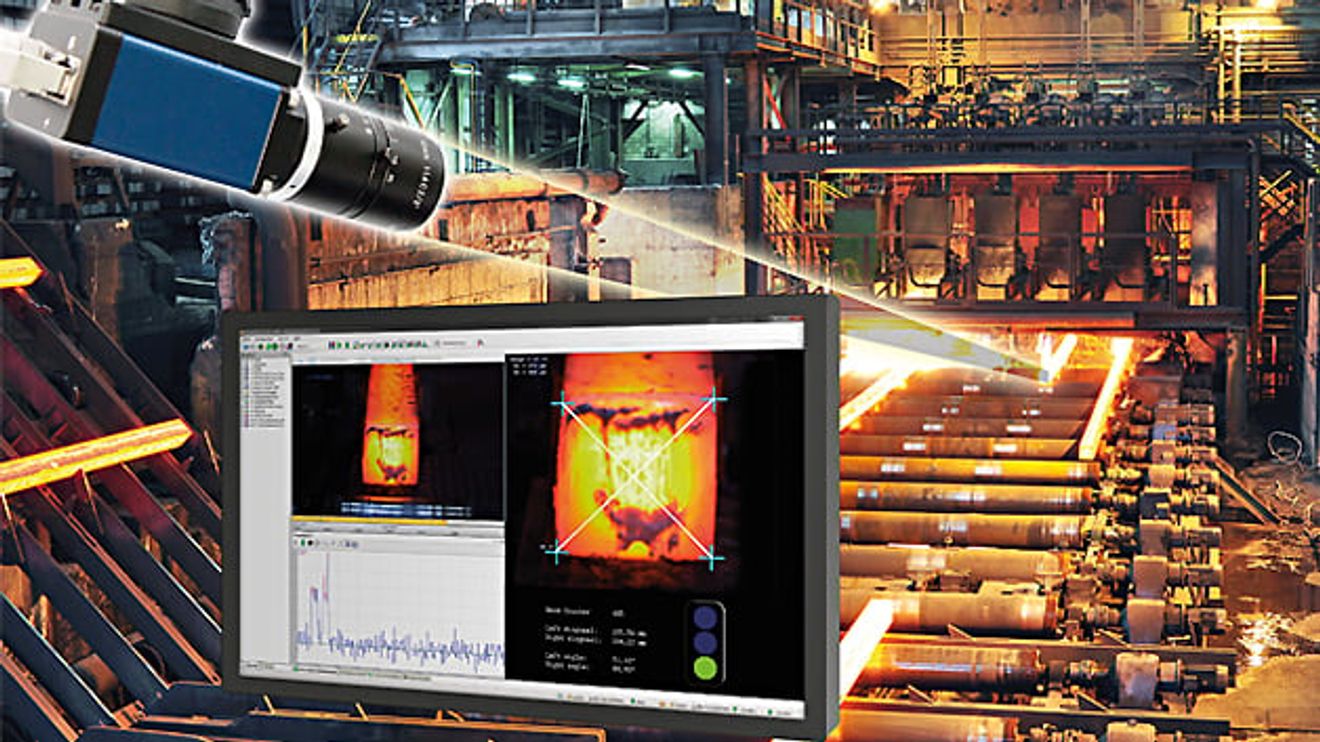
Process diagnostics and analysis play a key role in improving processes. Ideally, this should take place during ongoing operation in order to detect sources of disruption in real time and initiate countermeasures immediately. Machine vision systems support process monitoring when the production steps are difficult to monitor with sensors or when visual inspection by humans does not provide objective quality assurance. Such critical conditions exist, for example, in the material feed of machine tools or extruder systems, as well as in laser welding or material handling systems where excessive steam, dust, water and high heat occur, such as in steel and rolling mills.
Image processing systems are used to detect and measure edges and planes and to check machine-readable symbols and characters or the positioning of components. In this way, the dimensions of shapes and surfaces can be determined, missing parts identified or the correct structure of components checked. Thanks to camera-based process diagnostics, higher cycle rates can be achieved during the inspection process, measurement accuracy is reproducible, the results can be determined more objectively and, last but not least, are easier to document.
Enhanced with visual signals

With the 'ibaMachineVision' tool, the process data can also be used to control image processing.
© ibaFor camera-based process diagnostics, iba has added the image processing tool 'ibaMachineVision' to the 'ibaCapture-CAM' recording system, which consists of hardware and software. This tool converts visual process information into numerical or logical values and makes these available to the 'ibaPDA' process data recording system online in real time. Based on the recorded process signals, information about the process that is not based on video images is also available here. As the process signals are recorded synchronized with the camera images, this process information can also be used with the image processing tool for industrial image processing.
For example, the process signals can be used to determine which workpiece is currently in production and needs to be analyzed next. The camera can be focused on the size and position of the workpiece or, for example, a camera flash can be triggered when the workpiece is in the focus of the camera. The algorithm of the machine vision application can also be supported by this information in order to deliver better and more reliable results.
The combination of general process information with visual signals is also useful if the image processing system is part of online machine monitoring and complete systems need to be monitored in addition to individual mechanical components. The video capture system with downstream image processing provides additional visual process information that can be integrated into both online machine monitoring and downstream offline process analysis. In a rolling mill, for example, around 40 cameras can be used to monitor the rolling process. As the operator cannot observe the various camera images continuously, a method such as that of the iba system is useful as it extracts visual signals from camera images and links these to the process data. In this way, production trends can be identified and the operator alerted in the event of a malfunction.
Online and offline analysis

The long-term trend in the detection of continuous casting diagonals. This means that even gradually accumulating defects can be reliably detected.
© ibaThe procedure in detail: First, the 'ibaCapture-CAM' image recording system is used to record camera images synchronously with the measurement signals in the machine or system. The video recording is thus synchronized with the measurement signals in the 'ibaPDA' data recording. With the 'ibaMachineVision' module, the process data acquisition system also receives the values from the image processing. For this purpose, measured values or information about production are extracted from the video sequences. This extracted information can be dimensional numerical data such as distance, size and position, recognized text information (barcode, numbers) or status information about the workpiece or the process conditions. The information is fed back into the process data recording system as so-called visual signals so that it can be visualized on the user interface and displayed as a trend, just like other process signals. This enables users to view the live image of the machine or system at the same time as the result of the image processing and the long-term trend of the visual signals.
The long-term trend serves as a basis for process analysis and diagnostics. If the process changes, this can be easily identified in the graphical display of the trend and, if predefined thresholds are exceeded, signaled on the HMI system by a traffic light, for example. In this way, errors in the production process are detected online and therefore at an early stage. However, an in-depth offline analysis can also be carried out subsequently using the 'ibaAnalyzer' analysis tool in order to identify and rectify the causes of faults when problems occur. The analysis tool makes it possible to identify causal relationships between measurement data and visual information, which can be replayed synchronized in time for process analysis (offline replay).
Advantages of synchronization
Thanks to the synchronous recording of video images and measurement signals, the latter can also be used to display different camera images to the operator in a process-controlled manner (scenario player). This allows the operator to follow the material flow, for example, without having to look at several camera images in succession. Process faults, for example detected by a digital signal or the exceeding of a sensor signal threshold, quickly come to the operator's attention. It is also possible to replay critical process steps in slow motion. This allows the operator to evaluate this process step before switching back to the live view.
A third advantage of the synchronous recording of both variables is that so-called image triggers can be derived from process signals for later documentation of production and individual images can be saved from the continuous video stream of the cameras. In this way, the threading of material, the gluing process of various workpieces or the completion of a workpiece can be saved for quality documentation - controlled by digital signals or measured value overruns, for example.
Continuous casting plant example
The following example of a continuous casting plant illustrates the benefits of industrial image processing. In a continuous casting process in a steelworks, the shape of the cast product at around 800 to 1000 °C is to be monitored online. A process analysis with 'ibaMachineVision' makes it possible to detect whether irregularities occur during the shaping of the strand. For this purpose, the diagonal difference of the continuously cast steel profiles is calculated and evaluated.
The so-called spit edges are a defect that gradually builds up: if the strand is led out of the plant at an angle, this defect can be detected via the front side of the strand. For this purpose, an installed camera records the front sides of the strand and transmits the image data to the 'ibaCapture-CAM' system. When a workpiece is detected, the machine vision module initiates the evaluation of the strand. To do this, its corner points are first determined and then the lengths of the two diagonals are calculated. The difference between the diagonals is saved as a new measurement signal (visual signal) in the data acquisition system. The measured workpiece, the current numerical values, the live video stream and the production trend of all cast workpieces are graphically displayed on the screen. In addition, a traffic light signals the process quality to the operator. Based on this, the operator can now initiate the necessary measures in the event of process deterioration.
Without this type of process diagnostics, the spit edges could only be mechanically measured at random in the cooled state at the storage location, and the system would produce rejects for several hours.
Author:
Dr. Andreas Quick is Head of Product Management at iba in Fürth.


You might also be interested in
SWIR hyperspectral camera for industrial high-speed inspection
Teledyne Dalsa launches 'Kaleido', a hyperspectral camera for use in the shortwave infrared (SWIR) range, designed to overcome the existing integration and performance limitations of industrial sorting processes.
 read more...
IDS and Prophesee intensify partnership
IDS and Prophesee are intensifying their partnership for the next generation of event-based industrial cameras. Together they want to explore new sensor architectures that combine classic imaging with Prophesee's event-based 'Metavision' technology.
read more...Dual leadership in Shanghai
Stefan Becker has been appointed Managing Director of Eckelmann Automation Technology in Shanghai and will manage the subsidiary together with Zhongwei Huang.
read more...IDS Imaging Development Systems
Camera series for streaming, monitoring and event recording
IDS Imaging Development Systems launches the 'uEye Live' camera series with the 'uEye SCP' and 'uEye SLE' product ranges. They specialize in monitoring tasks, deliver various live streams and also enable event recording.
read more...AI and streaming meet robustness
IDS Imaging Development Systems is expanding its range of AI cameras with the 'IDS NXT oslo'. The model combines artificial intelligence with video streaming and recording functions in a compact, industrial-grade housing.
read more...With real-time data against disasters
A digital twin is more than just a two- or three-dimensional digital copy. It combines precise data with intelligent analysis and solves complex challenges. With locations in Paderborn and other cities, Eviden relies on the combination of artificial...
read more...Sold to Exaktera
AutoVimation will be part of Exaktera LLC, a portfolio company of Union Park Capital, based in Boston.
read more...Young Professional Award 2024 announced
The EMVA Young Professional Award is an annual prize worth 1500 euros that recognizes the outstanding and innovative work of a student or young professional in the field of machine vision or image processing.
read more...IDS Imaging Development Systems
Design freedom for board cameras
IDS has developed the 'uEye ACP' series, whose modular design principle makes a wide range of camera variants possible. The online configurator can be used to put together models that are available directly from stock.
read more...