

Image processing
Food in flawless packaging
Aluminum trays are ubiquitous as containers for food - for meals on planes, for transporting food ordered over the phone or for pre-cooked ready meals from the supermarket. How can their quality be tested economically during production?

Novelis uses around 50 presses at its Plettenberg site in Sauerland to produce countless tray variants with and without subdivisions and in a wide variety of shapes and sizes. The common requirement for all variants is that the products must be dense and have the desired contours. Due to the high cycle speeds, such large quantities are produced on the presses every day that manual inspection could only be carried out on a random basis. For this reason, Novelis invested in a two-stage image processing system and additional units at the beginning of 2017, thereby further automating the entire production process of a line. Several press lines have now been set up with identical automation systems. The image processing systems are crucial for ensuring the quality of each individual aluminum container.
The containers are inspected in a two-stage system, with which the trays produced are 100% inspected for leaks and contour accuracy.
Two image processing systems in series

A two-stage image processing system inspects the trays produced for 100% leak tightness and contour accuracy.
© Stemmer ImagingIn the first step, two line scan bars (LSB) from Mitsubishi Electric inspect the contours of the trays and detect target deviations of ±100 µm. One line scan bar with a CoaXPress interface and a sensor width of just under 400 mm is used for each line; each LSB is illuminated by a line light from CCS, which is mounted above the passing containers as background lighting. This station detects geometric errors such as so-called noses or punching residues on the containers. The tolerance of the contour check can be parameterized. Containers that are outside the specified tolerances are ejected at the end of the image processing system in order to collect and recycle the aluminum material from the detected trays.
Four cameras for hole inspection
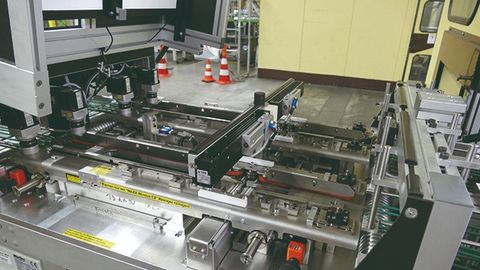
When the lid is open, you can see the front 'line scan bar' (bottom center), the two CCS lights above it and the four Nano cameras on the left.
© Stemmer ImagingThe second image processing station follows directly after the contour inspection. This is where the trays are checked for leaks. As the material thickness of the aluminum strips from which the trays are pressed is between 40 and 180 µm, depending on the container type, there is always a risk of material cracks when the presses deep-draw sophisticated container geometries. Such defects must be detected in order to ensure that the food is subsequently packaged tightly and hygienically and to rule out customer complaints.
At this point, images are captured by four 'Genie Nano' area scan cameras from Teledyne Dalsa, each of which captures one half of the trays. The best way to detect leaks is to work with backlighting, as this allows translucent light to be reliably detected and faults to be reliably identified. Containers that are found to be leaking are sorted out and sent for recycling.
A monitor, which displays the results of the image evaluation from both image processing stations combined, is used to check and visualize the inspections. Here, the staff can call up error images and thus check whether the system is working correctly. On this basis, good/bad decisions made by the system can be tracked and, if necessary, necessary settings can be corrected.
Increased efficiency
The trays, which are recognized as faultless by the image processing station, are then stacked, shrink-wrapped and packaged fully automatically. The tasks of the employees responsible for supervising the automated lines in the Novelis production hall are therefore essentially limited to loading the aluminum coils at the entrance to the press line, providing the packaging materials and removing the pallets with the stacked, packaged trays.
For the implementation of the fully automated overall solution, Novelis turned to the company Industrielle Sensorsysteme Wichmann, which made an important contribution to the realization of this project, from initial tests and design studies through to integration and commissioning, by providing competent support. ISW specializes in image processing-based complete solutions.
One of the challenges with the Novelis systems was the desired user-friendly conversion of the press lines to other tray types. Both the operation of the system and the teaching of new trays had to be made as quick and easy as possible. By using suitable teach software, it is sufficient to show the system ten good parts and confirm them. Production and inspection of new containers can then begin.
ISW obtains the image processing components for its solutions from Stemmer Imaging. During the implementation of the systems at Novelis, machine vision components purchased by ISW from the German company headquarters are used almost exclusively. Stemmer Imaging supports its customers in the selection of components, whose process reliability for the respective application is often checked in advance in intensive feasibility studies. This was also the case with the Novelis systems, as the 'line scan bars' in particular had been developed for a completely different technical approach.
Author:
Peter Stiefenhöfer is the owner of PS Marcom Services in Olching.


You might also be interested in
SWIR hyperspectral camera for industrial high-speed inspection
Teledyne Dalsa launches 'Kaleido', a hyperspectral camera for use in the shortwave infrared (SWIR) range, designed to overcome the existing integration and performance limitations of industrial sorting processes.
 read more...
IDS and Prophesee intensify partnership
IDS and Prophesee are intensifying their partnership for the next generation of event-based industrial cameras. Together they want to explore new sensor architectures that combine classic imaging with Prophesee's event-based 'Metavision' technology.
read more...Dual leadership in Shanghai
Stefan Becker has been appointed Managing Director of Eckelmann Automation Technology in Shanghai and will manage the subsidiary together with Zhongwei Huang.
read more...IDS Imaging Development Systems
Camera series for streaming, monitoring and event recording
IDS Imaging Development Systems launches the 'uEye Live' camera series with the 'uEye SCP' and 'uEye SLE' product ranges. They specialize in monitoring tasks, deliver various live streams and also enable event recording.
read more...AI and streaming meet robustness
IDS Imaging Development Systems is expanding its range of AI cameras with the 'IDS NXT oslo'. The model combines artificial intelligence with video streaming and recording functions in a compact, industrial-grade housing.
read more...With real-time data against disasters
A digital twin is more than just a two- or three-dimensional digital copy. It combines precise data with intelligent analysis and solves complex challenges. With locations in Paderborn and other cities, Eviden relies on the combination of artificial...
read more...Sold to Exaktera
AutoVimation will be part of Exaktera LLC, a portfolio company of Union Park Capital, based in Boston.
read more...Young Professional Award 2024 announced
The EMVA Young Professional Award is an annual prize worth 1500 euros that recognizes the outstanding and innovative work of a student or young professional in the field of machine vision or image processing.
read more...IDS Imaging Development Systems
Design freedom for board cameras
IDS has developed the 'uEye ACP' series, whose modular design principle makes a wide range of camera variants possible. The online configurator can be used to put together models that are available directly from stock.
read more...