

Vision Optrix / Teledyne Dalsa
Crease-free adhesive tapes for medical applications
The US system integrator Vision Optronix has developed an image processing system that checks the quality of self-adhesive cohesive material during production. Line scan cameras form the basis of the system, which ensures significantly less waste.

Self-adhesive cohesive materials and tapes (pressure-sensitive adhesives, PSA) are often used in the manufacture of medical products such as wound dressings. They are based on non-reactive adhesives that form a bond when pressure is applied to secure the material to a surface. In the medical field, PPEs are most commonly used for wound care or surgical repair procedures, so the quality of the material is of paramount importance. Compared to traditional sealants and adhesives, PPE offers advantages such as ease of application and versatility of bond strength.
A manufacturer of PPE for medical applications was experiencing yield losses on their production line due to wrinkle defects occurring in the gauze-like nonwoven layer of the product. These non-woven PPEs are produced on lightweight PET plastic and paper substrates with a width of around 70 cm and a thickness of 0.025 to 0.075 mm. After the adhesive coating of the backing material, a thick, white non-woven material with a thickness of also around 0.025 to 0.075 mm is laminated onto the backing material at speeds of up to 55 m/min.
Problem of wrinkling
During the lamination process, the nonwoven material can periodically form wrinkles that render the product unusable and rejects. However, the wrinkles that form during production are difficult to see with the human eye, as the gauze-like nonwoven material is very thin and translucent. If the wrinkles are not detected and removed, they can extend over many hundreds of meters - resulting in the loss of raw materials used, unnecessarily consumed labor, increased overhead costs for the order and angry customers if the wrinkles are not detected before shipping.
Unable to find an off-the-shelf vision solution for this application, the manufacturer turned to system integrator Vision Optronix to develop a vision system to help detect, locate and report wrinkle defects during PPE production. The task of the vision system was to alert the PPE manufacturer's operators so that they could immediately remove any wrinkles that occurred and also to automatically mark the position of the wrinkle defects. In addition, a file of detected wrinkle defects should be created and stored together with the defect images, which the cutting machine operators can use to remove the marked wrinkle defects before shipping.
Illustration of the wrinkle defects
Vision Optronix investigated the problem in the laboratory to find the best method for imaging the wrinkle defects. In addition to the size of the defects and the process speed, the lighting requirements proved to be technically challenging.
During an on-site investigation, the system integrator first checked the wrinkle defects and the web coating system that applies the special coatings. It was important to understand how the various components of the image processing system had to be optomechanically designed in order to fit into the available space. On this basis, the system integrator developed, implemented, programmed and tested a preliminary design of the image processing system, including the necessary electronics, the image processing algorithms and the graphical user interface for the customer.
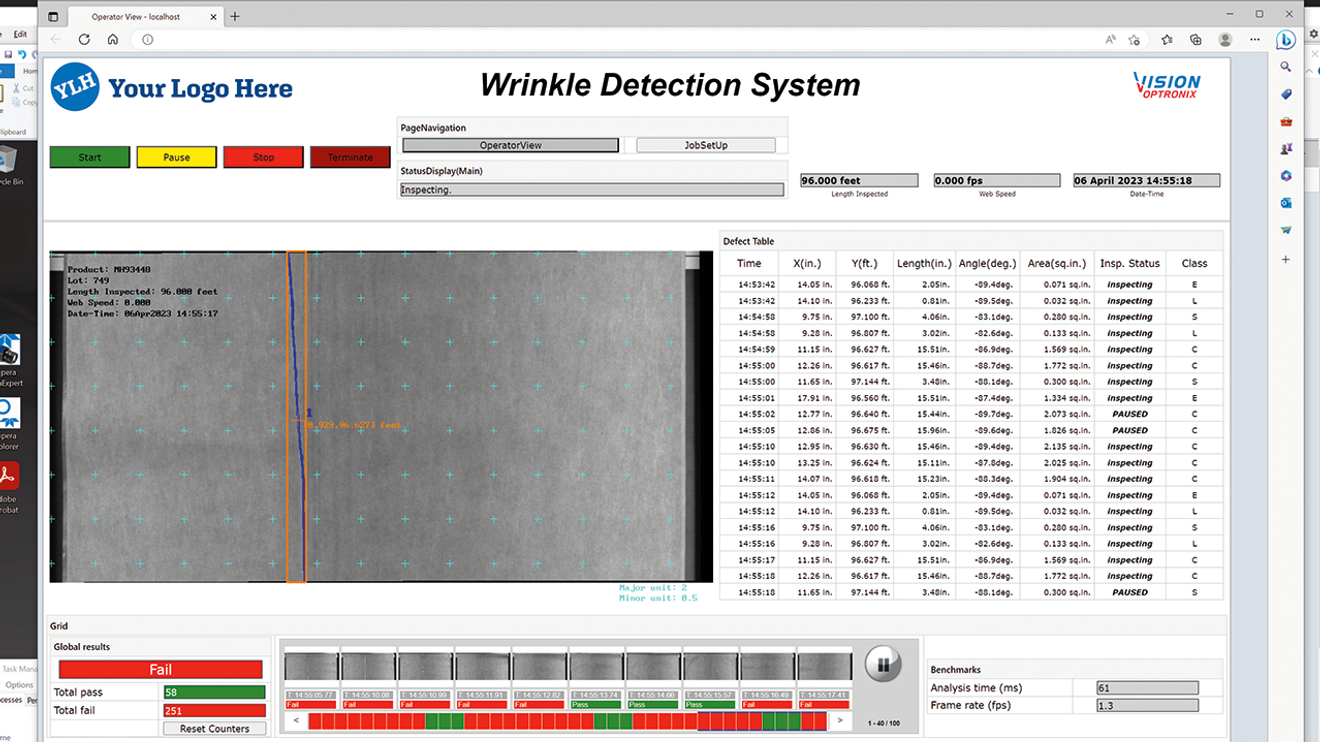
A graphical user interface allows operators and engineers to set up the vision system for each product using recipes and display detected defects.
© Vision OptrixDeveloping the contrast for the wafer-thin, gauze-like, white non-woven material laminated to white PET was particularly challenging. With the help of Massachusetts-based CPU Automation, Vision Optronix selected commercially available CCS line lights for the task. They allowed the vision system to develop enough contrast to find the wrinkle defects. Vision Optronix used a range of image processing algorithms to ensure that the system detected as many wrinkle defects as possible, but also as few false defects as possible.
For the cameras, the company opted for the Linea 2K and 4K line scan cameras from Teledyne Dalsa. As these have integrated encoders and line lighting, they are well suited to this application, as the nonwoven PPE is produced using a web process and the material moves over rollers during the manufacturing process.
Various image processing algorithms were applied, running on the vision controller at the required web coating speeds. This has ensured that the entire web process during manufacture can be imaged with sufficient contrast and analyzed frame by frame to detect, locate and report the wrinkle defects. The system has digital inputs and outputs for process control and monitoring, as well as options for storing defect images and reporting. A graphical user interface has also been developed to allow operators and engineers to set up the vision system for each product using recipes used in the manufacture of the product.
After Vision Optronix developed recipes for three of the customer's products in the lab, these were further optimized on site while the customer's engineers were trained in the recipe development process for further use with all of the customer's products. The user interface also allows operators to enter job data, select recipes and control parameters such as image handling, storage options and defect classification settings.

To set up and test the line scan cameras, Vision Optronix used the 'CamExpert' configuration application from Teledyne Sapera. The team was also able to activate line triggering via an encoder to match the line capture to the optical resolution (pixels on the web) with the integrated multiplier/divider. The design of the inspection system required the integration of various components, including interfacing digital I/O electronics, line triggering with the integrated multiplier/divider, and setting up an image buffer size to limit the likelihood of lost images.
In monetary terms, the cost of designing and developing the system, as well as the minor changes to the production line to accommodate the vision system, was significantly less than the loss of a single batch of material and other associated direct costs. In addition, the system provides safety and relieves operators who previously had to spend a lot of time near the laminating machine to check for possible wrinkling. With the system, Vision Optronix also fulfilled the user's wish to display the captured images on a large screen with native resolution, so that the web after the laminating machine is easily visible to everyone. The system also stores detected errors on a hard disk and refers to them in a report.


You might also be interested in
With AI recognition for rotated objects
The latest edition of Teledyne Dalsa's image processing software 'Sapera' includes improved versions of the graphical AI training tool 'Astrocyte 1.50' and the image processing and AI libraries 'Sapera Processing 9.50'.
 read more...
The e-paper for the special issue
Sensor & Vision 2023
Intelligent sensor technology always requires smooth interaction with software and surrounding systems. The examples in this e-paper demonstrate what this can look like in individual cases. This shows that team play counts - in sensor technology as...
read more...The challenge of battery production
The production of rechargeable batteries is challenging - and the inspection of both the individual LIB cells and the complete modules is no less so. What quality assurance options are there?
read more...Reliably sorted and packaged
Sorting food manually is time-consuming, strenuous and error-prone. It is therefore only logical to rely on automation with the support of image processing, as a look at two companies belonging to the Unilever Group shows.
read more...Teledyne takes over Flir Systems
The conglomerate Teledyne Technologies wants to acquire the sensor system manufacturer Flir Systems - as part of a cash and share transaction worth around 8 billion US dollars. The two companies signed an agreement to this effect on January 4, 2021.
read more...SWIR hyperspectral camera for industrial high-speed inspection
Teledyne Dalsa launches 'Kaleido', a hyperspectral camera for use in the shortwave infrared (SWIR) range, designed to overcome the existing integration and performance limitations of industrial sorting processes.
read more...Machine vision industry expects turnaround in 2026
After difficult years, the European machine vision industry is sending out the first signs of recovery: growth is expected again in 2026 - driven by global demand, AI and automation. However, uncertainties and weak investment in Europe continue to...
read more...Basler and Orbbec launch Technology Partnership
Basler, a provider of machine vision components and solutions, and Orbbec, a specialist in 3D vision technology and robotics, have announced a strategic partnership to implement industrial 3D solutions for factory and logistics automation.
read more...For critical tasks in logistics automation
The Cognex 'Solutions Experience (SLX)' product range comprises application-specific solutions for critical automation tasks in key industrial sectors.
read more...