
3D sensor technology
Collisions don't stand a chance
3D sensors help self-driving systems, reversing aids and intelligent spatial analyses to secure work areas and routes. What do modern devices do in detail?

Driver assistance systems are particularly in demand when the person at the wheel has to concentrate fully on their work - for example when moving bulky loads. This is because the driver often lacks a complete overview of the route and of impending dangers or obstacles in the vicinity. Typical areas of application for driver assistance systems can therefore be found in transport logistics, agriculture, on construction sites, in mines and ports - in other words, wherever industrial trucks, loaders, tippers or container vehicles, some of which are gigantic in size, dominate the scene. But how can the areas that are hidden from human view due to blind spots be safeguarded?
Sensors for collision warning

'Visionary-B' is based on 3D snapshot technology and functions as a 'two-eye principle' in the outdoor area.
© SickSick's '3D snapshot' technology, for example, can detect objects in three-dimensional space with just a single image. The scene can be captured in three dimensions without the need to move actuators or mechanical parts inside the sensor. This means that the entire blind zone surrounding a vehicle can be analyzed, even if the vehicle is moving slowly or is stationary. With a snapshot, such a 3D sensor evaluates not only the width and height of the object, but also the distance to it. The technology also makes it possible to classify objects based on 3D vision. For example, a shelf, a crate, a kerb, a pedestrian or a switch cabinet can be reliably distinguished in real time.
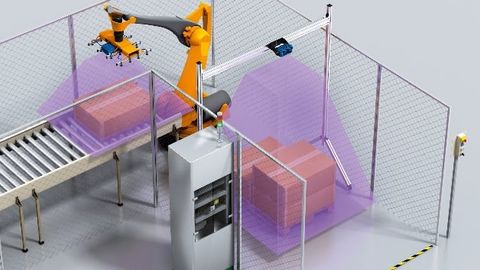
The 3D snapshot sensors are also suitable for collaborative productions where people work in the direct vicinity of robots.
© Sick3D-Snapshot enables two techniques: Time-of-Flight and stereoscopic triangulation methods.
3D time-of-flight (ToF) means measuring the time of flight of light pulses between the sensor and the target object for each pixel of the image. As soon as the arrival time or phase shift of the reflected light is known, the distance to the target object can be determined.
In stereoscopy, the depth information comes from two images taken by two synchronized cameras. These cameras are positioned in such a way that the scene is captured from slightly different perspectives. This allows the depth information to be calculated for each point of the image using a triangular relationship.
As both technologies are based on different physical principles, they have different characteristics. Solutions based on the 3D ToF principle, for example, provide 3D data with high accuracy. Stereoscopic measurements, on the other hand, are hardly influenced by objects with different reflective properties. Regardless of the physical source, both 3D snapshot technologies provide warning signals based on 3D image data in real time.
The detection zone of a 3D snapshot sensor depends on parameters such as the configuration, the distance to a limiting flat surface (e.g. floor, ceiling or wall) or the installation angle of the sensor in relation to the floor.
'Visionary-B' and 'Visionary-T' are sensors from Sick that rely on 3D snapshot technology. They capture scenes three-dimensionally as a whole with short exposure times. Laser scanners, on the other hand, scan their field of vision line by line. As a result, there is always a time offset in a static image - and therefore a blurring of the assessment of a scene at the current moment. 3D snapshot technology, on the other hand, works like a 'normal' digital camera, in which every single pixel of an image is exposed at the same time. This process prevents sudden events from creeping into the line-by-line scanning process.
Entire images without time offset
A three-dimensional image is captured either on the basis of stereoscopy using two lenses or using time-of-flight measurement with one lens. In both cases, mechanically moving parts are not necessary. 3D laser scanners, on the other hand, work with rotating mirrors or rely on the movement of objects in front of the scanner. This makes them more susceptible to vibrations and shocks, which are commonplace in harsh industrial environments such as mines or quarries. Static scenes also limit the possible applications of 3D laser scanners due to their design.
The absence of mechanically moving parts therefore increases the reliability and availability of the 3D snapshot sensors. The recording principle is accompanied by a robust camera design tailored to the operating conditions, including a shock- and water-resistant housing. The sensor head of 'Visionary-B', for example, can be cleaned with a fire hose.
Reacts quickly
The following scenario is conceivable, for example: an employee steps out of a bend in a mine tunnel while a mining vehicle is reversing. The sensor system must work correspondingly quickly and inform the driver of the danger immediately. As 'Visionary-B' records several images per second, the basis is created for a high information content of the stereo images, which a computer combines and evaluates to form a three-dimensional image.
This data density is necessary in order to reliably detect hazards or obstacles. However, drivers must not be distracted by this flood of information. The algorithms of the device software therefore filter out all information that is irrelevant to the driver - for example, small bumps and stones as well as rain or fog. In this way, the system only warns the driver of really critical situations.
Scaled solution also for indoors

Visionary-B' captures several images per second and thus creates the basis for a high information content of the stereo images. A computer merges the data into a three-dimensional image and evaluates it.
© SickWhile 'Visionary-B', with its robust design and low lighting requirements, is primarily designed for outdoor use, 'Visionary-T' is available for indoor driver assistance systems. Here, the camera technology also works with intelligent analysis software. However, the distance and size information of objects is not determined by measuring the disparities in the stereo image, but by time-of-flight. 'Visionary-T' has a single-lens design and uses infrared light sources to measure the light travel times between sensed object surfaces and the camera. Here too, the sensor provides depth information for each pixel in real time.
The system measures the fine time differences that the light needs to travel from its source to the object and back again, so that the process can deliver up to 50 three-dimensional images per second. The differences allow the distance to the reflective surface to be calculated. And this data in turn forms the basis for calculating three-dimensional representations in which different colors show different distances.
Thanks to the integrated active illumination of the surroundings, the camera even works in complete darkness. The limits of 3D Time-of-Flight technology are found in areas of application with strong external light sources, such as direct sunlight in open production or logistics areas. This is why the classic stereo camera is ideal for outdoor areas, where neither reflections nor direct sunlight can jeopardize surveillance.
Indoors, however - for example in large logistics centers or extensive production areas - a reliable detection system can be installed with 'Visionary-T' and 3D snapshot technology. The possibilities of the devices go beyond mere collision warning, as they can also be used in collaborative production environments where people work in the direct vicinity of robots. Here, the sensors can be parameterized and used in a targeted manner so that a robot can detect who or what is approaching it. If it is an automated guided vehicle (AGV), for example, the robot continues to move at full speed. However, if the detected object deviates from the taught-in AGV contours, for example because a person is approaching, precisely defined scenarios can be set up - from restricted or slowed movement to a complete standstill. In addition to objects, gestures can also be recognized - an essential basis for human-machine collaboration.
Further application examples for 'Visionary-T' can be found in logistics and material flow: The sensors can be used to reliably determine the dimensions of parcels or packaging units, for example. In addition, the 3D snapshot technology can be used to reliably detect positions when storing and retrieving pallets in high-bay warehouses. During palletizing itself, the 3D sensors reveal free areas. This means that material handling can be better controlled and optimized.
Author:
Fabian Zimmer is Product Manager 3D Compact Systems at Sick in Waldkirch.


You might also be interested in
SWIR hyperspectral camera for industrial high-speed inspection
Teledyne Dalsa launches 'Kaleido', a hyperspectral camera for use in the shortwave infrared (SWIR) range, designed to overcome the existing integration and performance limitations of industrial sorting processes.
 read more...
Machine vision industry expects turnaround in 2026
After difficult years, the European machine vision industry is sending out the first signs of recovery: growth is expected again in 2026 - driven by global demand, AI and automation. However, uncertainties and weak investment in Europe continue to...
read more...IDS and Prophesee intensify partnership
IDS and Prophesee are intensifying their partnership for the next generation of event-based industrial cameras. Together they want to explore new sensor architectures that combine classic imaging with Prophesee's event-based 'Metavision' technology.
read more...2D Machine Vision brands bundled under one roof
From January 2026, the image processing brands Allied Vision, Chromasens, Mikrotron, NET and SVS-Vistek will be merged under the Allied Vision brand. The companies, which are part of TKH Group NV, will combine their technological know-how,...
read more...Integrated SWIR sensors from Sony
Balluff has integrated the three SWIR sensors IMX990, IMX992 and IMX993 from Sony into the portfolio of the 5GigE camera family 'BVS CA-GV'.
read more...Changes to the Executive Board
The long-standing Basler CEO Dr. Dietmar Ley will be leaving the company at the end of the year and will be succeeded by the current CCO/COO Hardy Mehl. The CTO position will be filled externally by Dr. Kai Jens Ströder.
read more...Basler acquires 76% of Indian image processor
Basler, supplier of image processing components for computer vision solutions, has acquired 76% of the Indian sales partner Alpha TechSys Automation.
read more...'AI Cam' as a building block of the 'Industrial AI' strategy
True to the motto "Smart data instead of big data", Turck relies on 'edge AI' instead of cloud load. Managing Director Christian Wolf explains why industrial image processing with AI directly in the field is setting new standards for efficiency and...
read more...Dual leadership in Shanghai
Stefan Becker has been appointed Managing Director of Eckelmann Automation Technology in Shanghai and will manage the subsidiary together with Zhongwei Huang.
read more...