

Battle for the EU as an industrial location
Von der Leyen sees need for billions
The sums involved are in the hundreds of billions. Industries of the future, such as clean energy production, are being courted worldwide. Following an initiative by Ursula von der Leyen, the EU is now facing intense debates.
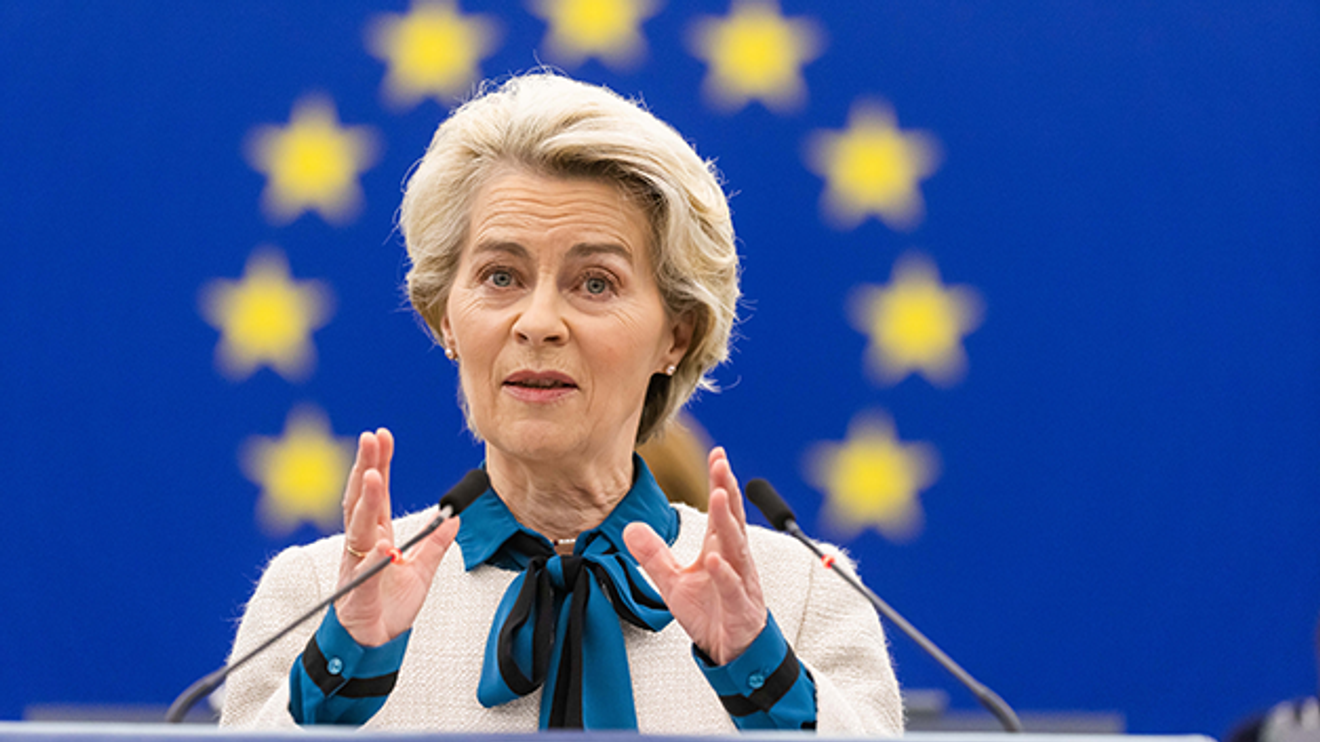
According to Ursula von der Leyen's Commission, the EU must invest hundreds of billions of euros in climate-friendly technologies to save Europe as an industrial location. The local industry is under strong pressure, not least because subsidies in countries such as the USA and China are distorting the competitive conditions, according to the authority's recommendations presented on Wednesday. This makes it necessary to expand and accelerate access to subsidies for climate-neutral industry.
Von der Leyen did not say exactly how much money is needed. She wants to make a proposal for a so-called sovereignty fund towards the middle of the year. This should ensure that funds are available for climate-friendly technologies throughout the EU. However, the Commission also emphasizes that hundreds of billions are already available in existing funds for a climate-friendly transition. "At the moment, we have to work with what we have", said von der Leyen.
The EU Commission also wants to give the EU states more freedom to grant subsidies. However, these would be limited to certain areas and limited in time. It is envisaged that the state aid rules could be relaxed by the end of 2025. "We need this first funding step now, so we can't wait too long," said von der Leyen with regard to state aid.
Response to subsidy programs in the USA and China
The plans are, among other things, a response to state aid in the hundreds of billions that the USA wants to invest in industries to combat climate change. However, as the Commission emphasizes, other regions of the world are also gearing up in the race for corresponding industrial sectors with similarly large sums. China has announced investments in clean technologies amounting to more than 280 billion US dollars (around 258 billion euros). Japan wants to raise around 140 billion euros through bonds for a green transition and the USA has mobilized more than 360 billion dollars (331 billion euros) with its so-called Inflation Reduction Act.
Because of these financial injections, there are fears in the EU that domestic companies could set up new sites in other regions of the world or relocate jobs there if they are not also supported here with taxpayers' money. At the same time, the EU Commission wants to use the initiative to strengthen climate-friendly energy production in Europe, for example.
Concerns about growing inequality
However, there are also concerns within the EU that large countries such as Germany, which can invest more money than others, could now distort competition. The Commission's proposal would be extremely helpful to Germany and France, says Green MEP Rasmus Andresen. For many other countries, however, it "doesn't actually help at all". "It could lead to more inequality", said the spokesperson for the German Greens in the European Parliament.
The EU Commission addresses this debate in its proposals. It emphasizes that more EU funds are needed for the green restructuring of industry. This should avoid exacerbating regional differences and close gaps between different levels of financial strength.
Angelika Niebler, Co-Chair of the CDU/CSU Group in the EU Parliament, emphasized: "Unfortunately, the answers presented today are only partially convincing." The announced further softening of state aid rules should not be used as an excuse for new debt funds. Bernd Lange, trade politician for the SPD, on the other hand, said: "The measures are a step in the right direction and have been chosen so precisely that they will not lead to new trade conflicts." The proposals could become a "game changer".
The Commission's proposals are to be discussed with the member states at an EU summit next week. Legislative proposals are then to be presented in March, which will then be discussed by the EU heads of state and government.


You might also be interested in
What happens to my device data?
Despite warnings from large companies, the EU has agreed on the "Data Act". The aim is to make better use of data from all kinds of devices, from coffee machines to wind turbines. Not everyone is happy with the planned regulations.
 read more...
European Parliament votes in favor of a standard charging cable
Less electronic waste, lower costs for consumers and less environmental pollution - this is what standardized charging cables are supposed to deliver. MEPs from all political parties have agreed to the project. However, industry representatives are...
read more...EU Commission wants to protect victims of artificial intelligence
According to the EU Commission, anyone who suffers damage due to artificial intelligence should be able to claim compensation more easily in future. According to the Commission, this should also increase confidence in new technologies.
read more...Dispute over patent protection
EU launches new WTO case against China
China is intimidating European companies with litigation bans. The EU no longer wants to stand idly by and watch.
read more...VDMA joins European Clean Hydrogen Alliance
The VDMA is a member of the European Clean Hydrogen Alliance. Its aim is to promote climate-neutral hydrogen in Europe.
read more...Father of the lithium-ion battery nominated
The European Patent Office announces the nomination of Japanese chemist and engineer Akira Yoshino for the European Inventor Award 2019. Yoshino is considered the father of the lithium-ion battery, which today supplies billions of devices with...
read more...EU starts the race to catch up
The fastest computers in the world are currently in countries such as China and the USA. According to the EU Commission in Brussels, this is not only bad for the image of the European Union. Now a race to catch up is to begin - with a billion euros.
read more...Paderborn University becomes part of 'ELLIS NRW'
Paderborn University is one of the founding members of the new research unit 'ELLIS Unit NRW'. The European network bundles AI research in North Rhine-Westphalia with a focus on machine learning and explainable AI.
read more...AI 'CheckMate' optimizes industrial processes
With 'CheckMate', the University of Klagenfurt has developed an AI system that independently creates algorithms for complex combinatorics and optimization problems. The technology is designed to make industrial planning and logistics processes more...
read more...