

Staufen study
Supply chain remains the industry's problem child
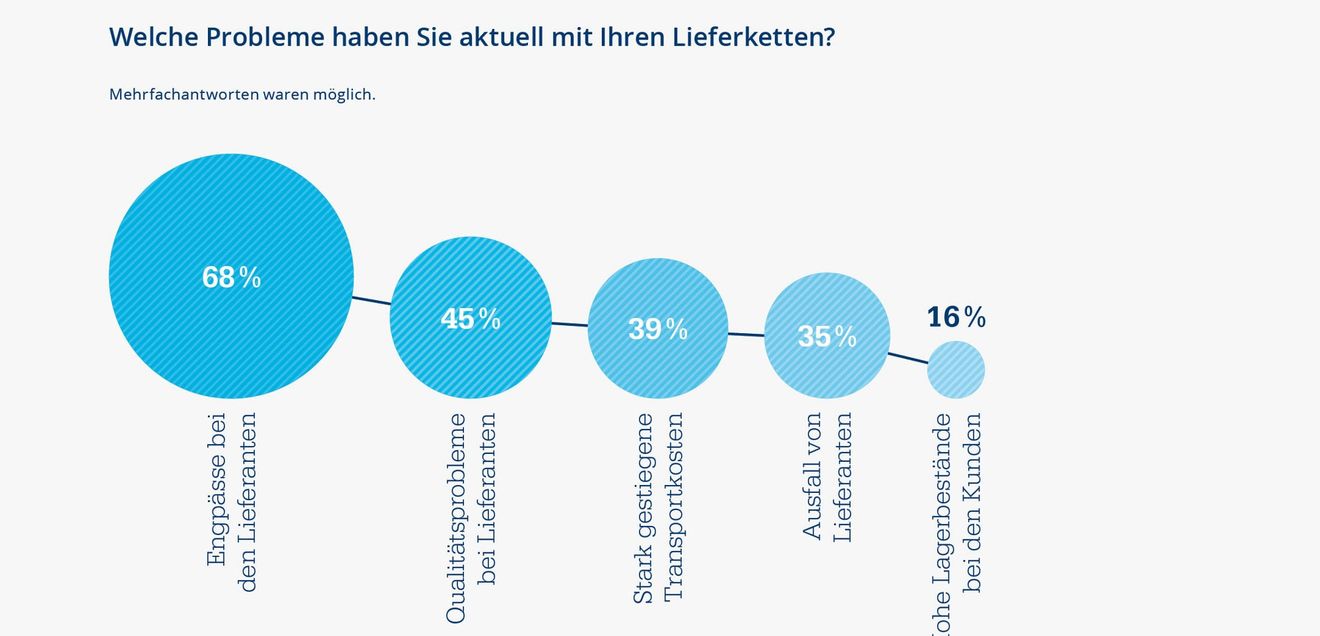
As the "Performance Drivers 2024" study shows, more than two thirds of companies in the DACH region are complaining about bottlenecks with their suppliers. Other burdens include quality problems at suppliers and a sharp rise in transportation costs. The problems in the supply chain are difficult to mitigate, with only around one in five companies describing themselves as truly resilient.
"The results of our study show that the consequences of the global crises continue to affect companies. Fragile supply chains and high costs continue to put companies under massive pressure. The corona pandemic, for example, was a long time ago," says Christian Ullrich, Supply Chain Network Management expert at Staufen.
For example, 68% of the companies surveyed admit to suffering from bottlenecks in the supply chain, almost half (45%) also complain about quality problems with their suppliers and 39% of the study participants are struggling with a sharp rise in transportation costs. Alarmingly, only 13% of the companies surveyed described their supply chains as "very stable". The majority (69%) consider them to be "rather stable", while almost one in five companies (18%) consider their own situation to be unstable.
The vulnerability of companies is also reflected in the answers to the question of how resilient they consider their own organization to be overall. Only 20 percent of respondents consider their company to be "very resilient". Staufen consultant Ullrich explains: "Resilience is not a luxury, but a necessity. Especially against the backdrop of increasingly volatile conditions, the aim should be to significantly increase the proportion of truly resilient companies and invest in their own adaptability." He advises diversified supply chains and flexible production systems, embedded in a corporate culture geared towards operational excellence.
The focus should be on investments
Ullrich adds: "It's not just about cutting costs, but about building resilient and flexible structures. This requires investment in technology, but also in expertise and partnerships, which can pay off many times over and should therefore become more of a strategic focus. This is an opportunity that many companies have not yet recognized."
For the study, management consultants Staufen surveyed 209 industrial companies in Germany, Austria and Switzerland.


You might also be interested in
DigiKey expands portfolio by 585,000 products
DigiKey significantly increased its stock in the third quarter of 2025. According to the company, more than 31,000 new immediately available items were added to the warehouse. In total, over 585,000 new products were added to the system, as well as...
 read more...
RS expands automation portfolio with Leuze products
RS has expanded its automation range to include products from Leuze electronic Germany. The company specializes in sensor solutions for industrial applications.
read more...Robotics against standstill
Downtime is expensive - especially when vehicles break down. Modern spare parts management relies on warehouse robotics and automated systems to ensure that processes do not come to a standstill.
read more...New Managing Director DACH appointed
RS, a provider of product and service solutions with increased consulting needs for industrial customers, has appointed Stefan Gierse as Managing Director DACH on August 1, 2025. Ralf Hellwig will retire from this position and take on a new...
read more...RS cooperates with Hilscher
Distributor RS has recently sealed its partnership with Hilscher. With the introduction of the Hilscher range, RS is expanding its offering in the field of factory automation. Hilscher gains access to target groups in the areas of development,...
read more...Four misconceptions about robots in the warehouse
Although the automation of warehouse processes using robotics has long been a reality, Exotec has identified and clarified four misconceptions about robotization in logistics.
read more...Helmholz complements the RS range
RS, a provider of product and service solutions for industrial customers, has expanded its line card. Helmholz adds products for automation projects to the distributor's product range. The focus is on switches, gateways and secure communication.
read more...DigiKey and Qorvo cooperate
DigiKey and Qorvo announced a global distribution agreement at the end of February.
read more...Manufacturer ept cooperates with French distributor
Connector manufacturer ept announces its collaboration with Steliau Technology France, a distributor of electronic solutions. The aim of this collaboration is to strengthen Steliau Technology's connector offering and create new business...
read more...