

Ethics Council warns
AI must not replace human decisions
Artificial intelligence is omnipresent: it filters posts on social media, helps to analyze X-ray images or process mountains of job applications. The Ethics Council has given some thought to the responsible use of AI.
Berlin (dpa) - "Is this dark skin spot a benign birthmark or black skin cancer?" If you put a machine with artificial intelligence up against flesh-and-blood doctors to answer this question, statistically speaking, the AI machine is now more likely to be right. What's more, the AI's decisions do not depend on human mood swings, the machines only need seconds for the analysis and they don't get tired even after many hours of use.
However, even if the advantages of using AI are obvious, the German Ethics Council strongly warns against giving the machine too much responsibility. "AI must not replace humans," said Alena Buyx, Chairwoman of the Ethics Council.
Four areas examined
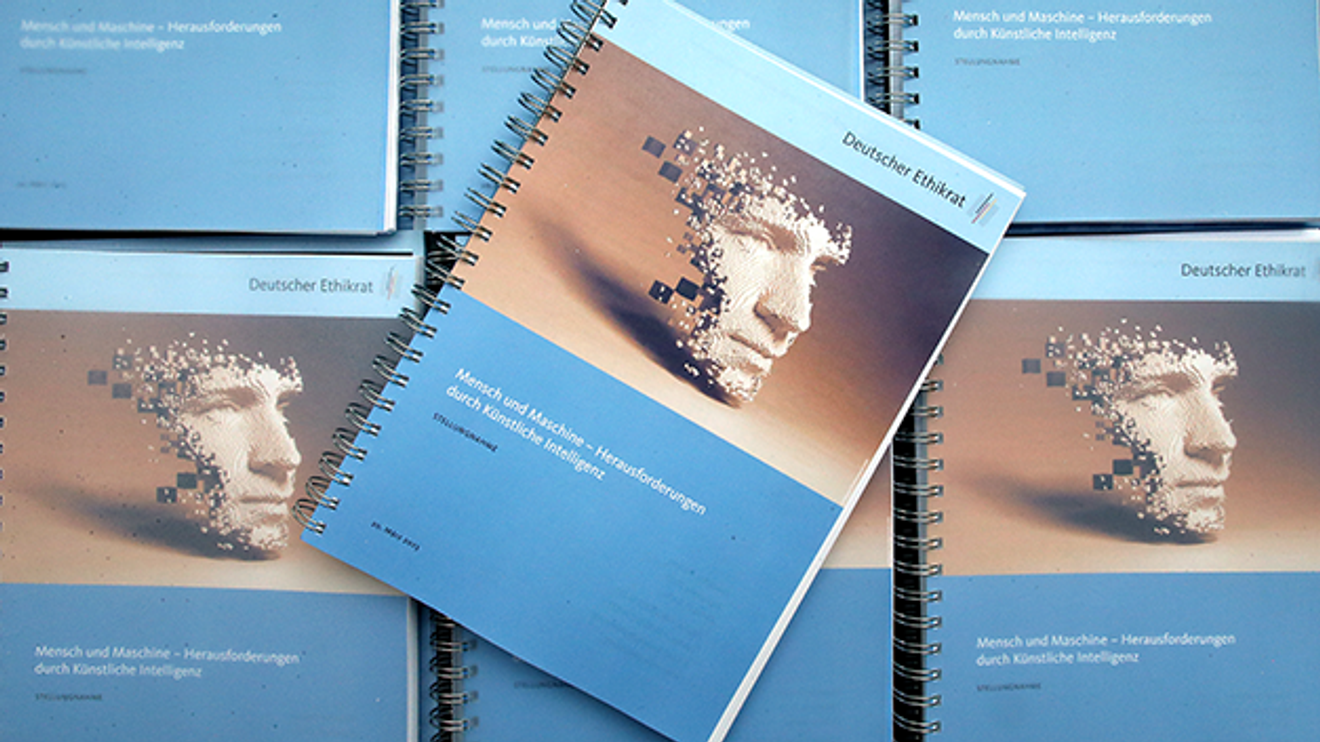
AI in medicine is one of four areas that the Ethics Council has analyzed in terms of the relationship between humans and machines. The use of AI in schools, in communication and opinion-forming and in public administration were also scrutinized. In October 2020, the then President of the Bundestag, Wolfgang Schäuble (CDU), asked the committee to draw up a statement on the relationship between humans and machines. At the presentation of the 287-page study in Berlin on Monday, Buyx sums up the results: "The use of AI must expand human development and not diminish it," says the medical ethicist.
For the medical sector, the report lists a number of reasons why the use of AI could be useful: for example, AI could be used to alleviate care bottlenecks due to staff shortages and provide more precise diagnoses. In medical care, AI tools are also being developed for diagnostics and therapy, for example for breast and prostate cancer.
At the same time, however, the Ethics Council sees dangers that should not be ignored: A loss of medical expertise must be avoided in the development and use of AI products. The privacy of patients must be reconciled with the intensive use of data in medical research. Completely replacing doctors with an AI system would endanger patient welfare and could not be justified by staff shortages.
Ban the use of AI in education?
In the area of education, the members of the Ethics Council discussed quite controversially whether or not the use of AI in schools should be banned in general. Specifically, the question was whether it should be allowed to record what happens in the classroom on video in order to use AI to analyze how the learning process works for individual students.
While some members of the Ethics Council rejected this form of "classroom analytics" in principle, others saw opportunities because it could provide teachers with continuous feedback and significantly improve teaching results. As a compromise, it was agreed that data collection and provision should serve the learning process. "It must not be misused to monitor and stigmatize learners," said Julian Nida-Rümelin, Deputy Chairman of the German Ethics Council.
AI in communication and opinion-forming - critical use case
The Ethics Council is also predominantly critical of the role of AI in public communication and opinion-forming. The polarization and brutalization of discourse has increased in social media, Nida-Rümelin lamented. It is often only possible to stand out from the "white noise" of the networks with particularly extreme views. The former Minister of State for Culture also blamed this on the commercial interest of platforms such as Facebook and Twitter in retaining users for as long as possible. This is achieved with personalized offers that are tailored to the recipients with the help of AI.
However, AI is also used to moderate problematic or even criminal content. This creates a tension between freedom of expression and the civil culture of communication, which is resolved in the hands of private digital companies according to their own rules, said Nida-Rümelin. At this point, the Ethics Council is proposing a public service alternative so that this issue is not left to private commercial companies alone. "We are not referring to public broadcasters," said Nida-Rümelin. Public-law foundation models without major state influence are conceivable.
AI in administration and homeland security
AI is increasingly being used in public administration to support decisions and ensure greater efficiency, reported Judith Simon, Professor of Ethics in Information Technology at the University of Hamburg. However, it has not been proven that its use necessarily leads to better decisions. The Ethics Council is committed to ensuring that citizens are protected from discrimination. Machine recommendations should not be followed blindly. Furthermore, case-by-case considerations as well as the rights of inspection and objection of those affected must be guaranteed.
This also applies to the use of AI to improve internal security. "If software predicts that 99% of a person will commit a crime, we can never know whether the person in front of us is exactly one percent."
AI and skills shortage - untapped potential
Research Minister Bettina Stark-Watzinger (FDP) explained that the Ethics Council illustrates "the diverse potential and opportunities" associated with the use of artificial intelligence in key areas of social application. "We absolutely must make use of these." At the same time, the report provides guidance on how possible risks such as discrimination in the use of AI can be countered.
The AI association was more critical of the report: It does not focus enough on the positive effects of AI, explained the association's managing director Daniel Abbou. The opportunities that AI will have in an economic context, particularly in relation to the shortage of skilled workers, were ignored.


You might also be interested in
With a focus on artificial intelligence
The e-paper of issue 05/06-22
Three trade fairs and the special issue Sensor&Vision await you in issue 5/6 of Computer&Automation. Find out in our special Robotics&Automation section why high plant efficiency does not depend on full automation and how SMEs can use...
 read more...
embedded award 2026 honored
On March 10, innovative developments in the embedded industry were honored at embedded world. The jury selected the winners from 27 nominated products in nine award categories.
read more...13 % more visitors in Nuremberg
On March 12, embedded world in Nuremberg ended with a 13% increase in visitors compared to the previous year. As a new location, the trade fair will also be held in India in future.
read more...More exhibitors at embedded world 2026
The embedded world Exhibition&Conference continues to grow. From March 10 to 12, 2026, 1262 exhibitors from 43 countries will present new technologies for embedded systems in Nuremberg. The number of exhibitors has increased by around 6%...
read more...Embedded in the heart of the software
Artificial intelligence has become an integral part of everyday industrial life. But not all AI is the same. Its successful use depends much more on how well the AI functions are integrated into workflows, how practically they are used and how...
read more...Functional Safety - Works!
With the certified safety modular system from Neuron Automation, OEMs can implement functionally safe control solutions faster, more flexibly and more cost-effectively - from hardware and firmware to the application. Functional safety 'in time', 'in...
read more...Nine award categories for the first time
The embedded award recognizes outstanding innovations at the embedded world Exhibition&Conference. It is presented in nine specialist disciplines as part of a networking event on the first day of the trade fair.
read more...The knowledge hub of the embedded community
The embedded systems industry will meet from March 11 to 13. In seven exhibition halls, exhibitors in Nuremberg will provide information on hardware, software, services and tools. Two accompanying conferences, expert panels and exhibitor forums will...
read more...Secure embedded PC for industrial applications
According to the manufacturer, the 'ReliaCOR 54-13' embedded PC from Inonet is one of the first embedded computers made in Germany to be certified for AI applications in accordance with IEC 62443-4-2. It therefore meets the requirements of...
read more...