

Collaborative robotics
Sensors and drive technology for a 'cobot'
The new generation of collaborative robots - cobots for short - are designed to enable real teamwork with humans at the workbench. In order to achieve this, 'sensitivity' is required - which in turn places new demands on the sensor technology used.
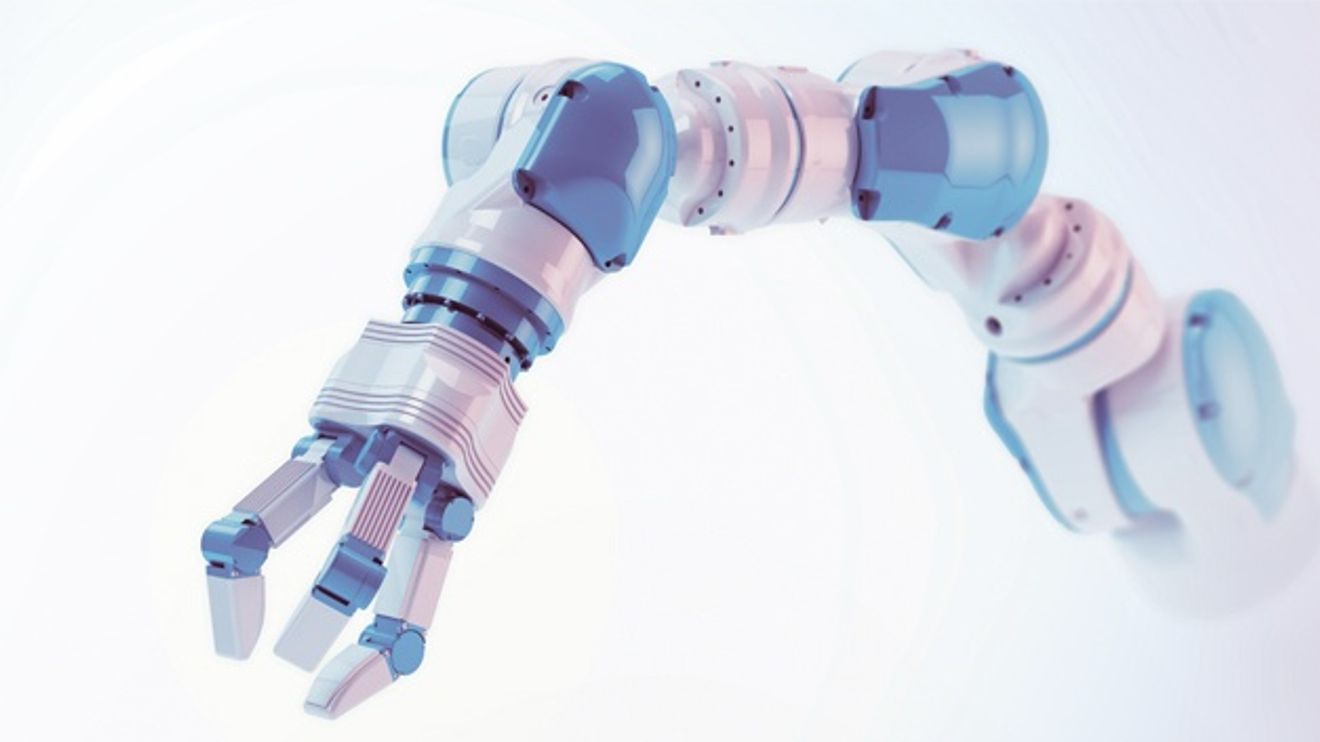
Who doesn't know them, the tinny companions of Jedi Knight Luke Skywalker from Star Wars? The lanky, eloquent C3PO in the shiny precious metal outfit and his small, beeping 'colleague' R2D2 in the sober industrial vacuum cleaner design are among the favorite characters of the space saga. In the 40 years since the first film in the series, a lot has happened technologically in robotics: sophisticated sensors and modern control technology now make 'real' teamwork between man and machine possible.
In technological English, the term cobots has become established for this new generation of robots - the abbreviation for collaborative robots. Unlike conventional industrial robots, which focus on repeat accuracy, speed and moving large loads, cobots are designed for lower forces, more flexibility and human working speeds. Instead of six or fewer axes, their arms often have seven in order to best imitate the mobility of a human arm.
The safety technology is also different. Conventional industrial robots are usually separated from the workers by fences or light curtains. If these barriers are crossed, the robot must be safely switched torque-free (Safe Torque Off, STO). However, as the worker is supposed to work together with the cobot, a safe distance cannot be implemented. The movement must therefore be switched to a slow mode (Safe Low Speed, SLS) and stopped much more quickly in the event of an unintentional interaction or collision (Safe Stop, SS1/SS2).
The robot must also be able to distinguish whether it is being taught by a human hand or colliding with an obstacle. Torque detection on the axes is essential for this. This can be calculated indirectly on the basis of the motor currents, but this can be imprecise and prone to errors. The more cost-intensive but more precise solution is the integration of torque sensors. However, these are located directly in the power transmission chain, where solidity is important, which in combination with sensitivity are rather contradictory goals. In both approaches, it is important to react quickly and immediately to sensor signals, especially those that indicate unintentional contact with a human.
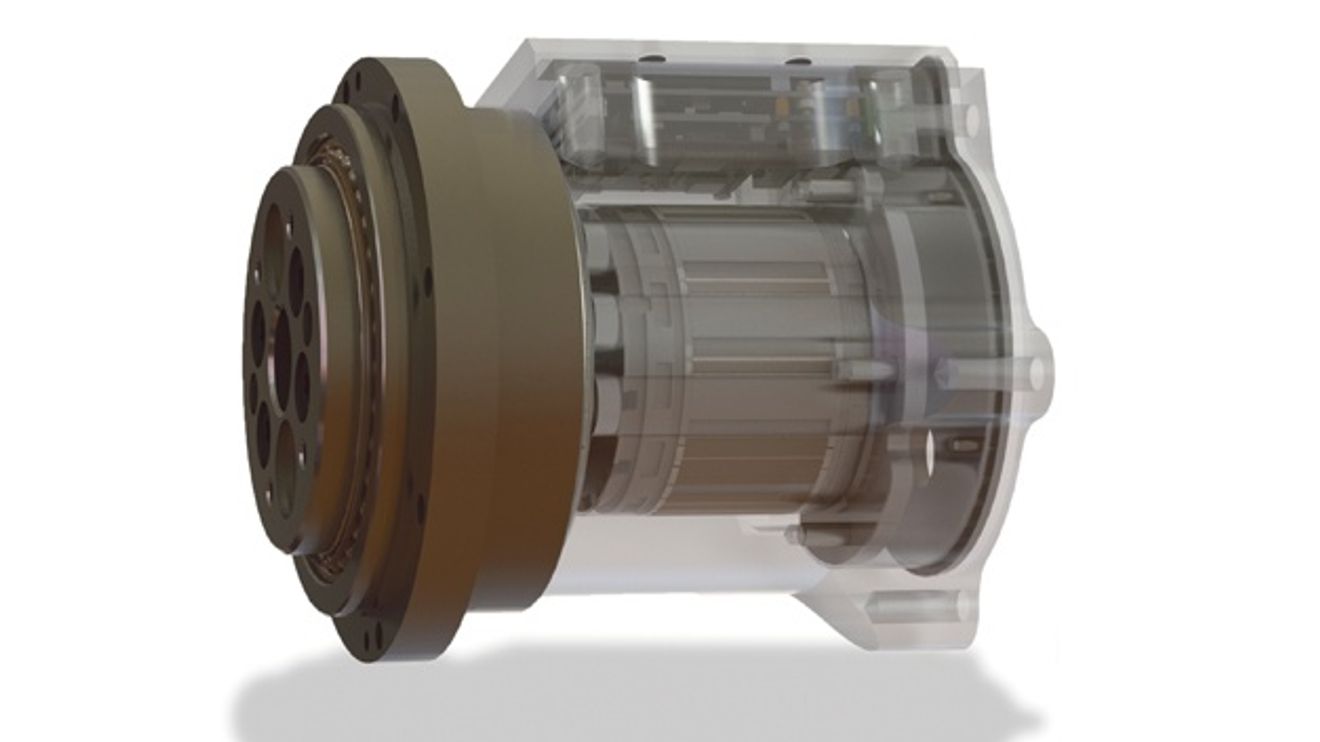
As a manufacturer of embedded solutions for robot controllers, Synapticon has risen to this challenge and developed a solution for evaluating sensor data directly on the drives. This allows the cobot to react quickly and precisely to sensor signals in the event of unintentional contact by its human colleague, for example to stop. The corresponding drive units include all functionalities for driving and controlling one or more robot axes. These include the power electronics for controlling various motor types, computing units for motion control as well as sensor and communication interfaces. The corresponding servo drives can be designed so small that they can be placed directly on the drive axes, including sensors - a 1000 watt node, for example, has a size of just 70 mm × 40 mm × 22 mm.
Fast-reacting sensor technology required
The safety functions for collaborative operation link sensory and motor functions directly, similar to human reflexes. As more control intelligence is located on the actuators instead of in the control cabinet, cables and long decision-making paths are no longer required and the speed of response increases. The decentralized approach manages with a two-wire supply bus and a four-wire Ethernet cable. Synapticon has packaged this solution in a modular system called 'Somanet', based on the human somatosensory nervous system. This means that, similar to the reflexes in the human body, sensor information can be evaluated directly in the axes and thus realize the fast reactions required for collaborative operation.
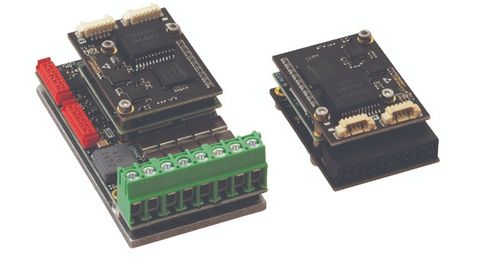
The modular system makes it possible to connect and combine drive controllers of different performance classes as well as digital inputs and outputs.
© SynapticonThe drives, which can be installed decentrally, are significantly smaller than conventional servo drives with the same power because they operate with very low voltage, i.e. in the range below 60 V. State-of-the-art semiconductor technology nevertheless allows high currents of up to 100 A and thus drives with currently up to 5 kW - even for larger robot arms and automated guided vehicles (AGVs). In addition to the high efficiency of the amplifier circuit, the resulting heat development is minimized by a model-predictive control approach with the aim of keeping the switching frequencies as low as possible while still being able to control or react very quickly. In practice, high-performance collaborative robotics require torque control of up to 100 kHz and position control of over 5 kHz. Despite the small size of the amplifier section (e.g. four phases with 1 kW on just 40 mm × 20 mm × 5 mm), the remaining waste heat can be effectively dissipated via a sophisticated circuit board design.
Modeled on human biology
Precise force control is required for special applications such as deburring, grinding or polishing workpieces or gripping and mounting sensitive components. Conventional, position-controlled robots can be equipped with similar capabilities to a certain extent via multidimensional force sensors at the end point; however, the indirect control of the force of the end point via the control of the position is a circumstance that does not lead to optimum quality and performance.
In addition to human-robot collaboration, the continuous cost reduction of robotic arms is an important trend. The visual servoing principle offers great potential here. Classic position control is simplified by using inexpensive cameras at the end point of the robot arm. Expensive position encoders can thus be dispensed with and even the quality requirements for the installed gears can be reduced. The basic idea is once again based on biology: humans not only feel in order to be able to carry out precise arm movements, but also look in the direction of the object, which enables efficient coordination. In Synapticon's solution, the data generated by the image sensors is transmitted on the same bus system as the control information. This means that additional cables routed in the robot arm are not required.
In a nutshell: efficient solutions for implementing human movements for collaborative work applications will prevail in the industry. While the droids in the movie also score with human emotion, cobots in industry will have to be measured solely by their technical capabilities. However, they are very well positioned for their intended purpose - and with their sensitive locomotor system, there is definitely a bit of 'human' in the machine.
Author:
Nikolai Ensslen is the founder and CEO of Synapticon.


You might also be interested in
"Chinese manufacturers are forcing German industry to rethink"
As reported by the VDMA, the mood among German robotics manufacturers is becoming increasingly gloomy. They expect growth of only 2% in 2024, mainly due to weak domestic demand. But the crisis is largely home-made, says Nikolai Ensslen.
 read more...
AI in robotics and mechanical engineering
Synapticon founds Synapticon Intelligence
Synapticon bundles its consulting and support services for AI and robotics system integration in the newly founded Synapticon Intelligence division.
read more...The e-paper special: looking for products of the year 2024
They've earned it: all 96 nominated products from 12 categories in their own e-paper. Browse through the individual areas and make your personal selection. You can also find out more about the companies and their solutions in the accompanying video...
read more...New product line for mechanical engineering
At SPS 2023, Synapticon presented the completely new 'Somanet Integro' product line for the first time, which marks the company's entry into a new market segment: general mechanical engineering.
read more...Stabilus and Synapticon work together
As part of a strategic partnership, Stabilus acquires a minority stake in Synapticon via a capital increase.
read more...Management team strengthened
Synapticon, provider of solutions for integrated motion, is strengthening its management team. Matthias Fritz is joining the high-tech supplier for robot manufacturers and machine builders with immediate effect.
read more...Safety first
The development of cobots into a commodity product is closely linked to the issue of safety in robotics - a challenge that needs to be mastered efficiently.
read more...Current drive technology products
Without drive technology - in the truest sense of the word - nothing would turn in most machines and systems. Computer&AUTOMATION presents the latest innovations in this automation discipline in a series of pictures.
read more...New products in Nuremberg
What new products did the exhibitors present at SPS 2019? Computer&AUTOMATION provides an overview of what awaited visitors to the Nuremberg exhibition halls this year.
read more...