

VDMA
Mechanical engineering maintains employment levels despite crisis
Despite economic turbulence, the mechanical and plant engineering sector in Germany was largely able to maintain its core workforce in 2024.
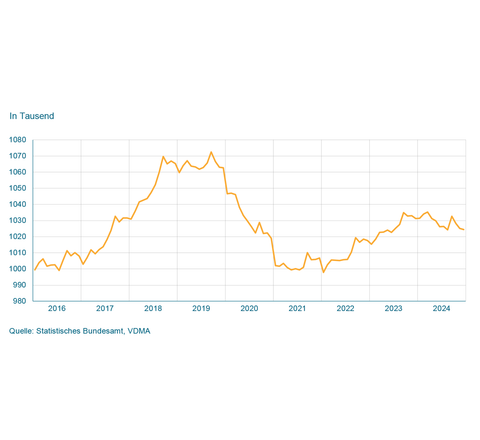
According to the VDMA, the number of jobs fell by 6,800 (-0.7%) over the course of the year to a total of 1.02 million employees in companies with at least 50 employees. "The mechanical and plant engineering sector was thus able to maintain its position as the largest industrial employer in Germany. This is remarkable because, according to preliminary figures from the Federal Statistical Office, mechanical engineering production fell by 7.5% in the past year after adjusting for prices," commented VDMA Chief Economist Dr. Ralph Wiechers.
Growing concerns for 2025
Nevertheless, the outlook for the labor market remains tense. Early indicators such as the ifo employment barometer and the latest VDMA economic survey suggest that job cuts will continue in 2025. "This will not pass entirely without leaving its mark on employment figures," warned Wiechers. Manufacturers of capital goods, who are struggling with considerable economic and structural challenges, are particularly affected.
Short-time work on the rise
Many companies are increasingly relying on short-time work to avoid redundancies. According to the Federal Employment Agency, around 53,000 mechanical engineering employees were on short-time work in October 2024 - and the trend is rising. According to the VDMA survey, 27% of companies expect a further increase in short-time work in the first half of 2025, while 58% anticipate a stable level. Despite all efforts, a quarter of companies expect to reduce their workforce. "How much of this will be permanent and how much can be compensated for by new hires at a later date is impossible to say with any certainty," says Wiechers.
Demand for reforms
The VDMA is calling for rapid labor market policy reforms. Rising social security contributions are a particular burden on companies. "There is a great need for structural action to stabilize the social security system. Because their contributions continue to drive up the cost of employment," emphasized Wiechers. In addition, a more flexible working time law with weekly instead of daily maximum working hours and a reduction in bureaucracy are urgently needed. "If you want to retain medium-sized industrial companies, you must not shy away from sometimes painful reforms in the labor market," Wiechers concluded.


You might also be interested in
Portal for data exchange in mechanical...
VDMA and Innovalia develop data rooms
VDMA and Innovalia are jointly developing a data room portal for mechanical and plant engineering. It is intended to facilitate the secure exchange of data and accelerate the use of data-based applications in industry.
 read more...
Industry invests more in AI
A survey by the ZVEI shows: Almost every second company in the electrical and digital industry is already using industrial AI productively. Many are planning increasing investments and expect rapid economic effects. The industry is forecasting...
read more...VDMA at the Hannover Messe 2026
Relocation concerns in mechanical engineering
The German mechanical and plant engineering industry is under increasing pressure from regulation, high costs and geopolitical risks. According to the VDMA, many companies are considering investing abroad. At the same time, the industry remains...
read more...Weak start to the year for incoming orders
The German mechanical and plant engineering sector is off to a weak start in 2026. In January, price-adjusted incoming orders were 6% below the previous year's level, with fewer orders received from euro countries in particular.
read more...Electrical industry expects growth again in 2026
After three weak years, the German electrical and digital industry expects real production growth of 2% again in 2026. Exports to Europe are stabilizing business, while customs duties, network expansion and AI regulation remain key challenges.
read more...David Reger appointed to the Management Board
The founder and CEO of Neura Robotics, David Reger, is a new member of the board of the VDMA Robotics + Automation Association.
read more...International Federation of Robotics
These are the five key robotics trends for 2026
The global market value of installed industrial robots reaches 16.7 billion US dollars - a new high. The International Federation of Robotics (IFR) analyzes five technological and structural trends that will shape robotics and automation in 2026.
read more...Incoming orders fall in the third quarter
Incoming orders in the German machine tool industry fell by 5% in the third quarter of 2025. Domestic demand in particular fell sharply, while foreign orders remained stable. Dr. Markus Heering from the VDW explains the current trends and regional...
read more...Business calls for a reduction in bureaucracy
Associations urge implementation of the 'Omnibus I' package
Nine leading business associations criticize the failure of Omnibus I in the European Parliament and call on the EU and the German government to swiftly implement the planned reduction in bureaucracy to ease the burden on companies.
read more...