
Measurement technology
Power under control
Mechanical surface hammering involves the targeted modification of metallic surfaces. However, it has not yet been possible to record parameters such as the force and acceleration of the hammer ram and evaluate them in real time - something that a transfer project from "Digital in NRW" aims to change.
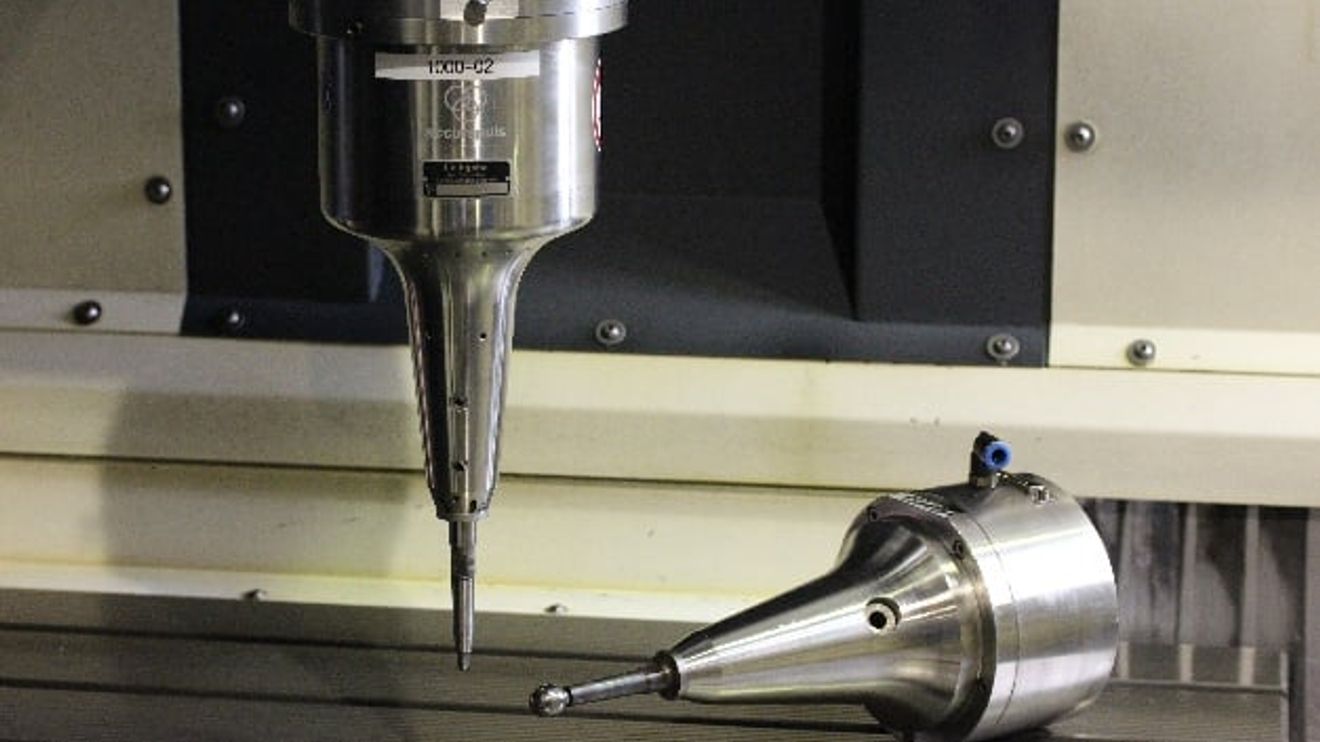
The Dengel hammer has been used for centuries to sharpen scythes. It is used to thin and sharpen the edge of the cutting edge by hammering. Mechanical surface hammering using modern CNC technology has developed from this very simple technique. A hammer head with a ram processes the surface of a workpiece at a high frequency. In this way, for example, the functional surfaces of deep-drawing tools for car body parts can be influenced in such a way that they interact optimally with tribological systems and thus minimize friction and wear during forming. Surface hammering can also be used to specifically increase the strength of highly stressed components such as ship propellers and turbine blades. It is therefore a (surface layer) hardening process that does not require a chemical process or high temperatures. Only mechanical energy is applied to the workpiece.
One specialist in this field is the company Accurapuls from Lippetal, which was founded in 1995 and is regarded as the world leader in the electromechanical surface hardening of metallic components using mechanical surface hammering.
The electromechanical hammer system
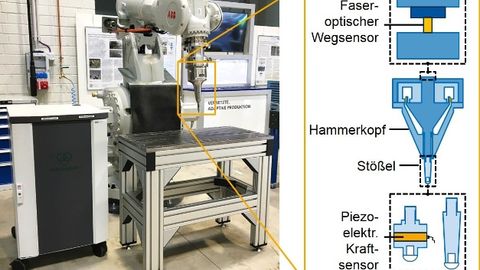
An electromechanical hammering system from Accurapuls: adapted to an industrial robot. Next to it, the sensor implementation in the hammer head.
© WZLThe electromechanical hammering system developed by Accurapuls allows metallic tool surfaces to be plastically deformed. A spherical ram processes the roughness peaks on the surface of the metallic components with high-frequency impacts of up to 500 Hz and thus smoothes them incrementally. This leads to an increase in hardness and thus to a hardening of the edge zone and, as a result, significantly increases the wear resistance of the metallic components.
In addition to this hardening process, surface hammering can also be used to polish or tap alloy and finishing materials and to induce residual compressive stresses in metallic components. In this way, the tendency to crack formation is prevented and fatigue strength is increased. Depending on the material composition, penetration depths of up to 15 mm can be achieved. Compared to mostly manual polishing processes, the user benefits from shorter throughput times and a surface roughness <0.3 µm with complete reproducibility.
Online force measurement for process control
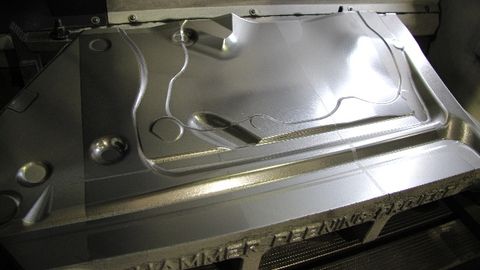
Hammered areas (specular) on the surface of a casting tool made of EN 2070 cast iron for automotive deep-drawing applications.
© WZLWhen adapting the hammering or tapping process to the individual component and the desired material properties, Accurapuls employees are highly dependent on empirical values, as only the process parameters frequency, ram travel and power to be applied have been adjustable to date. The force with which the slide hits the workpiece is still unknown because there is no online force measurement. Therefore, neither a real-time process analysis nor the resulting optimization of the ongoing process are currently possible.
This is where the transfer project "Networked mechanical surface hammering" of the 'Digital in NRW' competence center comes in. The aim of the project was to implement force and displacement measurement technology in the hammer head of the electromechanical hammering system as well as real-time signal recording and wireless transmission of the data with microcontrollers to a cloud-based analysis platform. Accurapuls worked together with the Machine Tool Laboratory (WZL) at RWTH Aachen University; the WZL is one of the research partners of the 'Digital in NRW' competence center.
The project participants first defined the requirements for the sensor technology and signal evaluation. Suitable piezoelectric force sensors and fiber optic distance sensors were then selected. The optimum positioning of the sensors and their implementation in the hammer tappet or hammer head were also investigated.
Data in the cloud
The sensors record the hammer force applied and the distance traveled by the ram. This data is transmitted wirelessly to a cloud-based platform where it is analyzed. The sensors and evaluation are designed in such a way that existing surface hammering systems can also be retrofitted and technically upgraded.
One challenge that had to be overcome when developing the 'force tappet' for online force measurement was its weight. The tappets used in the Accurapuls systems weigh around 60 grams. By integrating a sensor into a specially designed plunger, the weight is increased
The integration of a sensor into a specially designed plunger increases the weight so that the oscillating mass changes, which in turn has a significant effect on the process forces and kinematics.
A second challenge is signal transmission for data evaluation. When using microcontrollers or mini PCs, wireless data transfer must be guaranteed. The contact time during which the plunger is in contact with the material edge zone is very short during surface hammering. For this reason, a relatively high sampling rate must be ensured in order to record the analog measurement signal with sufficient accuracy. This results in a large amount of data, which must be sent wirelessly to the cloud in the shortest possible time due to the real-time requirement. Here, the project participants see the possibility of reducing the amount of data required and thus enabling real-time transmission to the cloud, primarily through the selection of protocols (e.g. MQTT).
Simulation of the process
The project also creates the basis for an optimized process design: The data can be used to create a precise finite element simulation of the hammering process. The primary purpose of the simulation is to investigate variables that are difficult or impossible to measure, such as stresses and strains. In order to achieve the most accurate results possible, a precise representation of the real process kinematics is required (force-displacement diagrams from sensor data) as well as a precise representation of the material behavior.
Based on the simulations, predictions can then be made about the material behavior in the workpiece edge zone, among other things. This is particularly important if the process is to be used for new materials. In addition, the determined force and acceleration profiles offer the possibility of expanding the control technology of the hammering systems in the future.
The project result
The concrete result of the five-month transfer project is an implementation concept on the question of how medium-sized companies can economically equip their existing hammering systems with sensors and benefit from the advantages for their production. The real-time evaluation also provided insights into how the reproducibility and precise control of the process can be improved in the future. This applies not only to surface hardening, but also to polishing and the introduction of compressive stresses by surface hammering.
For the companies using the technology, the introduction of networking in mechanical surface hammering is also a step towards digital production, which promises to increase efficiency as well as knowledge.
Author:
Robby Mannens is an employee of the Machine Tool Laboratory WZL at RWTH Aachen University.
The 'Digital in NRW' competence center
With 'Digital in NRW - The Competence Center for SMEs', the federal initiative 'Mittelstand 4.0' is being implemented in North Rhine-Westphalia. Small and medium-sized enterprises in NRW receive targeted support in the planning and implementation of digitalization projects in line with the principles of Industry 4.0, with one company and one research partner working on a specific project for a defined period of time. The spectrum of projects carried out to date ranges from production planning and control to product development, quality and process management and human-machine interaction.
Thecontacts for 'Digital in NRW' projects are research institutions from three business and research locations in the Rhineland, the Ruhr Metropolis and OstWestfalenLippe.


You might also be interested in
The e-paper of issue 1/2-2024
Distributors can help to master the three megatrends of electrification, automation and digitalization. The service providers explain how in this issue. Our new article series "ChatGPT in the industry" also starts in issue 1/2-2024.
 read more...
The top articles in January 2024
The year is off to a fast start for companies and is already bringing with it all kinds of collaborations and changes at this early stage. Developments in the field of robotics and control technology are not standing still either, as our top...
read more...Large mobile robot for flexible use
The Laboratory for Machine Tools and Production Engineering (WZL) at RWTH Aachen University has presented a large mobile robot as part of its research into line-free mobile assembly systems, or LMAS for short. This enables the flexible manipulation...
read more...WSS research prize for RWTH Aachen University
100 million Swiss francs for sustainability research
A team from RWTH Aachen University came out on top in the Werner Siemens Foundation's ideas competition and won 100 million Swiss francs for research into technologies for the sustainable use of resources.
read more...Cobots - lightweight robots with great potential
In recent years, so-called lightweight robots have been developed. They are also known as collaborative robots or cobots. A group of scientists at RWTH Aachen University has researched how these mechanical helpers can be integrated into a system.
read more...Additive manufacturing for the lightweight construction of flexible grippers
How can the use of flexible lightweight grippers promote the energy-efficient operation of robots in production? The research project "addFlex - Additive manufacturing for the lightweight construction of flexible grippers" aims to answer this...
read more...The "GeMeKI" research project
The GeMeKI research project at the WZL at RWTH Aachen University is investigating the use of transferable AI applications to optimize production.
read more...The German-Emirati Institute
RWTH Aachen University is establishing the new German-Emirati Institute in Germany to promote scientific and economic exchange between the United Arab Emirates (UAE) and the Federal Republic of Germany.
read more...Key to the 'factory of tomorrow'?
5G can play a key role in the digitalization of manufacturing processes in the future. This series of articles deals with the prerequisites that need to be created for this. The first part deals with the characteristics of 5G and typical...
read more...