

TU Munich
The sensitive robot
A team at the Technical University of Munich has developed a system of artificial skin and control algorithms inspired by biological models. This has enabled a human-sized autonomous robot to be fitted with artificial skin over a large area for the first time.
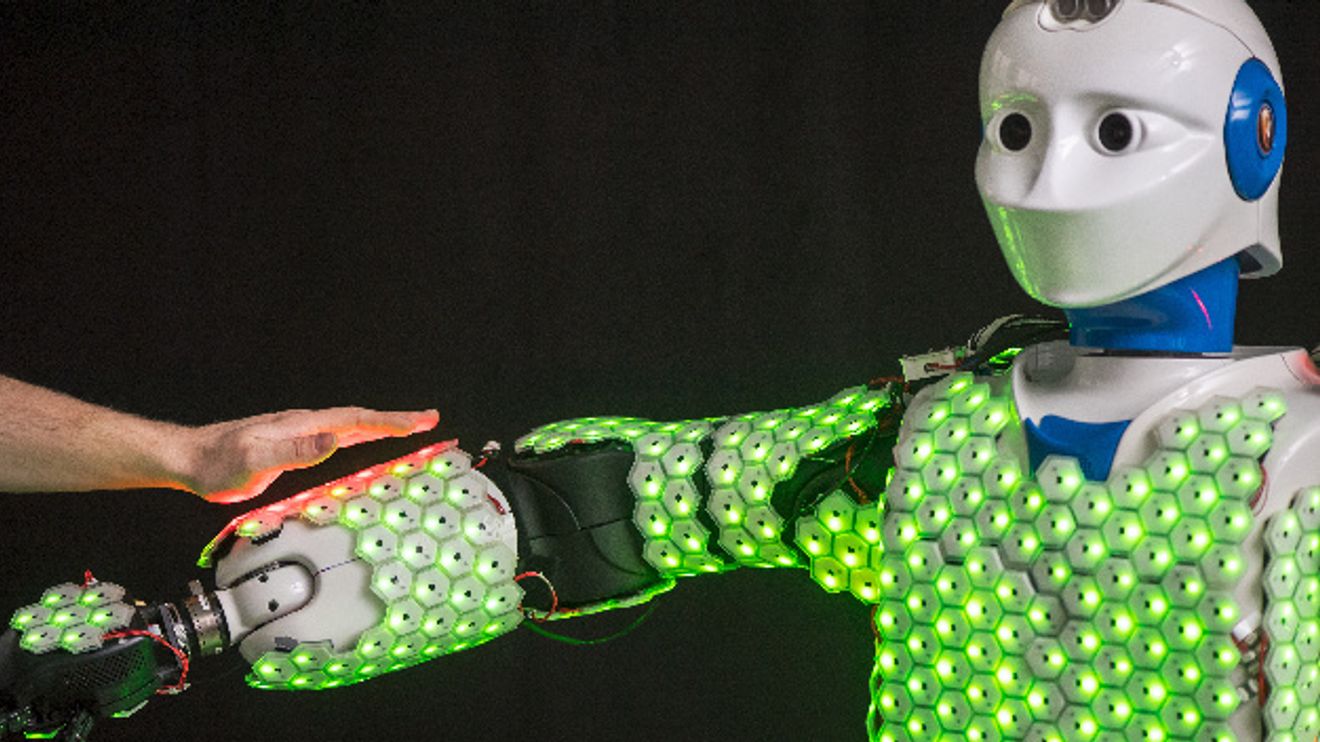
Sensitive artificial skin allows robots to feel their bodies and their surroundings, which is particularly important for close contact with humans. The artificial skin developed by Prof. Gordon Cheng and his team at the Technical University of Munich (TUM) is made up of hexagonal cells about the size of a two-euro coin. Each is equipped with a microprocessor and sensors that measure touch, acceleration, proximity and temperature. Such artificial skin enables robots to perceive their environment in much more detail and with greater sensitivity, which not only helps them to move safely, but also ensures that the machines are safer when interacting with people and can actively avoid accidents.
The biggest obstacle to the development of robotic skin has so far been computing capacity. Human skin has around five million receptors. If you want to permanently evaluate the data from sensors in artificial skin, the limits quickly become clear. Previous systems were already working at full capacity with data from a few hundred sensors. To solve this problem, Gordon Cheng and his team have chosen a neuroengineering approach. Instead of permanently monitoring skin cells, they use what is known as an event-based system, which reduces the computing effort by up to 90 %. The trick: individual cells only pass on information from their sensors when measured values change. Our nervous system works in a similar way. For example, we feel a hat the moment we put it on, but we quickly get used to it. As there is no need to constantly pay attention to the hat, we only become aware of it again when it blows off our head. This allows our nervous system to concentrate on new impressions to which the body has to react.
Safety even with close physical contact
The event-based approach has made it possible for the first time to equip a human-sized autonomous robot that is not dependent on external calculations with artificial skin. The H-1 robot is equipped with a total of 1,260 cells and accordingly more than 13,000 sensors on its upper body, arms, legs and even on the soles of its feet, which provide a new 'body feeling'. For example, the skin on the soles of the feet helps H-1 to react to unevenness in the ground and even balance on one leg.
Through the skin, H-1 is able to hug a person safely. This is less trivial than it sounds: robots can exert forces that would seriously injure humans. When hugging, a robot has contact with a person at many different points and must very quickly calculate the correct movements and the appropriate amount of force from this complex information. "This may be less important in industry, but in areas such as care, robots need to be designed for very close contact with people," explains Gordon Cheng.
The robotic skin system is also robust and variable. As the skin is made up of cells rather than a single piece, it is still functional even if individual cells fail. "Our system is designed to work smoothly and quickly with all types of robots," says Gordon Cheng. "We are now working on designing smaller skin cells that can be produced in larger quantities in the future."


You might also be interested in
Robots for the hospital of the future
ABB has opened its first global Health Care Hub dedicated specifically to healthcare research on the campus of the Texas Medical Center (TMC) in Houston, Texas. A number of technology concepts were presented at the opening, including a mobile YuMi...
 read more...
IFR forecasts growth pause at record level
The 'World Robotics Report 2019' published by the International Federation of Robotics (IFR) reports a global record sales value of 16.5 billion US dollars for industrial robotics in 2018. After a pause in growth this year, double-digit growth is...
read more...Preview of the 'Human Robot Forum 2019'
What can visitors expect at the 'Forum Mensch Roboter 2019', which takes place in Stuttgart in October? Congress director Prof. Dr. Markus Glück gives an outlook on the two-day event with accompanying exhibition in the short video.
read more...Nominations for Electrifying Ideas Award have been announced
An independent jury of top-class experts from business, research and society has nominated three companies for the Electrifying Ideas Award 2026: Ideas from Philips, Rittal and ZeMA - Center for Mechatronics and Automation Technology convinced the...
read more...Circular economy for flexible materials
With a budget of 7.5 million euros and twelve partners from six countries, the European research project 'FlexCycle' is pursuing the goal of making recycling processes for the reuse of flexible materials suitable for industrial use. To this end, it...
read more...Schunk founds tech spin-off for humanoid robot hands
Schunk is bundling its activities in humanoid robotics by founding its own spin-off at the beginning of January. The aim of the new company is to develop modular humanoid robot hands for industrial applications.
read more...Second generation of vacuum grippers
Coval has redeveloped the carbon face gripper 'CVGC'. The new generation also takes into account current and future trends in the market for collaborative robots.
read more...Schunk receives the Hermes Award 2024
Schunk was honored with the Hermes Award for its AI-based project during the opening ceremony of the Hannover Messe.
read more...Schunk at the Hannover Messe 2024
Digital and automated for healthy production
Schunk is focusing on two key topics in Hanover: 'The Healthy Factory' and 'Innovation through Collaboration'. The aim is to design a healthy and economically successful production for people and the environment.
read more...