

Joanneum Research
The evaluation of physical security
When robots are used as collaborative assistance systems in modern production, they are operated without a safety fence. Physical safety therefore plays a very important role for the workers involved.
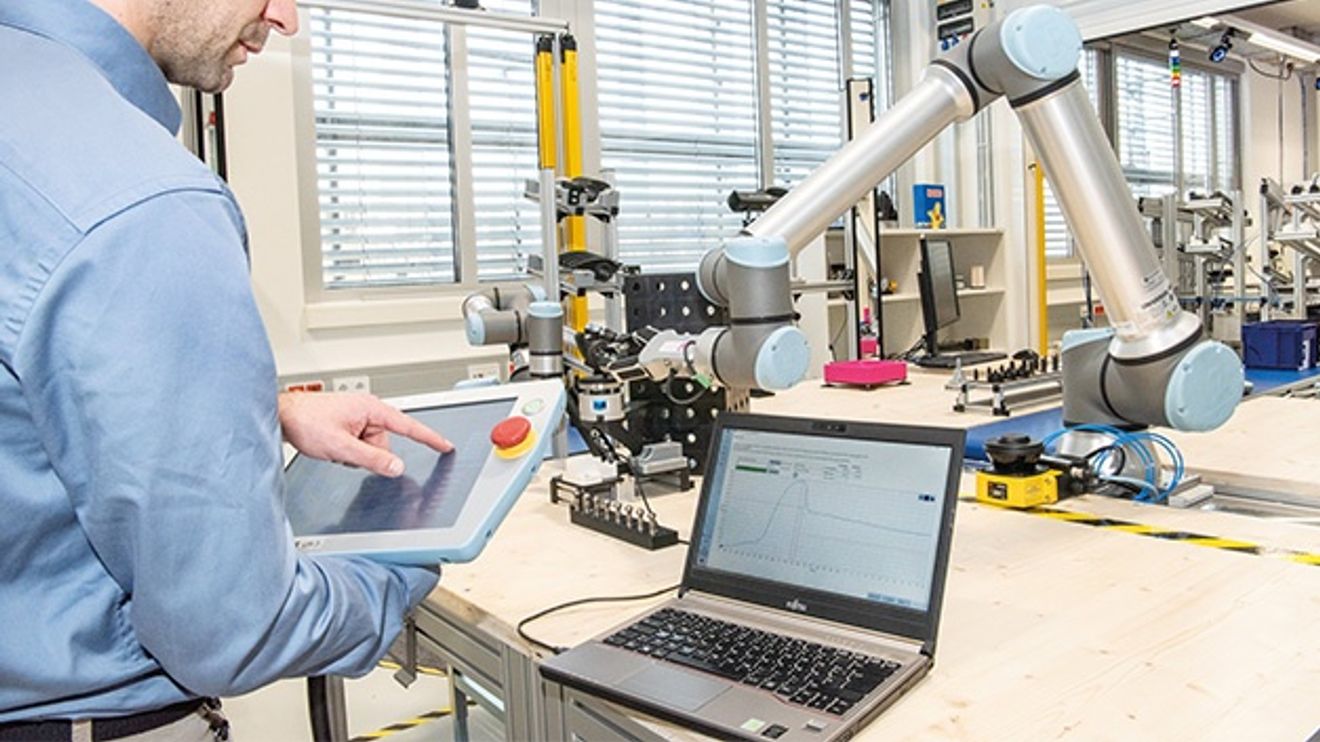
Digitalization and automation in production require modern robotic systems that not only perform their tasks correctly, but also without danger to humans. The safety issue becomes particularly important when these systems are not only used in production areas specifically designed for robots, but also operate as so-called 'cobots'. Unlike traditional industrial robots, these robots, which have been specially developed to work together with humans, operate in the same work area so that they can carry out production steps together. Due to the close cooperation, the possibility of unintentional physical contact between robots and humans cannot be ruled out.
Clearly structured rules are needed to define the safety of human-robot collaboration. In addition to the EC Machinery Directive 2006/42/EC, harmonized standards and regulations for robot safety define the regulatory framework for safe collaboration between humans and robots in an industrial application context - in particular ISO 10218:2011 (Industrial robot safety requirements) and ISO/TS 15066:2016 (Robots and robotic devices - Collaborative robots). The special feature of cobots is their extended equipment with additional, highly reliable sensors and their ability to implement safety-rated functions that go beyond the mandatory emergency stop. For example, the robot can monitor and limit its position and speed with increased reliability.
Part 2 of ISO 10218, which deals with the safety of robot systems, describes the relevant safety measures for collaborative robot operation. Four clearly outlined scenarios for physical collaboration between humans and robots are defined for this purpose. A predefined task execution, the activation of all necessary safety measures and the use of a robot (cobot) designed for collaborative operation form the starting point for these interaction scenarios. The four options are
- Safety-assessed monitored stop (and restart)
- manual guidance
- Speed and distance monitoring
- Power and force limitation
For modern robot applications, the latter two operating modes are of particular interest.
Physical robot safety and its evaluation
In classic robot systems, structural and functional safety measures are used to prevent an unintentional collision between humans and robots. These precautions are particularly necessary if moving parts of the robot and the robot environment are not monitored in a safety-rated manner and this object detection is used for collision avoidance. Due to the insufficient availability of safety-rated sensors for valid environment detection, the 'speed and distance monitoring' operating mode is currently still reaching its limits in terms of applicability. This is also one of the main factors why this form of collaboration is mostly still being investigated in the laboratory environment as part of research work and is only occasionally used in an industrial context.
In contrast, the 'power and force limitation' operating mode is currently the most widespread collaborative operating mode. As the name suggests, the performance parameters of the electric drives in the robot joints and the sensitivity of the control in the form of force limitation are set in such a way that, in the event of a human-robot contact situation, the impact energy transmitted from the robot to the human is below the normative specifications.
The test laboratory
The Robotics Evaluation Lab (REL) - https://rel.joanneum.at/ - is a specially equipped measurement and testing laboratory of the Joanneum Research Forschungsgesellschaft at the Robotics Institute in Klagenfurt am Wörthersee. In this laboratory, biofidelic loads in contact situations in robot applications can be measured and evaluated in a traceable and valid manner. For this purpose, calibrated state-of-the-art measuring equipment is used and the entire testing process is carried out under quality assurance measures in accordance with ISO/IEC-17025. The Robotics Evaluation Lab is the first and only test center in Europe to be accredited to measure the potential impact of force in human-robot collaboration. Depending on customer specifications, the tests are carried out at the REL premises or directly on site at the customer's system.
In addition, the testing laboratory supports business and industry with project-related consulting services, independently conducted safety and risk assessments and competence-enhancing training in the field of robot safety. Thanks to their involvement in national and international standardization committees, the experts in the testing team are always up to date with the latest developments in this field and can actively shape trends based on their practical expertise. Under the motto 'Safety as a Service', tailor-made and practice-oriented service packages are offered for the entire design and life cycle of robot systems.
Identification of potentially dangerous situations

The Robotics Hands-on Area is a modular test and verification platform in which a wide range of industrial applications can be simulated and their physical safety verified.
© Joanneum ResearchAs a first step, potentially hazardous contact situations must therefore be identified in a corresponding risk assessment as part of the intended use of the robot system and in the event of foreseeable misuse. The minimum requirements of the Machinery Directive and the principles of the ISO 12100 and ISO 10218 standards must be observed. Identified mechanical hazards can occur in the form of crushing or free impact situations. In crushing situations - so-called quasi-static contact - a part of the body (e.g. hand or arm) is trapped between a moving robot part and a rigid surrounding object. In free impact situations - known as transient contact - the load is only of short duration, as the human body part involved in the impact (e.g. shoulder) can move back.
According to the requirements of the safety standard for collaborative robotics ISO/TS 15066, precisely these two types of load - i.e. a quasi-static load value for the case of clamping and a transient load value for the case of impact load - must be evaluated for the physical contact situations that pose a risk according to the risk assessment.
Both the contact force and the associated contact pressure value must be recorded for the evaluation of a human-robot contact load. For a conformity assessment, the ISO/TS 15066 standard contains a comparative table with limit values determined from corresponding studies for the onset of human pain when force and pressure are applied to different parts of the body. The measured quasi-static or transient force and pressure values are compared with these specifications, taking into account the measurement uncertainty. If the limit values are exceeded, risk-reducing measures must be taken. If the force load is too high, this typically involves reducing the speed of movement or increasing the robot sensitivity with regard to the shutdown behavior if the torque load on the joint drives is too high. If the pressure load is too high, a structural modification of the robot tool or a workpiece holder to increase the contact surface usually leads to the required limit values being reached - for example by rounding off or padding sharp edges.
Metrological verification

Michael Rathmair is head of the Robotics Evaluation Lab competence group at the Joanneum Research Forschungsgesellschaft in Klagenfurt, Austria.
© Joanneum ResearchDuring the design phase, computer-aided tools such as simulation, virtual commissioning and digital images of the system can make a valuable contribution to the verification of physical robot safety, i.e. the conformity of potential transient and quasi-static contact loads. However, no simulation software can currently replace a metrological evaluation directly on the realized collaborative robot system. In addition, this metrological investigation is essential in order to provide certainty as to whether the robot system behaves reliably and therefore safely.
During metrological verification, potential collisions between humans and robots are examined in the sense of a non-destructive crash test using a so-called biofidelic measurement setup. Biofidelic means that the measuring devices (force and pressure measuring instrument) are equipped in such a way that the compliance properties of the body part involved in the contact are technically simulated. This is achieved using a combination of steel springs and plastic damping elements. The measuring arrangement is then positioned accordingly in the robot's workspace and the contact situation to be evaluated is brought about by executing the corresponding control program. In the process, force and pressure loads are determined and their conformity assessment against normative specifications, as described above, is carried out. In order to guarantee the validity of the results, quality assurance measures in accordance with ISO 17025 (General requirements for the competence of testing and calibration laboratories) should be observed. This includes cyclical and accredited calibrations of measuring equipment, proficiency tests and participation in interlaboratory comparisons, adequate documentation of measurement results in test reports and the handling of test projects using a suitable QM system.


You might also be interested in
Nominations for Electrifying Ideas Award have been announced
An independent jury of top-class experts from business, research and society has nominated three companies for the Electrifying Ideas Award 2026: Ideas from Philips, Rittal and ZeMA - Center for Mechatronics and Automation Technology convinced the...
 read more...
Circular economy for flexible materials
With a budget of 7.5 million euros and twelve partners from six countries, the European research project 'FlexCycle' is pursuing the goal of making recycling processes for the reuse of flexible materials suitable for industrial use. To this end, it...
read more...Schunk founds tech spin-off for humanoid robot hands
Schunk is bundling its activities in humanoid robotics by founding its own spin-off at the beginning of January. The aim of the new company is to develop modular humanoid robot hands for industrial applications.
read more...Second generation of vacuum grippers
Coval has redeveloped the carbon face gripper 'CVGC'. The new generation also takes into account current and future trends in the market for collaborative robots.
read more...Schunk receives the Hermes Award 2024
Schunk was honored with the Hermes Award for its AI-based project during the opening ceremony of the Hannover Messe.
read more...Schunk at the Hannover Messe 2024
Digital and automated for healthy production
Schunk is focusing on two key topics in Hanover: 'The Healthy Factory' and 'Innovation through Collaboration'. The aim is to design a healthy and economically successful production for people and the environment.
read more...These are your winners!
We put 96 products in twelve categories to your vote in December, and now the winners have been chosen! The trophies were presented at a 'Winner's Dinner' at the Seehaus in Munich. These are your "Products of the Year 2024"!
read more...Robotics & Handling - The winners
They ensure fast and safe handling of components and get them reliably from A to B: the winning products in the 'Robotics & Handling' category.
read more...Automation of separation processes
With the Solution Kit Part Separation with 2D Grasping Kit, fruitcore robotics and Schunk present a solution for the vision-based separation of non-layer-oriented workpieces.
read more...