
Practical test in Erlangen
Siemens uses humanoid robots in its plant
Humanoid robots working in factories has long been considered a vision of the future. Siemens, Nvidia and the British start-up Humanoid have now brought this moment a little closer - with a tangible practical test under real conditions.
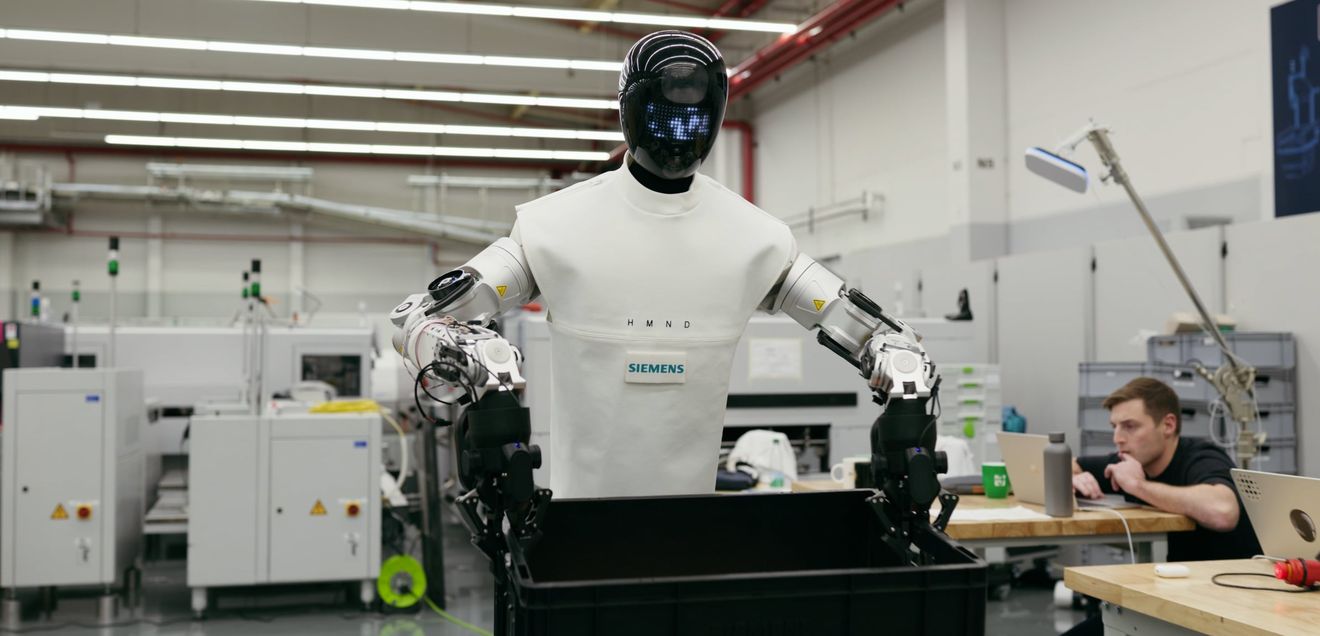
At the Siemens electronics plant in Erlangen, the wheel-driven humanoid HMND 01 Alpha performed autonomous logistics tasks for several hours: Grasping, transporting and depositing containers. Sounds simple, but it's not - at least not for a machine that is supposed to do this alongside human colleagues in a running production environment. The results are impressive: More than 60 container movements per hour, an operating time of over eight hours and a success rate for autonomous pick-and-place of over 90 percent.
What makes the test technically interesting is less the robot alone than the ecosystem behind it. Humanoid has fully integrated Nvidia's Physical AI stack into the HMND-01 platform - from Jetson Thor for edge computing to Isaac Sim for simulation and Isaac Lab for reinforcement learning. Remarkably, the simulation-based development approach allowed the prototype phase to be shortened from the typical 18 to 24 months to around seven months.
Building the industrial backbone
The true value of a humanoid robot lies in becoming a fully integrated component in manufacturing. This requires data exchange with production systems and other automated guided vehicles, synchronized workflows with other machines and human operators, and adaptive behavior that responds dynamically to changing conditions. Without this deep integration, even the most sophisticated robot remains an isolated building block.
Siemens provides the industrial backbone. The Xcelerator portfolio provides the digital twin, fleet management, communication networks and control interfaces as well as drives - everything that is necessary for humanoid robots to work efficiently in the entire factory environment. The result is a factory-ready model for the use of humanoids in any industrial environment.
"The factories of the future will require robots that can autonomously sense, understand and adapt to their environment alongside human workers to address the labor shortages and operational complexity that traditional automation has struggled with," said Deepu Talla, Vice President of Robotics and Edge AI at Nvidia.
Humanoid: Development of factory-ready humanoids
Behind the HMND 01 Alpha is the British AI and robotics company Humanoid, which designed its robot from the ground up for industrial use - not a retrofitted laboratory prototype, but a system that was designed from the outset to meet the requirements of real production environments. The omnidirectional wheel platform ensures flexible mobility in everyday factory operations, while the in-house AI framework KinetIQ provides the necessary intelligence for changing tasks and complex handling operations.
Company founder and CEO Artem Sokolov sees the Erlangen test as proof that the step from the lab to the factory has been successful - and that the combination of Nvidia's AI infrastructure and Siemens' industrial integration expertise was crucial.


You might also be interested in
Vertiv and Nvidia link physical infrastructure with digital twins
Digital twins instead of a flood of documents: Vertiv integrates 'SmartRun' into 'Nvidia Omniverse DSX' to accelerate the planning and implementation of AI factories.
 read more...
Quantum-resistant hardware security for Nvidia robotics platform
Infineon Technologies integrates the hardware security module 'Optiga TPM SLB 9672' into Nvidia's 'Jetson Thor' computing platforms for robotics and autonomous systems. The module secures cryptographic keys directly at chip level and thus protects...
read more...Ionos and Q.ANT cooperate on AI
Ionos and Q.ANT want to jointly advance photonic processor technologies for AI and high-performance computers. The aim of the partnership is to build energy-efficient and sovereign AI infrastructures in Europe.
read more...AI-supported lighting robot wins German Innovation Award 2026
Ledvance, provider of innovative lighting solutions, was named "Winner" in the Excellence in Business to Consumer Lighting category at the German Innovation Awards 2026. With the AI Companion Lighting Robot 'Elix', the company presents an...
read more...Paderborn University becomes part of 'ELLIS NRW'
Paderborn University is one of the founding members of the new research unit 'ELLIS Unit NRW'. The European network bundles AI research in North Rhine-Westphalia with a focus on machine learning and explainable AI.
read more...AI 'CheckMate' optimizes industrial processes
With 'CheckMate', the University of Klagenfurt has developed an AI system that independently creates algorithms for complex combinatorics and optimization problems. The technology is designed to make industrial planning and logistics processes more...
read more...New approaches in drive technology
Nabtesco develops physical AI solutions
Nabtesco is working on intelligent drive systems for industrial applications. The focus here is on the use of physical AI, the combination of artificial intelligence with real physical systems.
read more...Regulation and safety slow down robotics projects in Germany
QNX has published the study "Inside the Robot: Architecture Benchmark Report". The results of the global survey of 1000 robotics developers show that software and safety requirements are increasingly becoming the central bottleneck for innovations...
read more...Michael Ardelt becomes first COO at Robco
Robco, a company for autonomous industrial robotics, is further expanding its management team. As the company's first Chief Operating Officer, Michael Ardelt will assume responsibility for structuring and scaling Robco's growth in operational terms.
read more...