

In the 5G test field
Autonomous fruit and wine-growing robot
The test phase for the 'Elwobot', an autonomous fruit and wine-growing robot with a modular energy supply and electric drive, is starting immediately in the 5G test field.
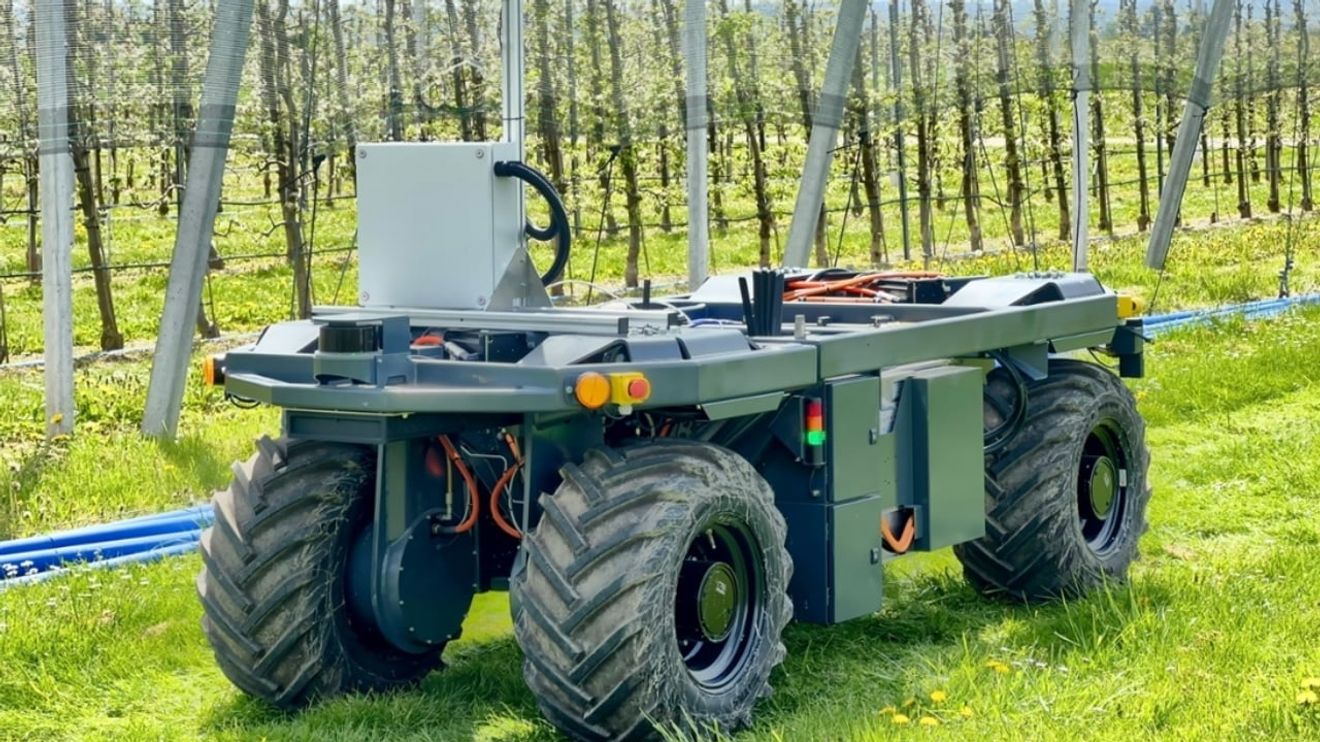
To test the 'Elwobot', the Technical University of Dresden and the Fraunhofer Institute for Transportation and Infrastructure Systems IVI have installed a small mobile 5G transmitter unit on the test fields of the Saxon State Office for Environment, Agriculture and Geology (LfULG) in Dresden-Pillnitz. Until spring 2024, all the work steps that the Elwobot will perform in the future will be tested in an apple orchard. For example, it is being tested how the use of pesticides can be reduced to the absolute minimum by scanning the treetops with a LiDAR sensor that determines the condition of the foliage. In addition, the sensor will continuously monitor the trees' leaf growth and thus provide information on the state of the nutrient supply. Tests are also being carried out to see how well the Elwobot can carry out maintenance measures such as working the area under the trees and mowing and mulching the tramlines.
The robot is to drive fully autonomously, both on planned and learned routes. This includes, for example, driving autonomously to the Agri-PV test facility of the HTW Dresden on the Pillnitz test areas to recharge the battery. Maximum safety for people and the environment is ensured by 2D and 3D laser sensors, which provide orientation and navigation in the plantation and detect obstacles.
In order to process the large amounts of data generated and adapt the crop protection module to the tree structure in real time, the data is sent to a central computer using 5G technology, processed and the adapted control commands are sent back.
The power and alignment of the 5G antenna are limited to the Elwobot's area of operation on the approximately nine-hectare test field in Pillnitz. This is intended to save energy and not interfere with other radio sources such as Wi-Fi, cell phones, CB radio or radios. The project will also test how well this works in practice. In order to further optimize energy consumption, the test field will only be activated for measurements of the transmission power in changing vegetation or for test drives of the Elwobot.
The Elwobot is a joint research project of the TU Dresden and the LfULG. The costs totaling around 1.8 million euros are being borne by the Free State of Saxony. A pre-series model of the Elwobot should be ready in summer 2024.


You might also be interested in
'Robot kitchen' opens
The CeTI Cluster of Excellence at TU Dresden has opened a 'robot kitchen' as a research laboratory for human-machine interaction. Among other things, it is intended to demonstrate the capabilities of modern cobots.
 read more...
Robotics - The winners
Robotics is regarded as one of the key technologies for coping with demographic change. Cobots in particular are predestined for human-robot collaboration. But cobots are nothing without the right gripper, as the winners in the 'Robotics' category...
read more...9 % sales growth forecast
The German robotics and automation sector expects industry growth of 9% to EUR 15.7 billion in 2023.
read more...Research network wants to bring robots into the skilled trades
A Saxon research association wants to increase the use of robots in the skilled trades and at the same time counteract the shortage of skilled workers.
read more...Irrigation by robot
Researchers at the Barkhausen Institute and TU Dresden have developed a casting robot prototype. From the end of August, it will be making its first test rounds in the listed Pillnitz Palace Park.
read more...TUD opens "incubator" for start-ups
The Technical University of Dresden (TUD) and the Technical University of Munich (TUM) have opened the new "launchhub42 ComSpace". In addition to cutting-edge research for future 6G communication networks, it also focuses on visionary ideas from the...
read more...Saxony and Bavaria conduct joint research
Over the next three years, three universities from Munich and Dresden want to work on making the use of artificial intelligence even better. This also involves energy consumption.
read more...Dresden University of Technology
Robotics researcher honored
Prof. Roberto Calandra from TU Dresden received the IEEE Early Academic Career Award in Robotics and Automation for his research contributions to the implementation of a sense of touch in robots.
read more...'Robot kitchen' opens
The CeTI Cluster of Excellence at TU Dresden has opened a 'robot kitchen' as a research laboratory for human-machine interaction. Among other things, it is intended to demonstrate the capabilities of modern cobots.
read more...