

TU Dresden
'Robot kitchen' opens
The CeTI Cluster of Excellence at TU Dresden has opened a 'robot kitchen' as a research laboratory for human-machine interaction. Among other things, it is intended to demonstrate the capabilities of modern cobots.
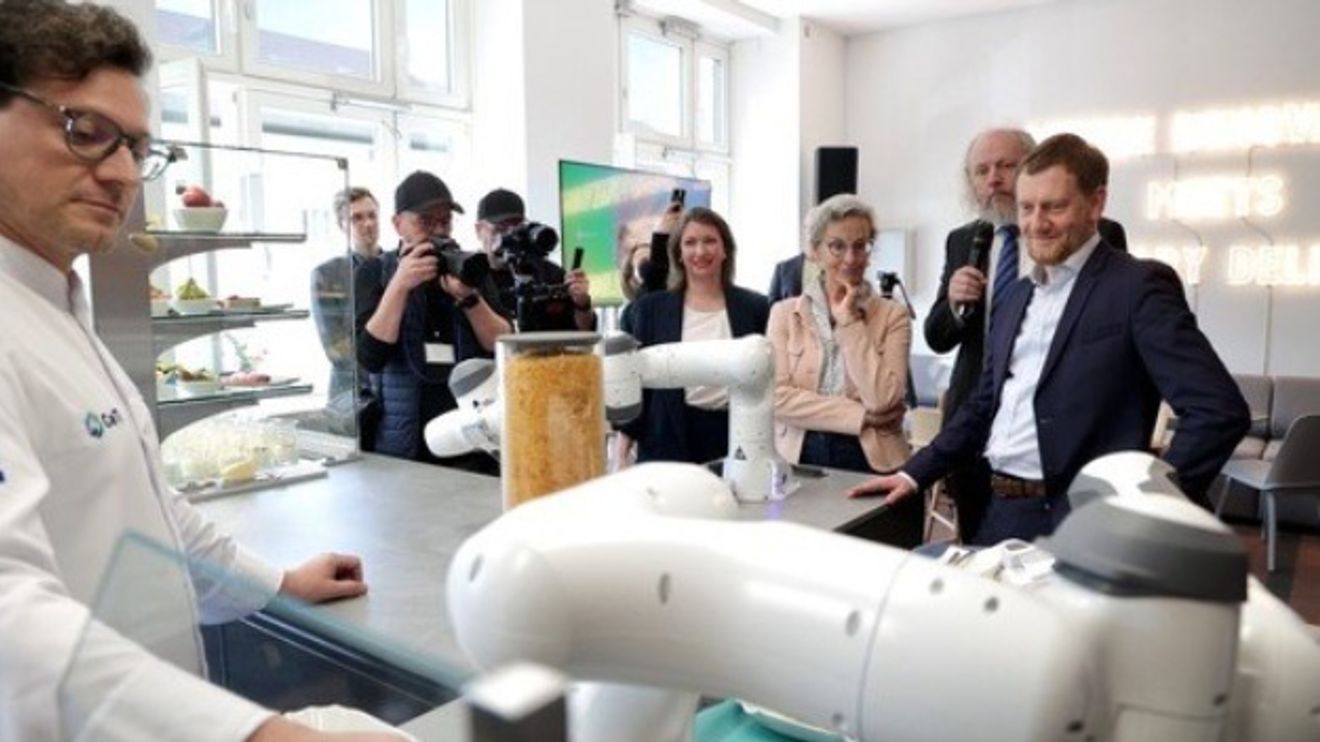
On April 15, 2024, the Cluster of Excellence Centre for Tactile Internet with Human-in-the-Loop (CeTI) at Technische Universität Dresden opened the 'CeTIBAR', a unique research laboratory that brings the performance of collaborative robots to life in an impressive way. The facility is used to research the interaction between humans and machines. At the same time, the direct presence of the cobots makes CeTIBAR "an inspiring venue where the results of innovative cutting-edge research become visible", according to the university.
The opening was attended by Saxony's Minister President Michael Kretschmer, Science Minister Sebastian Gemkow, University Rector Prof. Ursula M. Staudinger and celebrity chef Benjamin Biedlingmaier. The latter demonstrated the possibilities offered by the combination of top-class cuisine and top-class research.
"With CeTIBAR, we are inaugurating a living lab and a highly innovative place for science transfer on our campus. At this location, robotics and the future of the tactile internet can be experienced - a milestone on the path to democratizing skills and abilities," explains the University Rector.
"With CeTIBAR, we have created a place where researchers can collaborate across disciplines and test their ideas in society," says Prof. Frank Fitzek, spokesperson for the Cluster of Excellence CeTI at TU Dresden. CeTIBAR serves as a dynamic real-world laboratory for researchers from the Cluster of Excellence. There, they will get to the bottom of the question of how we will learn in the future or how our working world will be changed by robots.
At the opening, celebrity chef Benjamin Biedlingmaier gave a demonstration of his culinary skills in combination with robotics - while he created a dish, the machines prepared, decorated and served it. "The cobots take over repetitive tasks, leaving you more room for creativity. The idea behind this is not to replace the chef, but to support them in times of a shortage of skilled workers," he emphasizes.
The Center for Tactile Internet with Human-Machine Interaction is a Cluster of Excellence at TU Dresden. In future, people should be able to interact with robots or machines in the real or virtual world in real time. The aim of the research is to democratize access to skills and expertise in order to promote equal opportunities for people of different genders, ages, cultural backgrounds or physical disabilities. Scientists from the fields of electrical engineering, computer science, mechanical engineering, psychology, medicine and neuroscience work together on an interdisciplinary basis to create the foundations for new applications in medicine, industry and the Internet of Skills.


You might also be interested in
Dresden University of Technology
Robotics researcher honored
Prof. Roberto Calandra from TU Dresden received the IEEE Early Academic Career Award in Robotics and Automation for his research contributions to the implementation of a sense of touch in robots.
 read more...
Technical University of Munich
Care robot becomes a universal assistant
A generative AI model enables the assistance robot 'Garmi' from the Technical University of Munich to perform telemedical applications, physiotherapy or nursing tasks on demand for the first time - thanks to a digital twin, artificial intelligence...
read more...With robots, AI and photovoltaics
The semi-mobile agricultural robot called 'Davegi', developed by the start-up AI.Land in Kempen, which enables energy self-sufficient and resource-saving vegetable production using photovoltaics, is an exciting example of modern agricultural...
read more...No-code programming interface
RobCo has released the latest version of its easy-to-use programming interface 'RobFlow 5'. Based on the 'RobCo Studio' software platform, companies can configure, implement and manage robots in use via a digital twin.
read more...Humanoid robots on the assembly line
Humanoid robots are leaving the laboratory and moving into the production halls of large industrial companies, according to the Horváth market analysis 'Humanoid Robots in Operations'.
read more...Robotics & Handling - The winners
They ensure fast and safe handling of components and get them reliably from A to B: the winning products in the 'Robotics & Handling' category.
read more...Autonomous fruit and wine-growing robot
The test phase for the 'Elwobot', an autonomous fruit and wine-growing robot with a modular energy supply and electric drive, is starting immediately in the 5G test field.
read more...Research network wants to bring robots into the skilled trades
A Saxon research association wants to increase the use of robots in the skilled trades and at the same time counteract the shortage of skilled workers.
read more...Irrigation by robot
Researchers at the Barkhausen Institute and TU Dresden have developed a casting robot prototype. From the end of August, it will be making its first test rounds in the listed Pillnitz Palace Park.
read more...