

Relief for companies announced
Is Scholz releasing the handbrake?
There are obviously conciliatory tones between industry and the Chancellery. How the Chancellor presents himself to industry.
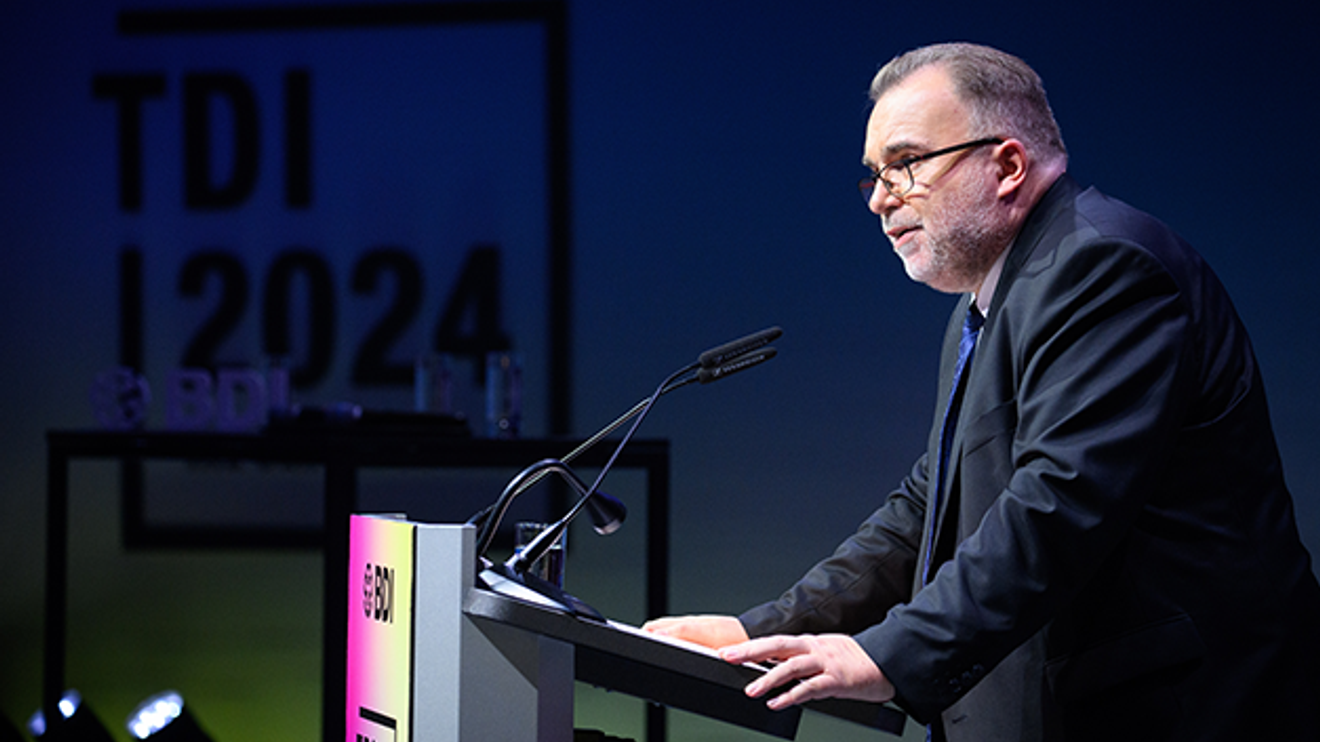
Berlin (dpa) - It was a general criticism: Industry President Siegfried Russwurm accused the Federal Government of two "lost years" for Germany as a business location, saying that the Chancellery was obviously underestimating the seriousness of the situation. The Chancellor countered, spoke of "turnaround years" and warned against badmouthing the location. That was in April - two months later, both sides are trying to de-escalate the situation on Monday (June 24, 2024) at the Industry Day in Berlin.
Russwurm, President of the Federation of German Industries (BDI), said that he had rarely heard the Chancellor use the words speed and pace so often. Scholz opened his remarks by saying that he had often clapped during Russwurm's speech. The Chancellor outlined points of a planned growth package. But Russwurm also made it clear that the coalition must now deliver.
Traffic lights before important decisions
The German economy is bobbing along, with the BDI expecting only mini-growth of 0.3 percent for 2024. However, weak growth means less leeway in the national budget, said Russwurm. This is exactly what is currently at stake in the federal government's negotiations on the 2025 budget. Billions of euros need to be plugged. Several departments do not want to adhere to the savings targets set by Finance Minister Christian Lindner (FDP). The coalition is also planning a "dynamization package" to boost growth.
Russwurm called on the coalition of SPD, Greens and FDP to send a clear signal for more growth. Industry is committed to Germany as a business location, companies want to invest and grow. "But you can't do that with the handbrake on." The announced "dynamization package" must live up to its name. In order for more companies to invest, depreciation must be made easier. The wish list also includes: less bureaucracy, faster approvals, more skilled workers, lower corporate taxes.
Scholz holds out the prospect of relief
Russwurm said that there is a clear awareness of the problem in the Chancellery. Translated, this means that the government headquarters has recognized that something needs to be done to boost growth. Behind the scenes in industry, it was said that the Chancellor was no longer talking about a "green" economic miracle through the climate-friendly restructuring of the economy - few in industry expect such a miracle.
With regard to the "dynamization package", Scholz said that the federal government wanted to promote private investment. "I could imagine that in terms of depreciation and research funding, we could go one better than we did with the Growth Opportunities Act." However, this would also require the approval of the federal states.
Following a mediation process between the Bundesrat and Bundestag, the Federal Government's Growth Opportunities Act, which provides relief for companies, was significantly smaller in volume than planned.
Chancellor: More incentives to work
The Chancellor went on to say that the labor supply should be expanded by making voluntary, longer working hours much more attractive. In addition, the employment of parents should be made easier and incentives to work should be increased, including tax incentives.
The industry will be keeping a close eye on the final outcome of the package - Russwurm described the law that was passed and ripped up in the conciliation process as a "growth opportunity law".
However, one thing will not happen, as Economics Minister Robert Habeck (Greens) said: special funds worth billions, for example for the renovation of the partly dilapidated infrastructure. The BDI had proposed such credit-financed special funds outside of the debt brake and under certain conditions. The association considers an additional public financing requirement of up to 400 billion euros to be necessary over the next ten years in order to strengthen the location.
Commitments in energy policy - and unanswered questions
High energy prices are one of the most frequently cited disadvantages in international comparison. With regard to the climate-friendly transformation of the economy, Scholz said that he was aware that the transformation posed a challenge for Germany as a business location due to the different levels of energy prices worldwide.
He referred to the German government's relief measures, such as the reduction in electricity tax to the European minimum rate for manufacturing companies. The Chancellor made it clear that the Federal Government is currently discussing intensively how relief measures could be made permanent. Companies should be given clarity.
Industry is also demanding clarity on important decisions in other areas. One example is the government's power plant strategy. The government had agreed on key points for the promotion of new gas-fired power plants, which would later be operated with hydrogen - and be "backups" for renewable energy sources when there is no wind or sunshine. However, the EU Commission has yet to give its approval under state aid law - and the future design of the electricity market is also unclear. Russwurm also sees such unanswered questions, for example, in the development of a hydrogen core network.


You might also be interested in
Saxony and Bavaria conduct joint research
Over the next three years, three universities from Munich and Dresden want to work on making the use of artificial intelligence even better. This also involves energy consumption.
 read more...
German industry records more orders for the first time in 2024
German industry surprisingly received significantly more orders in June. However, experts do not believe the downward trend has been broken yet.
read more...Data leaks more expensive - German companies fix them quickly
Data leaks can cost companies dearly. In Germany, the costs have recently risen significantly - but local companies are among the fastest when it comes to fixing them.
read more...Authority wants to regulate industrial discounts on grid fees anew
In view of the changing electricity mix in Germany, the Federal Network Agency is planning to revise the discounts that industrial companies receive for their electricity consumption. The regulatory authority presented a key issues paper on the...
read more...Bridge between research and application
DFKI AI Center launches
A new facility for AI is to be a point of contact for small and medium-sized enterprises and start-ups in particular. The Digital Minister speaks of AI "Made in Germany".
read more...Worldwide computer malfunctions - What we know and what we don't know
Computer problems are disrupting air traffic in many places around the world. Here is an overview of what is known so far and the aspects that are still unclear.
read more...Electrical exports continue to shrink
The German electrical and digital industry is once again feeling the effects of weaker demand from abroad. Germany's most important trading partner is also holding back.
read more...Technology and digital skills in demand in the future
The demands on industrial employees are changing. Technological and digital skills will become more important by 2030. This is shown by a study - which should now also help with further training.
read more...Fewer orders in May
The high order intake in April proved to be a flash in the pan for the German mechanical engineering industry. Disillusionment set in the following month.
read more...