

Industrial communication
Wago gears up for Time Sensitive Networking (TSN)
In the future, Ethernet TSN will enable continuous communication in machine and plant engineering without gateways and interruptions. Wago is launching two new automation systems on the market for the SPS, with which users can take advantage of all the benefits of the extended Ethernet standard.

What characterizes Time-Sensitive Networking (TSN)? Experts appreciate its versatility. TSN provides a technology that contains the latest communication mechanisms and can be used at all levels of an automation solution. This extension of the Ethernet standard is seen as having great advantages for automation. Some experts even believe that TSN can initiate a paradigm shift in industrial communication.
However, according to Dr. Thomas Holm, Head of Innovation at Wago Kontakttechnik, the primary focus of TSN has so far been on increasing transmission speed and transmission performance: "In my opinion, the discussion and reporting has often neglected the other decisive advantages that TSN offers industry."

"The interaction between deterministic communication and standardized semantics is the 'missing link' for many future automation issues," says Dr. Thomas Holm, Wago Kontakttechnik.
© WagoAccording to Thomas Holm, the concept of Ethernet expansion and the vision behind it must be viewed holistically. Then you quickly realize what fundamental changes TSN brings to communication technology: "Only when it is possible for devices to communicate with TSN-based production structures via standard Ethernet can the classic automation pyramid with its technologies encapsulated on the levels really be dissolved."
In the context of Industry 4.0, this dissolution has already been described as a goal for several years. TSN provides the basis for communicating directly from the field level with every device on other levels without having to access gateways or completely change the communication technologies, as was previously the case. There is also discussion about the fact that the consistency of a network infrastructure also brings with it new challenges, for example in terms of cyber security or functional safety. "Ultimately, however, it is one of the key capabilities of TSN," says Holm.
The Wago innovation expert sees another important aspect of TSN: "The expansion of Ethernet is right and good - but it only becomes really powerful in combination with OPC UA, which can act as a semantic counterpart to TSN. The interaction of deterministic communication and standardized semantics is the 'missing link' for many future automation issues." This interplay will enable devices, machines and system components to describe themselves, understand each other and automatically configure themselves appropriately in the future. This, in turn, is a prerequisite for modular approaches in mechanical and plant engineering to actually 'fly' in practice.
What do operators of production plants now need to do in order to benefit from the advantages of TSN in the future? According to Holm, they must first take a serious look at the topic. And they need automation solutions that are already prepared for the standard. With the fast IP20 'I/O System Advanced' and the 'I/O System Field' for applications with IP67 protection, Wago is currently launching two systems on the market with which the Minden-based company wants to give topics such as OPC UA and TSN a face. The 'I/O System Advanced' is a completely new development. It is intended for use in mechanical and plant engineering, where high demands are placed on real-time capability. For this reason, emphasis was placed on the lowest possible latency. Thanks to the gateway to the existing 750/753 series I/O system with its 500 I/O modules, the advantages of the systems can be combined. The 'I/O System Advanced' therefore complements the existing 750 system and also offers a new design as well as convenient and error-preventing mechanics.
The short latency of the Advanced system and the associated high synchronicity between input and output signals are achieved with a newly developed internal communication bus. This makes it possible to use fast Ethernet fieldbuses such as Profinet, Ethercat and Ethernet/IP. Particular emphasis was placed on compatibility with TSN. For example, the system has the option of synchronizing the time domain of the communication network directly up to the I/O level.

Compatibility with TSN means, among other things, the ability to synchronize the time domain of the communication network directly down to the I/O level.
© WagoThe system also enables simple and safe handling during the assembly and disassembly of I/O modules and nodes. In concrete terms, this means that I/O modules are plugged in from above without exception and securely connected to each other using stable guides and blade contacts. There are extensive labeling and various coding options to ensure that connectors and I/O modules are always positioned correctly. The top-hat rail interlock closes automatically when a module is placed on the top-hat rail - no further manual intervention by the user is required. It is also possible to snap entire nodes onto and remove them from the top-hat rail. For example, there are three-part I/O modules with a pluggable wiring level and replaceable electronics. The wiring level plug snaps into place with a clearly audible click. This lets the user know that it has been plugged in correctly.
Proven PFC technology forms the basis
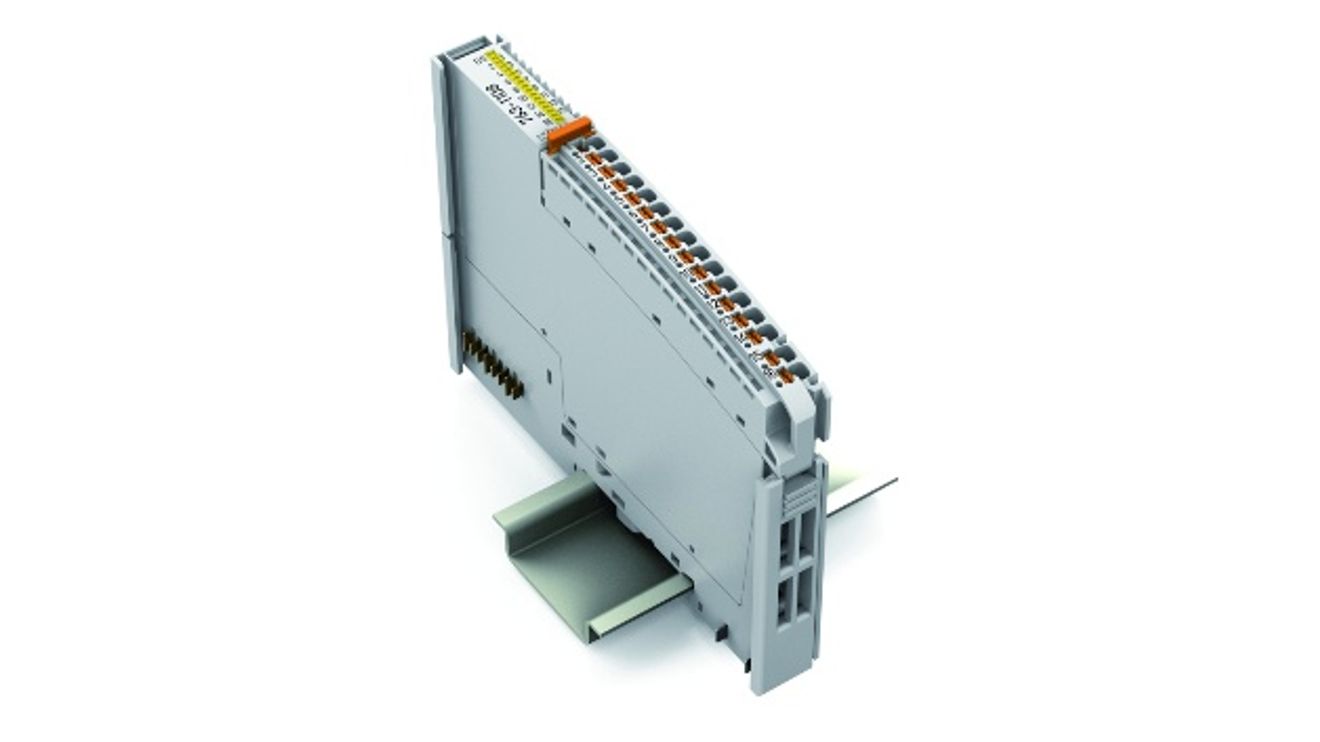
Without exception, the modules of the I/O System Advanced are plugged in from above and securely connected to each other using stable guides and blade contacts.
© WagoWith the 'I/O System Advanced', Wago is also introducing a suitable controller, the PFC200 ADV 2ETH. It is based on the proven PFC technology and is designed to make it as easy as possible for users to get started with the new system. Thanks to the open Linux operating system and Docker technology, the controller forms a bridge to a wide range of IT technologies. The ability to communicate directly from the PLC program via MQTT, for example, makes it easier to send data to the cloud. In combination with VPN and firewall, even the last meter to the controller can be secured. The PFC200 ADV 2ETH therefore includes the familiar PFC functionalities and Codesys-based programming with the e!Cockpit engineering software.

For requirements outside the control cabinet: the 'I/O System Field' with protection class IP67, which is available in various housing variants.
© WagoFor requirements outside the control cabinet, the I/O system Field with IP67 protection is the preferred solution. It also integrates fast, Ethernet-based fieldbuses such as Profinet. OPC UA and, in future, MQTT are used as communication protocols, for example for connecting to the cloud. This system can also be adapted to TSN. Various IP67 housing variants are available in order to adapt it optimally to the respective application and machine: fully encapsulated metal housings for harsh environments and lightweight, non-encapsulated plastic housings with low mass for moving applications, such as on robot arms. Narrow housing variants and side mounting options create more space and offer additional protection options.
Increase productivity with IO-Link
The field system can fully exploit its strengths in combination with IO-Link as a flexible 'IO distributor' for recording and distributing data. The communication standard enables a seamless data flow from the sensor to the control level. This considerably simplifies project planning and cabling. It also opens up completely new possibilities for diagnostics, parameterization and device identification: with the corresponding IO-Link master, for example, both the process data and acyclic data for identification, configuration, parameterization and diagnostics can be communicated to the respective device (sensor and actuator) via a 3-wire connection. The functions and performance data are defined via device description files for masters and devices. If a device needs to be replaced, configuration and parameterization can be restored automatically and without intervention by maintenance personnel.
Last but not least, special power management ensures that the performance of the system is optimally utilized through load management of the supply currents. It can also monitor the currents and voltages of the outputs and supply contacts on a channel-by-channel basis and specify limit values. The overload limits of the supply currents can also be set on a channel-by-channel basis. This allows faults to be detected more quickly and accurately and predicted more easily - an essential prerequisite for predictive maintenance, for example.
The sensors and actuators are connected to the I/O system Field via M8 and M12 cables. The power supply is provided by a high-current-capable M12 connector with L-coding. It is smaller and cheaper than standard 7/8 inch and M23 solutions on the market and is capable of providing up to 16 A. This means that more power can be connected in less space.
In a nutshell: Thomas Holm believes that now is the time for machine builders and manufacturing companies to take a serious look at TSN. "Even if market penetration does not increase by leaps and bounds in the near future, it is important to recognize the possibilities and advantages of TSN and its potential for your own production," says the expert. There is also currently still a great opportunity to get involved in specifying the technology.
Author
Sascha Rentzing is Team Leader Content in the Corporate Marketing department at Wago Kontakttechnik.


You might also be interested in
Arrive in reality!
Time Sensitive Networking has firmly established itself in the vocabulary of the automation industry. All well-known suppliers have started activities to evaluate or even introduce TSN. But where exactly are the goals for the use of TSN and what is...
 read more...
OPC UA and DDS combined
To date, OPC UA and DDS have often been presented as competitors. Competitors that will both be based on the Ethernet standard TSN. - However, the key to successful automation in the future lies in a combination of the three standards DDS, OPC UA...
read more...The interaction of Ethernet TSN, OPC UA and 5G
Only the reliable and structured interaction of all units in an ant colony ensures its survival. Data communication in a modern industrial network works no differently in a figurative sense.
read more...Where there are still problems with 5G
5G in automation - a hot topic at the moment. How quickly can we actually expect 5G to be used in industry? What obstacles still need to be overcome? Thomas Schildknecht summarizes the key points in this interview.
read more...Data pipeline ASi-5
High data width, short cycle times, improved integration of intelligent sensors and actuators using IO-Link and cloud connectivity via OPC UA - ASi-5 makes AS-Interface fit for the requirements of digitalization.
read more...OPC UA - a must for the industry (Part 2)
OPC UA is regarded as the new communication standard for industrial automation. Part 1 explained why a new communication technology is needed in automation and described the OPC UA methods. Part 2 deals with the OPC UA pub/sub methods and the power...
read more...OPC UA, MQTT and co.
The Industrial Internet of Things (IIoT) covers very different areas of application. The available connectivity technologies and standards are just as diverse as the application areas. How can the right technology be filtered out in each case?
read more...The question of licenses
Will OPC UA in combination with TSN become 'the' standard for industrial communication? What role do licenses play in this question and what part does OSADL play?
read more...The safety solution for OPC UA
Safety over OPC UA based on Profisafe: A year ago, the OPC Foundation and PI launched a joint concept for this. Now the specification is about to be published and is available for OPC UA-based controller-controller communication.
read more...