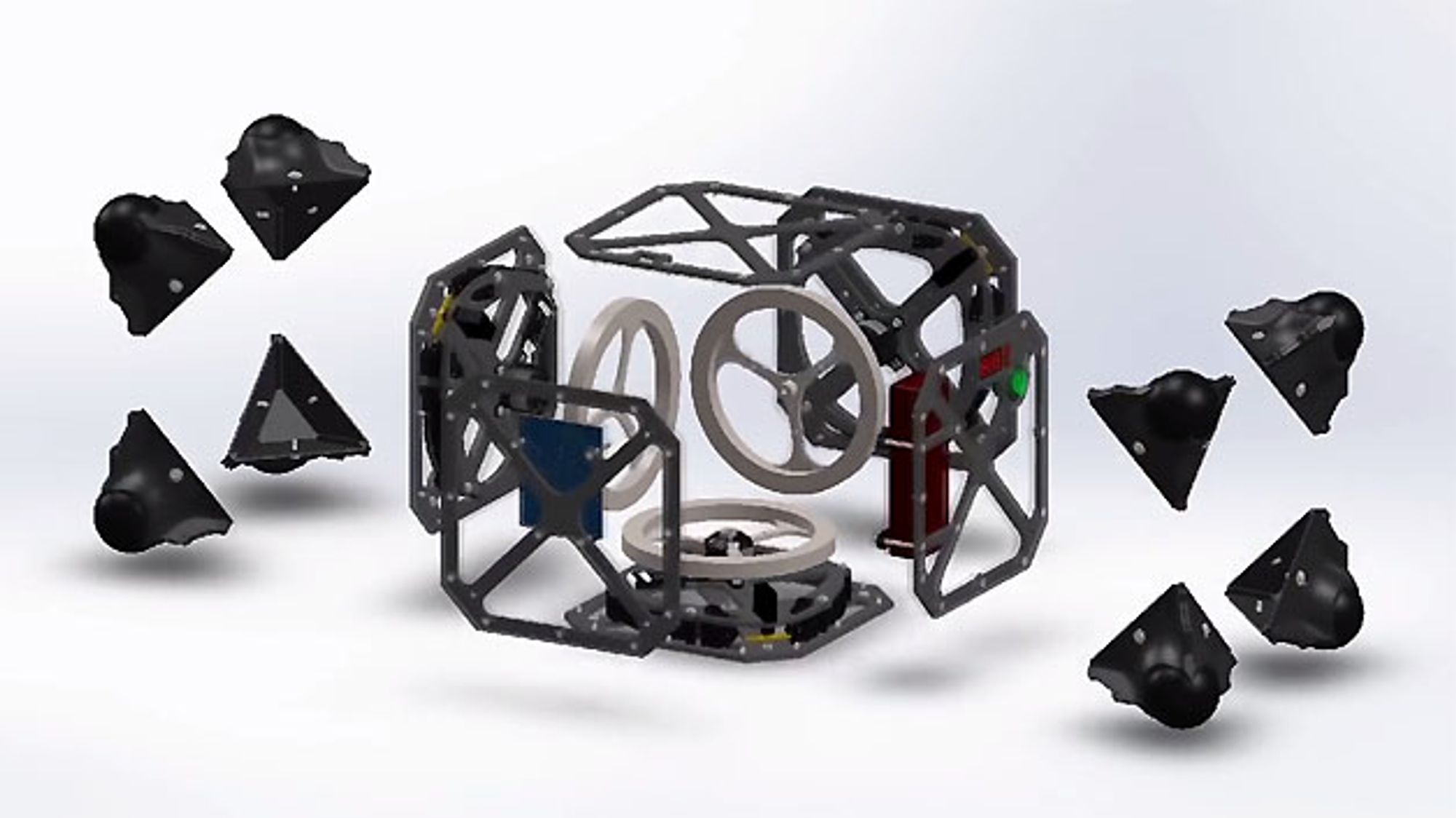
© NASA / JPL-Caltech / Stanford
... can carry out its experiments regardless of which side it lands on. Its interior contains three flywheels that transmit rotational impulses to the robot: it tilts to one side, turns and can even jump into the air - this is an advantage in situations where the robot is stuck or in danger of sinking into sandy terrain. So far there are two prototypes: one from NASA's Jet Propulsion Laboratory (JPL) and one from Stanford University in Stanford, California. One of the differences between them is the braking mechanism: the JPL version uses brake disks that attach to the flywheels. Stanford University, on the other hand, has installed friction belts in its prototype, which are designed to brake the flywheels abruptly. The behavior of the robot ...

