

Products of the year 2024
Image processing - The winners
The winning products in the 'Image processing' category enable the monitoring of 3D zones and logistics processes and allow mobile robots to navigate freely in production.

Julian Häusler (Cognex, left) and Antonio De Angel Gutierrez (ifm) with Andrea Gillhuber (Computer&Automation).
© Julia Bergmeister Photography / Computer&Automation
3rd place - Schmersal
Schmersal launches a 3D camera for the automated acquisition of digital process data in real time. The AM-T100 time-of-flight camera (ToF camera) generates 3D depth images with millimeter precision using a Sony DepthSense sensor. The frame rate is up to 60 fps. With IR illumination and an image resolution of 640 x 480 pixels, the camera achieves a field of view of 67° x 51° at a range of up to 6 m. The image data is made available via the standardized GenICam data interface and can be processed with common image processing software. An Ethernet interface enables data transmission and, if required, a 24 V power supply (Power over Ethernet). The 'Consam-T' configuration software is pre-installed. With its help, the camera can be configured to monitor complex and individually defined 3D zones. If it detects an object within these zones, digital outputs are switched. In addition, digital inputs can be used to switch back and forth between different 3D zones.
2nd place in the image processing category

2nd place - Cognex
Cognex introduces the In-Sight 2800 Detector for logistics. This object detection system is based on the 'In-Sight' platform and uses AI-based edge learning technology to automate sorting processes and improve the accuracy of logistics inspections. It is suitable for object recognition applications such as checking whether an item is present on sorting equipment, in bins or trays, classifying parcel types and identifying process issues.

Julian Häusler from Cognex with trophy and certificate for 2nd place in the 'Image Processing' category.
© Julia Bergmeister Photography / Computer&AutomationThe integrated edge learning technology even recognizes items on unsteady or low-contrast backgrounds. According to the provider, setting up the object recognition system takes less than 15 minutes. With edge learning technology, training takes place directly on the device and only requires a small number of images, without the need for a specialist.
1st place in the image processing category
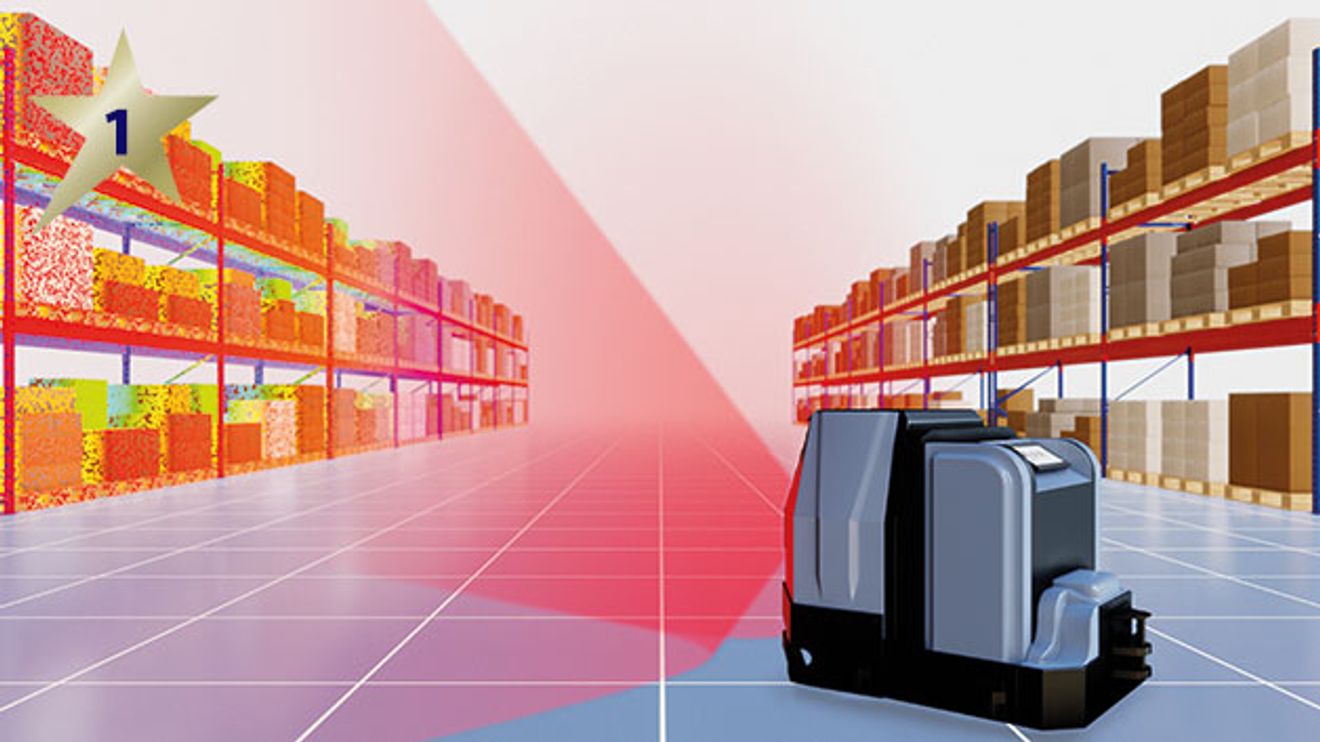
1st place - ifm
ifm has developed the O3R hardware platform for the mobile robotics sector, which facilitates both preliminary and series development for developers through a software environment, software tools and interfaces. The central component is an edge device that provides both high computing power and the ability to easily connect a wide variety of sensors. A total of up to six 3D cameras and numerous other sensors can be connected. The camera connection is made via FDP-Link, while GigE interfaces are available for the other sensors. CAN interfaces ensure integration into the architecture of a mobile robot.

Antonio De Angel Gutierrez accepted the trophy.
© Julia Bergmeister Photography / Computer&AutomationA Linux system equipped with an NVIDIA video processing unit forms the hardware basis. As the performance of this GPU is scalable, it can be adapted to the respective application. The system can be integrated into robotics applications using the available ROS2 drivers. As the image processing takes place in the edge device, hardly any data processing is required in the camera itself, which means that several cameras can be used. ifm offers suitable camera heads, 3D sensors or a combination of 3D and 2D sensors with different aperture angles and resolutions.


You might also be interested in
The eyes of the robot
In order to equip robot applications and cobots in particular with 'vision', image processing must be integrated. Smart vision sensors suitable for this purpose can now be put into operation simply by configuration.
 read more...
The golden mean
What to do with vision applications that are too complex for rule-based image processing on the one hand, but too simple to justify investing in a full deep learning solution on the other? One option is machine learning 'at the edge'.
read more...Software & IT - The winners
For the first time, an IT company has been voted among the top 3 in the 'Software & IT' category. An indication that OT and IT are truly growing together.
read more...Safety & Security - The winners
In theory, protection against unauthorized access is the declared aim of all winners in the 'Safety & Security' category. In practice, however, they could not be more different.
read more...Sensors - The winners
Detect objects at 80 meters? Developed according to cybersecurity standard IEC 62443-4-2? Thinner than a bar of chocolate? No problem for the winners in the sensor technology category.
read more...Robotics & Handling - The winners
They ensure fast and safe handling of components and get them reliably from A to B: the winning products in the 'Robotics & Handling' category.
read more...Measurement technology - The winners
The winners in the 'Measurement technology' category could not be more different: a handheld device for force measurement, a current collector system and a pressure transducer impressed the readers.
read more...Communication & networking - The winners
TSN, fast data migration and muting are among the key features of the winning products in the 'Communication & Networking' category.
read more...Embedded Computing & IPC - The winners
A 'classic', a 'scene product' and a 'pragmatic approach' convinced the readers of Computer&Automation in the 'Embedded Computing & IPC' category.
read more...