
SAS survey
Companies are hesitant about quantum AI
According to a global SAS survey of 500 managers, the productive use of quantum technology currently remains unclear for many companies. At the same time, experts expect quantum hardware to be more widely available in the early 2030s.
A global survey of 500 executives by SAS shows a growing interest in quantum AI, but at the same time a clear reluctance to introduce it in practice. Many companies do not yet see any clear application possibilities for quantum technology in productive operations, although experts assume that powerful quantum hardware will be available on a larger scale in the early 2030s.
The most important obstacles cited by respondents were uncertainty about specific use cases, high implementation costs, a lack of specialist staff, a lack of expertise, a limited number of available solutions and an unclear regulatory framework.
"Despite continued strong interest, executives understandably remain cautious and don't want to go all in on investments in expensive quantum technology that they fear may not have worthwhile use cases," says Bill Wisotsky, Principal Quantum Architect at SAS.
According to SAS, it relies on a hybrid approach in which machine learning algorithms are already being executed on available quantum hardware. The aim is to process complex tasks or tasks that were previously difficult to solve more quickly.
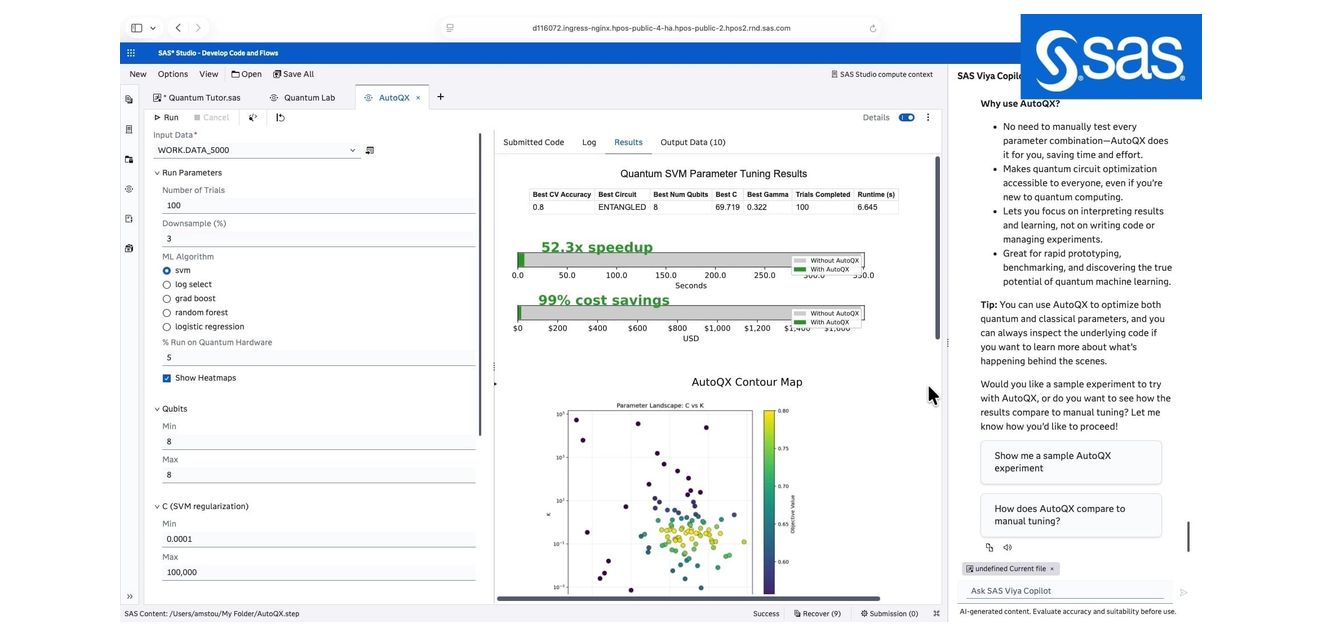
For the fourth quarter of 2026, the company is announcing the SAS Quantum Lab for customers of the SAS Viya platform. The environment is designed to enable companies without in-depth knowledge of quantum physics to test applications and evaluate economic potential. Functions for comparing classic, quantum-based and hybrid methods, a virtual AI tutor and, according to SAS, tests with more than 100 times faster data processing and up to 99 percent lower operating costs are planned.
The fields of application expected by companies include more precise fraud detection in the financial sector, optimized 5G networks, faster molecular simulations in drug research, more efficient supply chains, more powerful machine learning models and the optimization of large language models.
"The survey illustrates what SAS experts have already observed in the market: Executives are very interested in using quantum computing. But the barriers to entry and risks of a 'homegrown' architecture are too high. They prefer to wait for a ready-to-use solution," says Amy Stout, Head of Quantum Product Strategy at SAS.


You might also be interested in
Vertiv and Nvidia link physical infrastructure with digital twins
Digital twins instead of a flood of documents: Vertiv integrates 'SmartRun' into 'Nvidia Omniverse DSX' to accelerate the planning and implementation of AI factories.
 read more...
Quantum-resistant hardware security for Nvidia robotics platform
Infineon Technologies integrates the hardware security module 'Optiga TPM SLB 9672' into Nvidia's 'Jetson Thor' computing platforms for robotics and autonomous systems. The module secures cryptographic keys directly at chip level and thus protects...
read more...Ionos and Q.ANT cooperate on AI
Ionos and Q.ANT want to jointly advance photonic processor technologies for AI and high-performance computers. The aim of the partnership is to build energy-efficient and sovereign AI infrastructures in Europe.
read more...AI-supported lighting robot wins German Innovation Award 2026
Ledvance, provider of innovative lighting solutions, was named "Winner" in the Excellence in Business to Consumer Lighting category at the German Innovation Awards 2026. With the AI Companion Lighting Robot 'Elix', the company presents an...
read more...Paderborn University becomes part of 'ELLIS NRW'
Paderborn University is one of the founding members of the new research unit 'ELLIS Unit NRW'. The European network bundles AI research in North Rhine-Westphalia with a focus on machine learning and explainable AI.
read more...AI 'CheckMate' optimizes industrial processes
With 'CheckMate', the University of Klagenfurt has developed an AI system that independently creates algorithms for complex combinatorics and optimization problems. The technology is designed to make industrial planning and logistics processes more...
read more...New approaches in drive technology
Nabtesco develops physical AI solutions
Nabtesco is working on intelligent drive systems for industrial applications. The focus here is on the use of physical AI, the combination of artificial intelligence with real physical systems.
read more...Regulation and safety slow down robotics projects in Germany
QNX has published the study "Inside the Robot: Architecture Benchmark Report". The results of the global survey of 1000 robotics developers show that software and safety requirements are increasingly becoming the central bottleneck for innovations...
read more...Michael Ardelt becomes first COO at Robco
Robco, a company for autonomous industrial robotics, is further expanding its management team. As the company's first Chief Operating Officer, Michael Ardelt will assume responsibility for structuring and scaling Robco's growth in operational terms.
read more...