

AI for the industry
Industrial AI: Siemens launches data alliance for manufacturing
Siemens and several partners from the mechanical engineering sector have founded a data alliance to make generative AI specifically usable for industry. The focus is on applications such as automated NC programs and adaptive manufacturing processes - building blocks for a new, industry-specific AI model.

At EMO 2025,Siemens has agreed a cooperation with several machine tool manufacturers - including Grob, Trumpf, Chiron, Renishaw and Heller - as well as the Machine Tool Laboratory (WZL) at RWTH Aachen University and the Voith Group. The aim of the alliance is the structured exchange of engineering, production and machine data for the development of generative AI applications in an industrial environment. The collaboration is seen as an important step towards an industry-specific AI model, the Siemens Industrial Foundation Model, whose vision was first presented at the Hannover Messe 2025.
"Together with customers and partners, we are taking a significant step today towards scaling up industrial AI. I see a great opportunity here for Europe's economy with its strong industrial base. Automotive, chemicals, pharmaceuticals, mechanical engineering, energy, healthcare, infrastructure and transportation, among others - by making our companies' unique wealth of data available for generative AI models, we can achieve completely new levels of productivity. And the data alliance in mechanical engineering is leading the way," says Roland Busch, CEO of Siemens AG.
The alliance aims to significantly increase efficiency and innovation cycles in the manufacturing industry through the targeted use of AI technologies. One conceivable use case in the machine tool sector is the automated creation of a parts program for machine tools. This allows part programs to be created considerably faster, while the error rate during code creation is reduced. In addition, programmers are relieved of basic tasks and can concentrate on more complex challenges.
"Access to high-quality machine data from different manufacturers is key," explains Busch. "With this alliance, we can develop AI systems that understand the complexity of development and production and thus become a powerful partner for specialists."
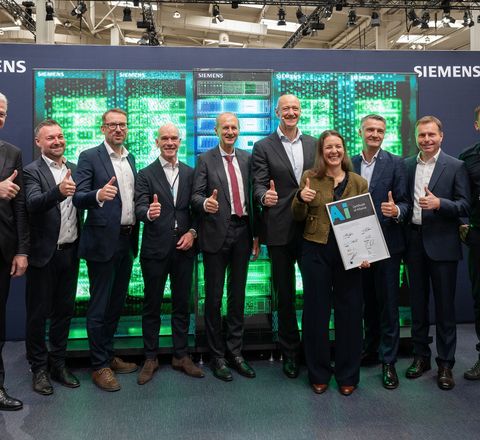
The partnership involves the exchange of anonymized machine data in strict compliance with data protection and security standards. Among other things, this data will be used to develop and train AI models that are specifically tailored to the requirements of industrial production. For example, the data from the alliance will be used to automatically create NC programs - a kind of "work instruction" for special production machines. Other use cases include predictive maintenance with precise machine-specific forecasts, adaptive manufacturing processes that adjust to changing conditions in real time and energy efficiency optimization through intelligent control of machine parameters.
In the long term, the alliance plans to acquire further companies - including those outside the machine tool industry - in order to use industrial artificial intelligence across all sectors.


You might also be interested in
Vertiv and Nvidia link physical infrastructure with digital twins
Digital twins instead of a flood of documents: Vertiv integrates 'SmartRun' into 'Nvidia Omniverse DSX' to accelerate the planning and implementation of AI factories.
 read more...
Quantum-resistant hardware security for Nvidia robotics platform
Infineon Technologies integrates the hardware security module 'Optiga TPM SLB 9672' into Nvidia's 'Jetson Thor' computing platforms for robotics and autonomous systems. The module secures cryptographic keys directly at chip level and thus protects...
read more...Ionos and Q.ANT cooperate on AI
Ionos and Q.ANT want to jointly advance photonic processor technologies for AI and high-performance computers. The aim of the partnership is to build energy-efficient and sovereign AI infrastructures in Europe.
read more...AI-supported lighting robot wins German Innovation Award 2026
Ledvance, provider of innovative lighting solutions, was named "Winner" in the Excellence in Business to Consumer Lighting category at the German Innovation Awards 2026. With the AI Companion Lighting Robot 'Elix', the company presents an...
read more...Paderborn University becomes part of 'ELLIS NRW'
Paderborn University is one of the founding members of the new research unit 'ELLIS Unit NRW'. The European network bundles AI research in North Rhine-Westphalia with a focus on machine learning and explainable AI.
read more...AI 'CheckMate' optimizes industrial processes
With 'CheckMate', the University of Klagenfurt has developed an AI system that independently creates algorithms for complex combinatorics and optimization problems. The technology is designed to make industrial planning and logistics processes more...
read more...New approaches in drive technology
Nabtesco develops physical AI solutions
Nabtesco is working on intelligent drive systems for industrial applications. The focus here is on the use of physical AI, the combination of artificial intelligence with real physical systems.
read more...Regulation and safety slow down robotics projects in Germany
QNX has published the study "Inside the Robot: Architecture Benchmark Report". The results of the global survey of 1000 robotics developers show that software and safety requirements are increasingly becoming the central bottleneck for innovations...
read more...Michael Ardelt becomes first COO at Robco
Robco, a company for autonomous industrial robotics, is further expanding its management team. As the company's first Chief Operating Officer, Michael Ardelt will assume responsibility for structuring and scaling Robco's growth in operational terms.
read more...