

TDK
The leakage currents under control
In variable-speed drives, the individual components cause leakage currents which, in total, can trigger the residual current circuit breaker and lead to production downtimes. These currents can be largely compensated for with a new type of module.
Variable-speed drives are used in industrial systems for a wide range of tasks - for example in machine tools, pumps, compressors, conveyor systems, but also in non-fixed devices. As a rule, these drives are supplied from three-phase TN networks.
A complete drive system consists of an EMC mains filter, the frequency inverter and the motor. An equally important component, which is often neglected when considering the system, is the shielded cable between the inverter and motor. This can often be 200 meters or longer. For safety reasons, the drive systems are connected to the mains via residual current circuit breakers.
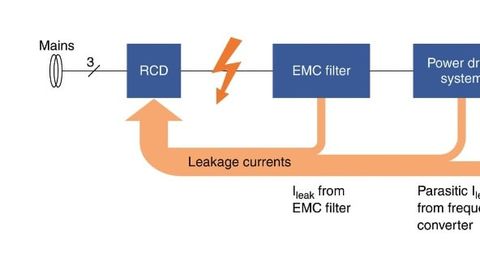
RCDs (residual current devices) do not differentiate between an actual residual current and a leakage current. If the sum of all system-related leakage currents is too high, the RCD will trip.
© TDKA major problem with variable-speed drives is an operational leakage current, which is generated in particular by the inverter. Its magnitude depends on the interference suppression capacitors and the parasitic capacitances to earth, the commutation of the B6 rectifier circuit and the switching processes of the power semiconductors. In many applications, the sum of the leakage currents exceeds the tripping threshold of the residual current circuit breaker.
Conventional residual current circuit-breakers for variable-speed drives, for example, have a tripping threshold of 30 mA for currents in the frequency range below 100 Hz, which increases significantly in the range above 100 Hz. Figure 2 shows the tripping characteristic of a typical residual current circuit-breaker, with a limit of 300 mA for frequencies above 1 kHz.
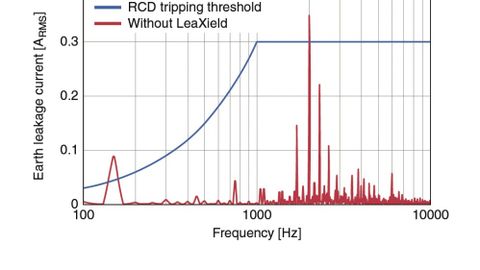
Figure 2: Leakage current in the frequency range (red) compared to the RCD tripping threshold (blue).
© TDKVariable leakage currents generated by the switching processes in the inverter can cause the 300 mA threshold to be exceeded. In the example shown, this is the case at 2.7 kHz. Stationary leakage currents, on the other hand, which are generated by the commutation of the B6 rectifier circuit, already occur at a significantly lower frequency of 100 Hz to 1 kHz, where the trigger threshold already assumes significantly lower values. Specifically, the 150 Hz component is around 90 mA, which always triggers the residual current circuit breaker. Finally, there are also transient leakage currents, such as those that occur when the mains voltage is switched on and off.
The disadvantages of previous approaches
To date, there has been no comprehensive solution to counter the various causes of leakage currents. Attempts are often made to vary the total capacitance to earth in the system. For example, the 150 Hz component of the leakage current can be reduced by switching off the filter capacitor in the inverter. However, EMC compatibility is then no longer guaranteed in many cases. If, on the other hand, the capacitance of the Y capacitors in the EMC filter is reduced, the 50 Hz leakage current decreases, but the clock-frequency leakage current component also increases.
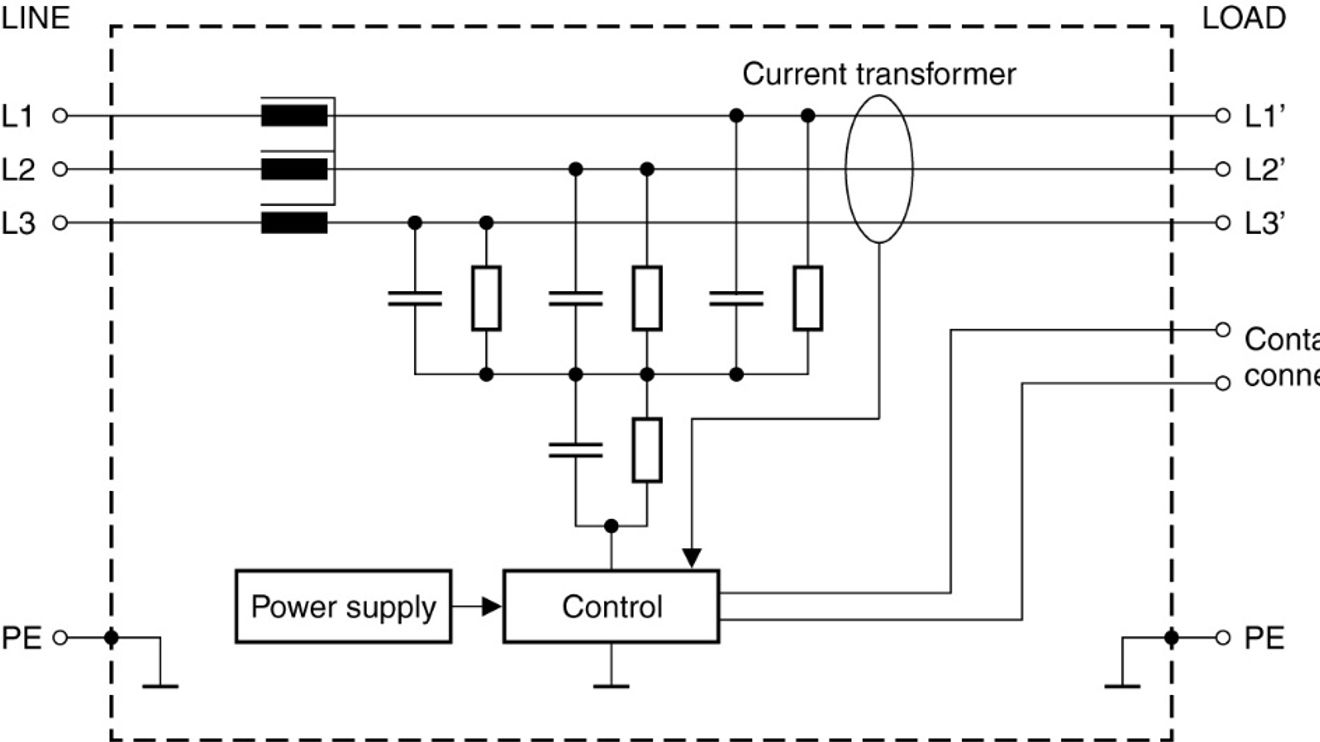
Figure 3: The schematic diagram of the LeaXield module. The leakage currents are fed back to the source through the resulting current sink. With the Contactor Connection connections, which can be used as an option, the module is ready for operation before the leakage current flows.
© TDKAlthough the use of an isolating transformer offers a technical solution, costs and installation space limitations often make its use impossible. Dispensing with the residual current circuit breaker is by no means an alternative, as this harbors considerable potential for danger and accidents. In short, the methods described are technically and economically unsatisfactory.
With this in mind, Epcos has developed the so-called LeaXield module to compensate for leakage currents. The module is connected between the residual current circuit breaker and the EMC line filter. Figure 3 shows the schematic diagram.
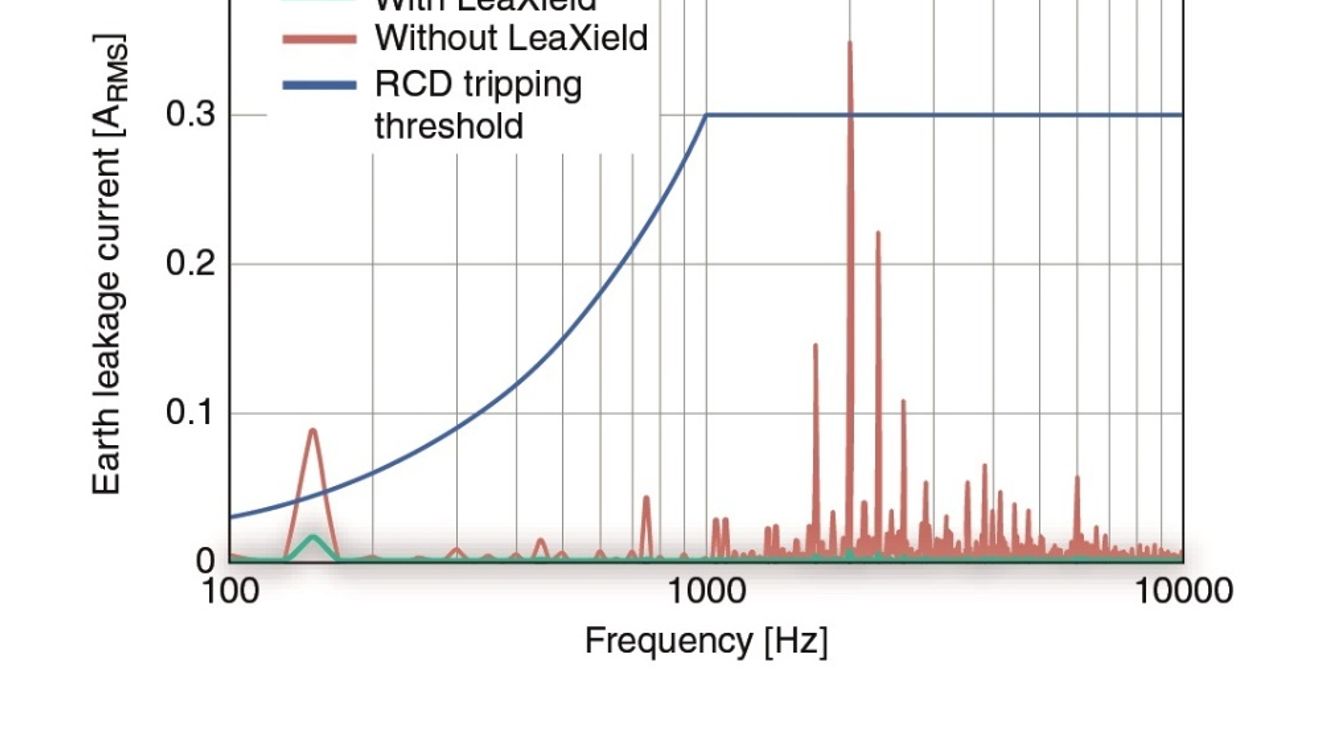
Figure 4: The unfiltered leakage currents (red) are drastically attenuated by using the LeaXield (green) and fall far below the RCD tripping threshold. This ensures system availability even with high leakage currents.
© TDKA current sensor is integrated into the module on the load side to measure the residual current across the three phases. An operational amplifier is then used to generate a current with identical amplitude that is phase-shifted by 180° and capacitively coupled to the respective phases.
The leakage currents are fed back into the system through the resulting current sink. This prevents these leakage currents from flowing through the residual current circuit breaker and tripping it unintentionally. Specifically, the module described can compensate for leakage currents of up to 1 A. The compensation effect extends over a frequency range from 150 Hz to around 30 kHz. Figure 4 compares an unfiltered leakage current (red) in the spectral range with a leakage current filtered by the module (blue). The latter is far below the RCD tripping threshold, which prevents unintentional tripping of the residual current circuit breaker.
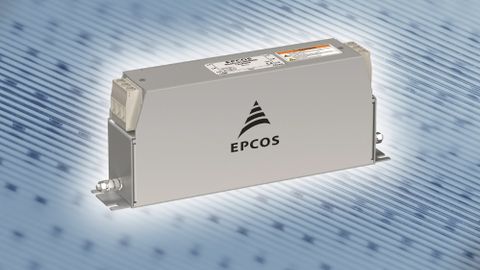
The characteristics of the LeaXield module:
Rated voltage UR (V/AC) 305 / 530 (50 Hz) --
Rated current IR max. (A) 50 --
Maximum leakage current (A) 1 --
Frequency range (Hz) 150 - 30,000
Thanks to its small dimensions of just 270 mm x 60 mm x 119 mm (LxWxH), the module is also suitable for retrofitting in existing systems. As no external power supply is required for operation, the installation effort is kept to a minimum.


You might also be interested in
Smart services and cloud technology bundled
On January 1, 2020, the Phoenix Contact Group bundled its digital service portfolio in the subsidiary Phoenix Contact Smart Business in Berlin. This includes all activities relating to cloud technology and data analytics as well as software services.
 read more...
Changes in the management team
Lenord + Bauer has appointed a new Chairman of the Management Board as of January 1, 2020: Dr. Rudo Grimm now forms the dual leadership of the specialist for motion sensors and integrated drive technology together with Dr. Matthias Lenord.
read more...New management for Group strategy
Peter Körte will be the new Head of the Siemens Strategy Department from February 1, 2020. He replaces Horst J. Kayser, who has been responsible for the Siemens Portfolio Companies since the beginning of January and has continued to manage the...
read more...Embedded motor controller with 2 A peak current
TDK Corporation expands its 'Micronas HVC' embedded motor controller family with the 'HVC 5223C', a fully integrated motor controller with automotive grade 1 qualification for driving small BLDC and BDC motors with a peak phase current of 2 A.
read more...Housed in a stainless steel casing
TDK has extended the MiniCell family with pressure transmitters in stainless steel housings in IP67 for differential pressure measurement in industrial applications.
read more...Current drive technology products
Without drive technology - in the truest sense of the word - nothing would turn in most machines and systems. Computer&AUTOMATION presents the latest innovations in this automation discipline in a series of pictures.
read more...News from electromechanics
Connectors, cable glands, cables and wires - there are always numerous innovations for industrial users when it comes to electromechanics. Computer&AUTOMATION has summarized a selection of current products in a series of pictures.
read more...Triton Partners takes over Flender
Global investment firm Carlyle has signed an agreement to sell Flender, a provider of mechanical drive technology, to Triton Fund 6, advised by Triton. The terms of the transaction were not disclosed and is expected to close in the fourth quarter of...
read more...New approaches in drive technology
Nabtesco develops physical AI solutions
Nabtesco is working on intelligent drive systems for industrial applications. The focus here is on the use of physical AI, the combination of artificial intelligence with real physical systems.
read more...