
Format adjustment on machines
Automatically instead of manually
When converting machines and systems - especially in the packaging sector - manual work is often still required. Automated format adjustments are faster and more efficient. A solution that can usually also be retrofitted.
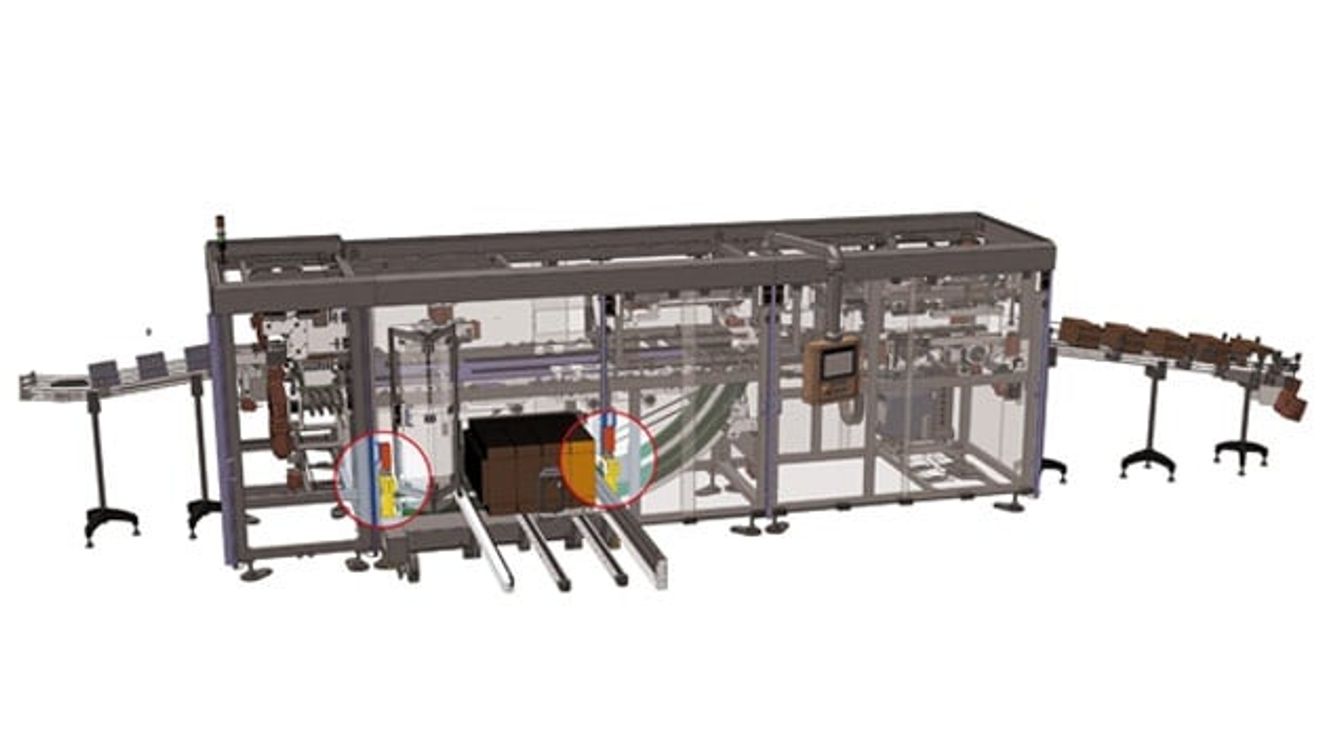
It is not only when designing new packaging machines or production lines with a large number of adjustment points, frequent product changes or small batch sizes that it can make sense to plan automated format adjustments and network them with one another. Existing systems also offer great potential for optimization: Wherever handwheels, guides with clamping devices or pneumatic cylinders with stops are still time-consuming to adjust manually, it makes sense to retrofit the production system. The following applies: the more manual adjustments there are and the more complex the system is, the faster a changeover to automatic positioning will pay for itself.
ETT Verpackungstechnik, for example, has implemented such a solution for its end-of-line packaging systems - together with the suppliers Rose+Krieger and Lenord+Bauer, who work together in the field of automated format adjustment as part of a partnership or jointly develop customized concepts based on their respective product portfolios. ETT from Moringen, in turn, develops and produces modular packaging machines, robot concepts and palletizing modules that can be flexibly combined with its approximately 190 employees.
At ETT, for example, a total of 21 actuators from Lenord+Bauer are used in the wrap-around system for a customer in the cosmetics industry - in some cases combined with linear axes from Rose+Krieger. Specifically, for example, the so-called PowerDrive from Lenord+Bauer for adjusting the plano magazine to the plano size to be processed is combined with a single-tube unit from Rose+Krieger of type E-II in size 40 with right-hand and left-hand threads, a length of 340 mm and a stroke of 2 x 50 mm. The axis is equipped with two drive journals, two guide carriages with sliding bush, ball bearing and spindle clamping.

Another PowerDrive system with the EP 60 twin-tube axis with left-hand thread is used to adjust the product infeed belts in the wrap-around system. The linear system with ball bearing and driven carriage is 650 mm long and achieves a travel speed of 20.8 mm/s. Five decentralized PowerDrive boxes feed the 21 actuators and simultaneously take over communication functions between the actuators and the system control via the Ethernet-based Profinet bus system.

A coordinated combination: The linear axes from Rose+Krieger, complemented by the actuators from Lenord+Bauer.
© Rose+WarriorAs part of their partnership, Rose+Krieger and Lenord+Bauer have initially combined the three linear Move Tec axis series E (single tube), EP-X (double tube) and quad EV (square) with the aforementioned actuators from the PowerDrive system. The Move Tec product range primarily covers simple and occasional positioning tasks, such as those required in the packaging industry. The single-tube axes of the E series are particularly robust - a bearing cover and the spindle equipment with plain bearings make them insensitive to dust, abrasion and splash dirt. The profile linear axes of the square quad-EV series are in the medium load range.
They are optionally available with one or two ball-bearing shafts. A stainless steel cover strip protects the drive spindle from unauthorized access or objects falling into the axis.
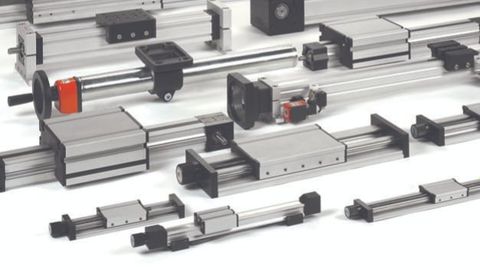
In addition to the axes for format adjustment, RK has a wide range of linear units in various designs and performance classes, including highly dynamic components.
© Rose+WarriorIf high bending moments need to be compensated, the EP/EPX series double-tube axes are ideal. Their trapezoidal threaded spindle is available with either plain or ball bearings. In the EPX version, two guide carriages connected to a large clamping plate move together and thus ensure that high torques can be absorbed. For all linear axes mentioned, the carriages can optionally be fitted with a sliding bush to reduce the drive torque and wear. The quad-EV units are equipped with adjustable sliding guides as standard.
Finally, the actuators from Lenord+Bauer are available in either a short or long design with an aluminum or stainless steel housing. Depending on the design (long or short), the devices deliver nominal torques of 1.4 Nm to 15 Nm. The company has designed a suitable torque support for mounting the actuators on the corresponding linear axes. The actuator is simply placed on the axis with the torque support fitted and pushed into position. A clamping ring fixes the drive to the shaft journal of the linear axis. In addition to the friction-locked shaft connection, a flexible motor mount on the torque arm also provides the required floating bearing.
Flexible and simple integration
Just like the linear axes, the actuators can also be used as a stand-alone solution or as a complete modular system. With the integrated fieldbus interface, the latter can be connected directly to the machine controller via connectors. All that is then required for commissioning is a 24 V power supply and the connection for bus communication.
If complex machines with several linear units and a decentralized communication unit need to be equipped, actuators with hybrid cables and the aforementioned PowerDrive box as well as a compact PLC controller with operator terminal are used. If required, both are available as ready-to-connect modules including operating software. They can be integrated into an existing control environment via the standard interfaces supported by the system, such as Profibus, Profinet, Ethernet/IP, Ethercat, CANopen, Sercos III and Powerlink.
Author:
Bernd Klöpper is Head of Marketing at Rose+Krieger in Minden.


You might also be interested in
New board member for production and quality management
Bosch Rexroth appoints Dr. Christina Franke (49) to the Management Board with responsibility for Production and Quality Management as of April 1. She succeeds Reinhard Schäfer (60), who is retiring.
 read more...
Integrated measurement technology for condition monitoring
There are new variants of the high-precision motor feedback system 'EDS/EDM35' from Sick. Variants with additional sensors for monitoring vibration behavior and humidity supplement the standard variants.
read more...Drive controller with high-current variant
As a high-current variant, the 'SD4B' drive controller from Sieb & Meyer extends the range of possible applications: as a servo amplifier for operating rotary and linear low-voltage servo motors or as a frequency inverter for high-speed...
read more...Robust electric cylinders for indoor and outdoor use
With the 'LD' series, RK Rose+Krieger offers electric cylinders that are suitable for indoor and outdoor use.
read more...Easy to implement
Leantechnik rack and pinion gearboxes can be used to design all types of lifting and positioning systems. Integration into the application is easy thanks to the 3D product configurator from Cadenas.
read more...Increase in orders for the German electrical and digital industry
The German electrical and digital industry started the second half of 2024 with a fifth more orders (+20.8% year-on-year).
read more...Expansion of the Management Board
The Supervisory Board of Siemens has announced personnel decisions at Managing Board level in order to further expand its position as a leading technology company and to accelerate the increase in value.
read more...Relieving the load on large gearboxes with a new control strategy
The IMA at the University of Stuttgart has developed a new monitoring and control system that detects damage to large gearboxes and provides relief without affecting the overall performance of the system. Unscheduled maintenance is reduced.
read more...Precision gearboxes for the food industry
The gearboxes in the 'Neco' and 'RD-C' series from Nabtesco have a hygienic design with smooth surfaces and optimized seals, making them easy to clean
read more...